

Ensuring students' holistic development.
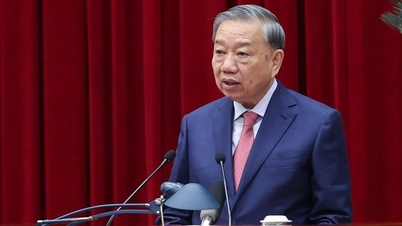
In Announcement 177-TB/VPTW dated April 25th, summarizing the working session with representatives of the Party Committee of the Government and central ministries and agencies on the implementation of Central Committee resolutions on education and training; preparing the Politburo 's Resolution on breakthroughs in education and training and some policies to support teaching and learning, General Secretary To Lam agreed on the principle that primary and secondary schools should organize two-session-per-day teaching depending on the conditions of each locality regarding facilities, finances, and teachers; with a step-by-step implementation roadmap for this principle. Two-session-per-day teaching should ensure no fees are charged and reduce pressure on students, while strengthening teaching in culture and arts to ensure students' comprehensive development.
The General Secretary instructed the Party Committee of the Government to direct the Ministry of Education and Training , other ministries, sectors, and localities to fully prepare the necessary conditions regarding infrastructure, teachers, curriculum content, and educational activities so that primary and secondary schools can conduct classes for two sessions per day, ensuring improved educational quality. The implementation period will begin in the 2025-2026 school year.
To implement the two-session-per-day teaching schedule as desired by General Secretary To Lam, four conditions are necessary: infrastructure, teaching staff, curriculum, and finances. The first minimum condition to ensure students receive two sessions per day is infrastructure. Mechanically speaking, there must be enough classrooms/rooms for teaching and learning activities to take place during a school day. A higher requirement is that schools must be equipped with multi-purpose classrooms, laboratories, playgrounds, and sports fields. These criteria were stipulated by the Ministry of Education and Training when implementing the 2018 education program.
Reporters' observations show that in Hanoi's inner districts, the two-session-per-day teaching schedule for primary and secondary schools only meets the minimum requirements. Ms. Nguyen Thi Van Hong, Principal of Chuong Duong Secondary School in Hoan Kiem District (Hanoi), stated that the school, with an area of 9,000 square meters and over 1,000 students, only provides one classroom per class. There are no functional rooms, no gymnasium, and no practical training rooms due to limited space. However, this does not prevent the school from implementing comprehensive educational activities for its students. The school develops physical education clubs; within the classroom, students can participate in music and art classes outside the main curriculum to develop themselves.
Chương Dương Secondary School regularly implements outdoor experiential activities by coordinating with the Ward Youth Union and other organizations to organize weekly "Green, Clean, and Beautiful Saturdays" in the ward. Students are responsible for cleaning and caring for the greenery in the Bờ Vở area near the school. Through these activities, the school aims to educate students about environmental protection, build a civilized lifestyle, and foster responsibility towards the community and locality.
Ms. Nguyen Thi Van Hong stated that, following the General Secretary's directive, the school is awaiting guidance from the Hanoi Department of Education and Training to implement a two-session-per-day teaching schedule in accordance with the spirit of reducing the workload, promoting holistic student development, and increasing cultural and artistic education.
According to a report by the Hanoi Department of Education and Training, in the 2024-2025 school year, 100% of primary schools in the city will have the necessary facilities to implement a two-session-per-day schooling schedule. However, at the secondary school level, reporters have observed that from inner-city districts to suburban districts, Hanoi needs to add more schools and classrooms to achieve 100% implementation of a two-session-per-day schooling schedule from the next school year.
Ms. Pham Thi Le Hang, Head of the Education Department of Ha Dong District (Hanoi), said that 16 out of 22 junior high schools in the district meet the requirements for a two-session-per-day program. Cau Giay District has 22 out of 25 junior high schools implementing a two-session-per-day program. Some other inner-city districts also lack sufficient schools/classrooms to implement a two-session-per-day program for junior high schools. The principal of a junior high school in Hoai Duc District (Hanoi) stated that with over 1,000 students, the school is currently implementing a one-session-per-day program.
The shortage of school buildings before the start of the new school year has been a frequent topic of discussion in the media in recent years. The rapid population growth in some districts of Hanoi, such as Cau Giay, Thanh Xuan, Nam Tu Liem, Ha Dong, and Hoang Mai, has exacerbated the shortage of secondary and high schools.
Learning academics while developing skills.
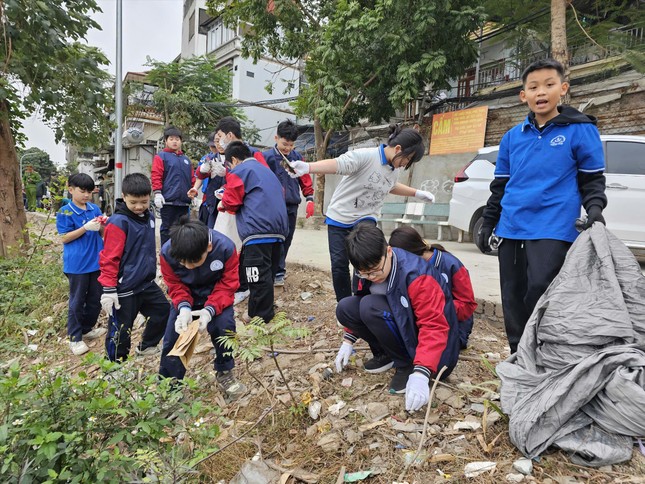 |
Students from Chuong Duong Secondary School participate in cleaning the embankment area near the school every Saturday morning. Photo: provided by the school. |
To date, 100% of primary school students nationwide are attending classes for two sessions per day. At the secondary and high school levels, implementation varies depending on local conditions. Mr. Nguyen Xuan Hong, Director of the Department of Education and Training of Nam Dinh province, stated that from March, secondary schools throughout the province have implemented two-session-per-day teaching.
According to our investigation, the two-session-per-day teaching system in most localities primarily focuses on academic subjects, with larger cities adding extra activities such as foreign language instruction during regular school hours. In this system, the first session follows the curriculum prescribed by the Ministry of Education and Training, while the second session includes joint foreign language instruction and supplementary classes in subjects like Literature, Mathematics, and foreign languages, for a fee (a form of extracurricular tutoring within the school). Therefore, when Circular 29 on supplementary tutoring from the Ministry of Education and Training came into effect from the second semester of this school year, many junior high schools were confused about how to implement educational activities for their students (because they are no longer allowed to offer paid supplementary tutoring within the school).
Many schools give students the afternoon off or leave the school day in between, causing parents to scramble to find extra tutoring or arrange pick-up times that conflict with their work schedules. Thus, it can be seen that the current two-session-per-day teaching system only ensures the teaching of academic subjects for exams and assessments. Schools almost completely neglect teaching skills and implementing holistic development programs for students as outlined in the 2018 general education curriculum.
"Students shouldn't be crammed with four academic lessons in the morning and three in the afternoon, studying Math in the morning and then Math again in the afternoon. That doesn't align with the spirit of a two-session-per-day teaching schedule."
Assoc. Prof. Dr. Nguyen Xuan Thanh
Associate Professor Dr. Nguyen Xuan Thanh, Principal of the School for Management Cadre Training in Hanoi, shared that teaching two sessions a day is essentially a full-day school model (staying at school all day). In this sense, the school space dedicates one day to students to both learn academics and develop skills and physical abilities comprehensively. This means that in addition to academics, students also participate in educational activities and experiences within the school environment.
According to Mr. Thanh, schools that do not yet have sufficient facilities for two sessions per day can still implement educational activities to comprehensively develop students. Besides classrooms, the school space includes a library, multi-purpose rooms, a stage, and a school garden... for students to engage in activities. For schools that lack these facilities, the government must build them.
In places where a two-session-per-day teaching schedule is feasible but only has enough classrooms and lacks playgrounds, sports fields, multi-purpose rooms, or practice rooms, teachers can conduct educational activities, experiential learning, and skills training within the classroom. In such cases, cramming students with four morning and three afternoon lessons of academic subjects, or having math lessons in the morning and then math lessons again in the afternoon, is inappropriate. This contradicts the spirit of a two-session-per-day teaching schedule. Morning classes are taught, while in the afternoon, teachers assign learning tasks and conduct educational activities, all within the classroom. For example, in the afternoon, students could be assigned to groups within the class to perform activities such as presenting a topic related to the curriculum, creating a short play, or choreographing a dance. Students would then utilize the classroom space for these educational activities. "There is space for flexible educational experiences. Schools with sufficient facilities can utilize spaces outside the classroom. I have visited schools abroad where students can conduct experiential activities anywhere in the school, such as hallways, libraries, or any open space," Mr. Thanh said.
In Official Document 5512 (issued by the Ministry of Education and Training in 2020, regarding the development and implementation of school education plans), the application activity is mentioned when discussing teaching and learning activities. This activity is clearly noted as only being implemented after certain lessons with appropriate content. Teachers assign open-ended problems to students, who then submit their work; no classroom teaching is conducted. Teachers only need to follow the Ministry's requirements, giving students ample space and opportunities for development. In this case, the school gates are closed, but classrooms are not closed all day.
Source: https://tienphong.vn/lieu-com-gap-mam-post1740258.tpo
































































Comment (0)