High, majestic mountains often appear in literature and art, such as the "Spiritual Mountains" of Gao Xingjian; the "Illusion Mountain" of Huangfu Yuxiang; "On the Floating Cloud Peak" of Fu Defang ; and "Brokeback Mountain" (an American film that won an Oscar in 2006, directed by Ang Lee)...
Reverse the source to Zinc
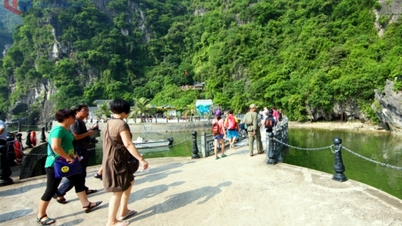
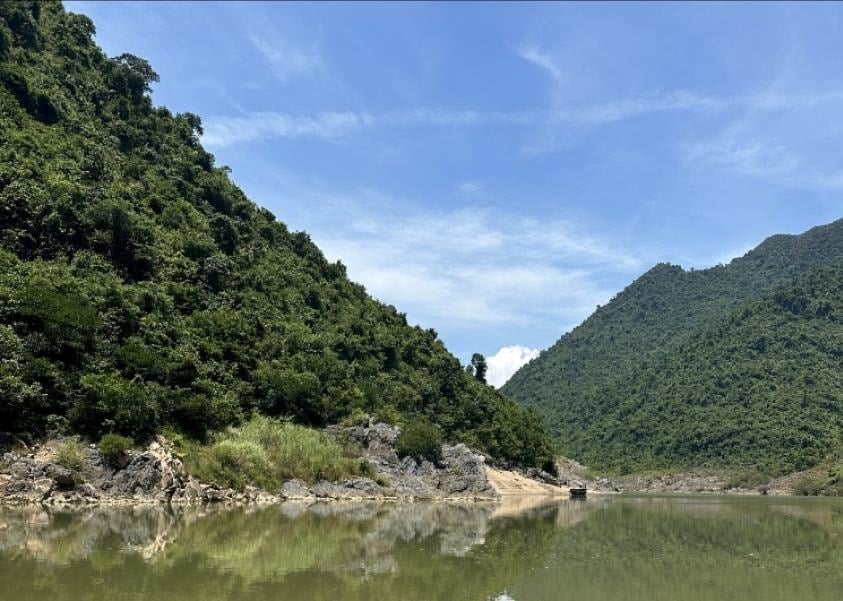
From Trung Phuoc town, we followed a narrow paved road, shaded by lush green acacia forests, then continued on a dirt path to the ferry landing. The motorboat was heading upstream towards Hiep Duc, and everyone was eager. The clear blue river flowed through the rolling hills. In the distance, the Ca Tang peak stood out against the sky in a majestic and mysterious indigo hue.
Traveling with me was Mr. Nguyen Thanh Lai, approximately 70 years old. He recounted that immediately after liberation, this area was desolate, the only road was badly damaged, with patches of asphalt and many sections mostly gravel. As a bank employee in the provincial capital, he said that collecting money was hard work, but it was nothing compared to the fear of carrying the money from here back to Tam Ky.
Many times we had to rely on local or district guerrillas for help, or wait for vehicles from military units to give us a ride… Lai recalled, then continued: “As a young man, I already felt the hardship, but I felt most sorry for the female teachers from the lowlands who came here. In this remote, deep forest and mountain area, the rain was sad, the sun was sad, and each of them missed home so much that their eyes were swollen from crying.”
Hon Kem Da Dung is so famous that countless records have been written about this place. In short, the name has a Vietnamese pronunciation, likely given by Vietnamese people who visited the area. Hon Kem is a place with two cliffs jutting out into the river. The Vietnamese Dictionary of Spelling and Vocabulary by Le Ngoc Tru (Thanh Tan Publishing House, first printed in 1959) explains: "Kem" means a narrow gorge or stream, with mountains on both sides.



There are two possible interpretations of Đá Dừng (Stopping Rock). "Stopping" can be a verb, like "to stop," or it can be a noun, as in "wall" or "wall-like structure," referring to a wall. It's unclear what the ancients meant, but both interpretations seem plausible. Nature created these towering cliffs here, as if to block the river's flow.
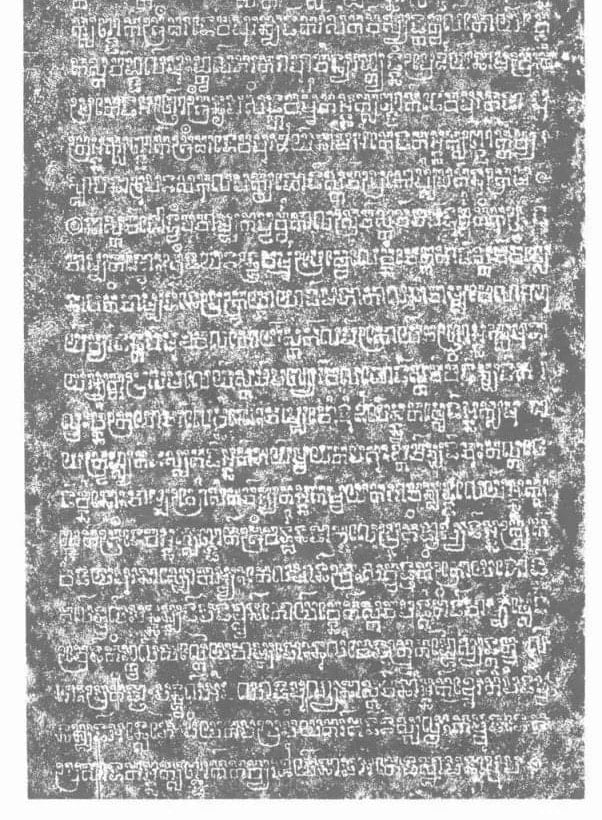
My friend pointed to a cliff and whispered, "During the low tide, there will be a rock formation with ancient Cham inscriptions." I knew this from books. In BAVH (Bulletin des Amis du Vieux Huế - Friends of the Old Hue), the French ethnologist Albert Sallet, who worked in Central Vietnam, recorded about this location: "A rock face with inscriptions, upstream of the Thu Bon River, only revealed at low tide, the Thach Bich cliff, is a religious object of worship for the fishermen…"
Later, in 1911, the French epigraphist Edouard Huber, a professor at the French School of Far Eastern Studies, took the trouble to visit the site and decipher the inscription by Latinizing and translating it into French. The inscription's content is concise: Cri Campecvaro vijayi mahipati Cri. Prakàcadharmmeti sthàpitavàn Amarecam iha. (Translation: Long live Emperor Parkàcdharma, the glorious king of Champa. The lord of this land offers this sacrifice to the Lord Shiva).
Cà Tang, a thousand years of white clouds
Thinking about the Cham inscriptions, I feel as if my soul is drifting upstream on the Thu Bon River, my heart suddenly stirred by a thousand-year-old sense of nostalgia. How many rivers have flowed by, how many lives have been born and departed from this distant river and mountain range? How long did the Vietnamese and Cham communities live together, to the point of intermingling their bloodlines to form a new community at the foot of Ca Tang Mountain?
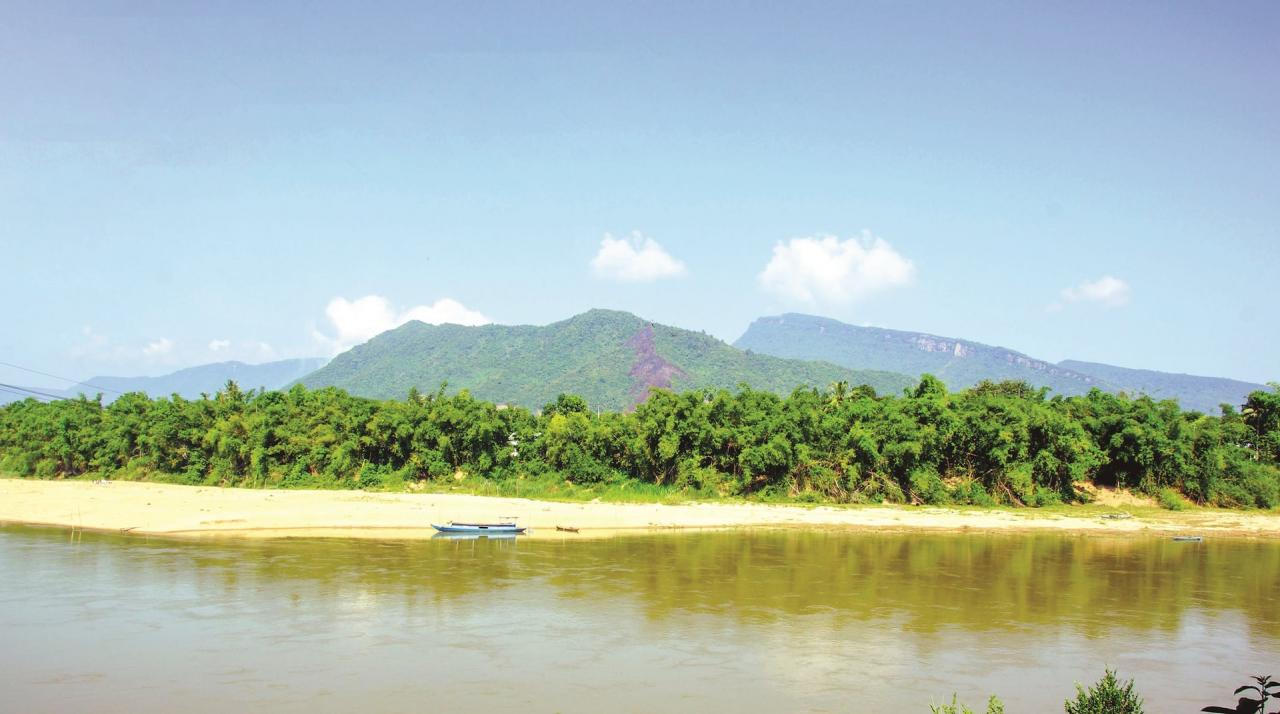
It was almost noon, and the peak of Mount Ca Tang gleamed brightly. Was it real, or was I dreaming? Suddenly, I remembered that Mount Ca Tang had also cast its shadow down the Thu River for a thousand years, along with the mysteries that later generations have strived to decipher.
Recently, the independent Cham researcher Thach Trung Tue Nguyen wrote about the war between Angkor and Campa, which lasted from the time of Yan Po Ku Sri Jaya Indravarmmadeva, mentioning Mount Ca Tang as follows: "According to inscription K.227 (discovered at Banteay Chmar temple, Cambodia), King Sri Yasovarman II attacked Campa and installed a Cambodian prince as king of the land. King Sri Jaya Indravarmmadeva organized a counterattack and besieged Yasovarman II's army on Mount Katang (possibly Mount Ca Tang, Quang Nam today)."
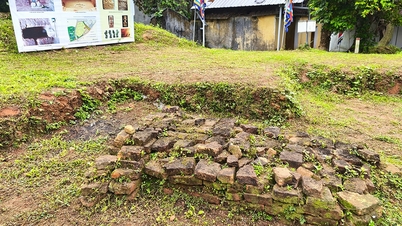
Thanks to the heroic battles and sacrifices of the warriors bearing the title Sanjak, Yasovarma II escaped. According to Thach Trung Tue Nguyen, the reign of Sri Jaya Indravarmmadeva, based on three inscriptions at Po Ina Nagar (Nha Trang) and My Son (Quang Nam), was approximately from 1163 to 1183. Thach Trung Tue Nguyen also stated that the place name Katang appears in inscription K.227, proving its origin in the ancient Cham language. We can tentatively consider Mount Katang (cek Katan) as Ca Tang… Mount Katang had a fortress built by Sri Jaya Indravarmmadeva; it is unknown whether any remains exist there.

For nearly a thousand years, white clouds have drifted over the summit of Ca Tang. New discoveries by researcher Thach Trung Tue Nguyen have revealed many stories waiting to be explored. Are there any remnants left? I have never set foot on the summit of Ca Tang, despite my longing to do so.
Suddenly I remembered that I have friends and younger siblings from the foothills, who love literature and poetry with artistic souls: Hoa Ngo Hanh, Tan Vu, Tran Que Son... Hoa Ngo Hanh temporarily set aside her literary dreams but has short stories that have resonated with readers, such as "Searching for Agarwood" and "The Simple Legend of Ca Tang Mountain"... Tan Vu also has talented essays and memoirs, his words imbued with love for the countryside, such as "Ca Tang - the mountain as a warm home."
Composer Tran Que Son not only loves his homeland but also dares to set to music ideas from the poems of the eccentric middle-aged poet Bui Giang. In a conversation, Tran Que Son confided that he loves Bui Giang's poetry and is moved by it for many reasons, including a part of the poet's life as a goat herder at the foot of Ca Tang mountain – where he had his own strange secret language: "Look at me, my dears, Gold, Black, and White / Do you understand the purple and white flowers? / Slowly raise the bracelet / I slowly lower it around your neck, swaying it…"
A gentle breeze swept across the river, carrying the fragrant scent of orchards from the peaceful village. For a moment, I looked up at the peak of Ca Tang. The mountain rose high, dimly visible in the darkness. But the light reflected from the Thu Bon River was ethereal, enough for me to see a legendary sacred mountain casting its shadow. It was as if a hundred years, a thousand years, or even longer, had instantly become eternity.
Source: https://baoquangnam.vn/linh-son-goi-bong-3148333.html