The breath-holding tactic helps hammerhead sharks withstand freezing temperatures when hunting prey at depths of nearly a kilometer below the sea surface.
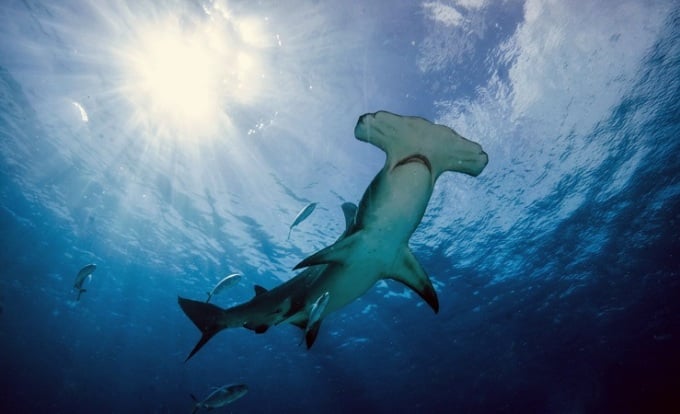
Hammerhead sharks hunt at extremely great depths. Photo: Earth
Hammerhead sharks can hold their breath when diving deep into freezing cold water. A study published on May 12 in the journal Science reveals this tactic, allowing the species, accustomed to warmer waters, to regulate their body temperature while hunting. According to Mark Royer, a shark biologist at the University of Hawaii and lead researcher, this technique was completely unexpected for him and his colleagues. This type of behavior has never been observed in any deep-diving fish and raises questions about the prevalence of breath-holding behavior in other species.



The critically endangered hammerhead shark typically relies on forward motion to propel water through its gills, allowing it to filter the oxygen necessary for breathing. However, when hammerhead sharks swim to depths of around 800 meters to hunt squid and other prey, the colder water can affect their metabolism, cardiovascular function, and vision, all of which diminish their hunting abilities.
By closing their gills and mouths to hold their breath, hammerhead sharks can limit their exposure to cold water. Some species, such as bluefin tuna and mako sharks, have special body structures that allow them to conserve body heat in cold water, but hammerhead sharks do not have that advantage. That's why some scientists hypothesize that hammerhead sharks maintain body heat by using simple thermal inertia—that is, relying on their large body size to retain temperature and carry heat with them when they dive in deep, cold waters. However, the small sensors the research team placed on an adult hammerhead shark showed that thermal inertia is not the reason they stay warm during their deep-sea hunts.
In the study, Royer's team analyzed detailed information on the swimming behavior, depth, and location of a group of six tagged male sharks. In total, they made more than 100 dives around Hawaii over several weeks. Sensors also recorded their muscle temperature during these repeated nighttime dives. Combined with modeling, the data indicated that the sharks maintained their body temperature both at the surface (around 26.7 degrees Celsius) and when they dived to depths of over 762 meters, where the temperature dropped to 5 degrees Celsius.
The sharks' body temperature actually drops as they swim to higher altitudes and reach warmer waters halfway back to the surface, opening their gills to gather necessary oxygen. This is not what the research team predicted with thermal inertia. Although they didn't observe the sharks actually closing their gills, they suspect that's what happens. To confirm the breath-holding hypothesis, Roger and his colleagues will need to attach cameras to the pectoral fins of hammerhead sharks to observe the gills opening and closing as the sharks dive.



The research team is still unsure how the 3.7-meter-long shark learned to hold its breath. According to Royer, it may have learned from social interaction with other hammerhead sharks. Another piece of evidence supporting their hypothesis is video footage from a remotely operated vehicle showing adult hammerhead sharks swimming in Tanzania at depths exceeding 914 meters with their gills closed. If hammerhead sharks hold their breath while feeding in the deep sea, they may be able to tolerate the increasingly common low-oxygen environments. This could explain their survival in the low-oxygen waters of the Gulf of California.
An Khang (According to National Geographic )
Source link




![[Photo] "Hanoi Lotus Festival" honors the lotus flower that has been associated with Vietnam for thousands of years.](https://vphoto.vietnam.vn/thumb/1200x675/vietnam/resource/IMAGE/2026/06/27/1782516943048_sen-ha-noi-2026-minh-duy-1-jpg.webp)








![[GALLERY] OpenAI and Anthropic change direction, a new billion-dollar AI war.](https://vphoto.vietnam.vn/thumb/402x226/vietnam/resource/IMAGE/2026/06/27/1782536755710_gn-1-png.webp)