

Reduce production costs.
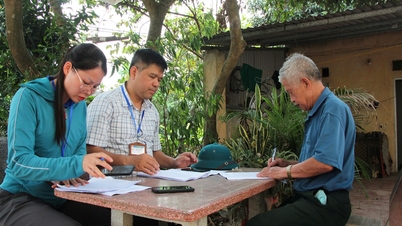
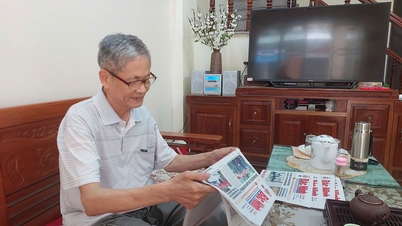
For many years, the family of Ms. Nguyen Thi Thuy in Ngo Cuong village, Nhan Thang commune, has been sorting waste at home. Organic waste such as leftover food, vegetables, and tubers are processed with IMO (Indigenous Microorganisms) to be used as fertilizer for plants or animal feed. Some types of waste can be recycled or sold to scrap collectors. This habit was formed thanks to the commune's People's Committee raising awareness about the impact of the environment on human health.
Speaking with us, Ms. Thuy said: “Previously, my family used to mix garbage together, which was unhygienic and took up a lot of space. After being educated about processing organic waste at home using IMO products, my family started sorting garbage according to the instructions of environmental officers, and now it has become a habit. We only have to put in a little extra effort, but in return, we can utilize the waste for reuse.”
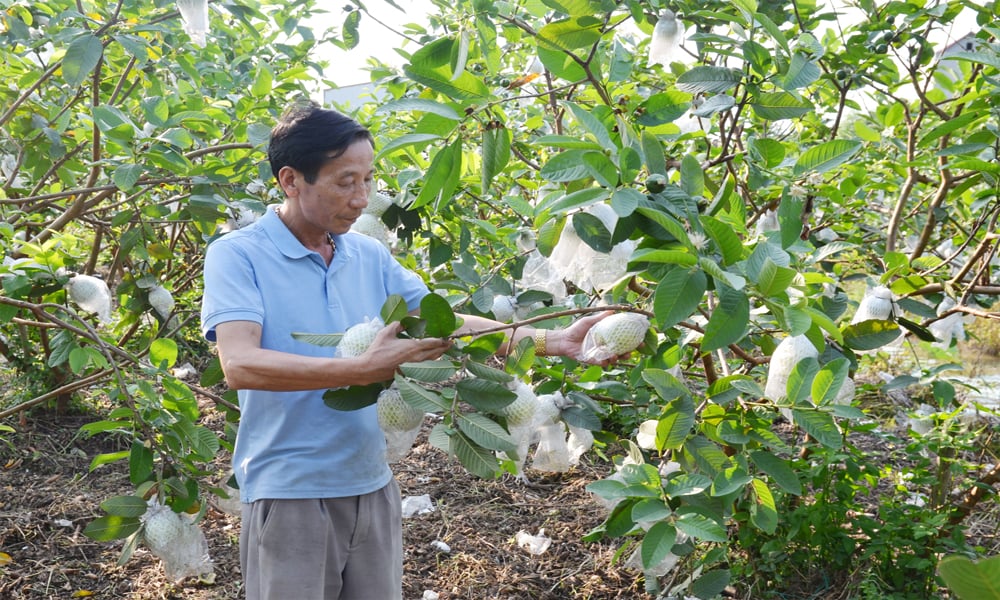 |
Mr. Nguyen Xuan Nam, from Phuong Do village, Nhan Thang commune, has a 6.7-hectare farm model that uses IMO microbial preparations to improve economic efficiency. |
The 6.7-hectare farm of Mr. Nguyen Xuan Nam's family in Phuong Do village, specializing in fruit tree cultivation combined with goat and earthworm farming, has generated a stable revenue of approximately 1.6 billion VND for many years. After deducting expenses, the profit is around 600 million VND per year. One of the farm's outstanding advantages is that all waste from the livestock process is used as raw material for earthworm farming, grass cultivation, and fertilizing crops; substandard fruits after harvesting are treated with IMO preparations and used as animal feed. This not only improves production efficiency but also contributes to reducing environmental pollution.
Previously, whenever she cooked or cleaned her garden, Ms. Nguyen Thi Vuong from Tan Huong village would throw discarded vegetable leaves and fruits into the trash can or at the base of trees. Since being guided by the Women's Union of the commune on how to process organic waste using IMO microbial products, she has "transformed" organic waste into fertilizer for her crops. Ms. Vuong said: "My family's economy depends on vegetable production. Since applying the method of treating waste with IMO products, I find it very useful because when watering vegetables and fruit trees with the product, the soil becomes more porous, the vegetables grow well, have fewer pests and diseases, and especially, I don't have to spend money on chemical fertilizers." According to Ms. Vuong, with only 100,000 VND, she can make 5 liters of IMO microbial product. With that amount, she can use and replicate it to compost organic waste into fertilizer for 1.5 acres of vegetables, whereas using chemical fertilizers would cost 500-600,000 VND. In addition, all organic waste is utilized to make products, contributing to keeping homes clean and tidy.
According to Ms. Vuong, the formula for creating IMO microbial fertilizer is very simple. The initial ingredients include: 2 liters of clean water, sugar, starter culture or digestive enzymes (containing Lactobacilus Acidophilus and Bacillus sublitis strains), yogurt, rice bran, ripe fruits, and yeast. These ingredients are fermented for 6 days to produce starter IMO. Then, this product is poured into organic waste and fermented for 1 month. The resulting liquid waste is diluted at an appropriate ratio to create organic fertilizer for plants.
Protecting the ecological environment
IMO (Indigenous Microorganism) microbial preparations are native microorganisms produced by fermenting natural raw materials, creating various types of microorganisms that exist in the natural environment and possess high biological activity. These preparations have many practical uses, such as: mixing into animal feed to support the immune system of livestock and poultry; rapidly decomposing organic waste to create fertilizer for plants; improving soil; and treating water in aquaculture ponds and lakes.
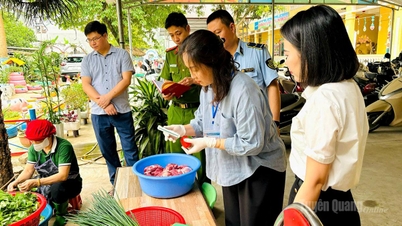
In Nhan Thang commune, 7,349 households have achieved a 100% rate of waste sorting, with approximately 2,200 households (30%) using IMO microbial products to treat organic waste at home, thereby reducing the amount of household waste released into the environment by 30-40%. All daily waste generated in the 15 villages of the commune is collected and transferred to designated collection points using pushcarts and sprayed with IMO before being transported to centralized waste incineration plants for processing.
| In Nhan Thang commune, 7,349 households have achieved a 100% rate of waste sorting, of which approximately 2,200 households (30%) use IMO microbial products to treat organic waste at home, thereby reducing the amount of household waste released into the environment by 30-40%. |
According to Mr. Nguyen Kim Huyen, Head of the Economic Department of Nhan Thang Commune, to raise people's awareness, the commune requires villages to regularly guide families in forming the habit of sorting waste at home. At the same time, they promote environmental protection awareness through consultations and integration into group activities such as the Women's Union, Youth Union, and Farmers' Association, encouraging people to voluntarily participate in cleaning the environment around their living areas. Each person contributes in their own way, collecting and sorting waste, sweeping, planting flowers, etc., creating a beautiful landscape along village roads and alleys. Through these general cleaning sessions, people's responsibility in preserving the environment has gradually increased. As a result, the rural landscape is more spacious, clean, and beautiful, with no more littering along the roadside or garbage piled up waiting to be collected; the rural appearance has become brighter, greener, cleaner, and more beautiful.
After more than four years of implementation, the method of treating organic waste using IMO microbial preparations has been adopted by many households in Nhan Thang commune. This is a good, easy-to-implement method that brings economic benefits while protecting the environment. Given the dual benefits of this preparation, in the coming time, alongside promoting household waste sorting, Nhan Thang commune will focus on training and guiding people, primarily women's association members, veterans, and youth union members, on the method of treating organic waste with IMO microbial preparations. People hope the commune will provide support policies for microbial inoculum and containers, and also intensify propaganda to help people understand the benefits of sorting and treating organic waste with IMO microbial preparations, thereby expanding the model further, contributing to environmental protection, and improving agricultural production efficiency.
Source: https://baobacninhtv.vn/loi-ich-kep-tu-su-dung-che-pham-vi-sinh-imo-postid428163.bbg

![[Image] National Assembly discusses the implementation of the socio-economic development plan.](https://vphoto.vietnam.vn/thumb/1200x675/vietnam/resource/IMAGE/2026/04/20/1776696707422_ndo_br_img-20260420-185419-jpg.webp)

![[Photo] General Secretary and President To Lam meets with National Assembly delegates from ethnic minorities.](https://vphoto.vietnam.vn/thumb/1200x675/vietnam/resource/IMAGE/2026/04/20/1776696701056_a1-bnd-8331-3342-jpg.webp)















































Comment (0)