

Cuc Phuong not only hides the allure related to the tens of thousands of species of plants and animals that this forest encompasses...
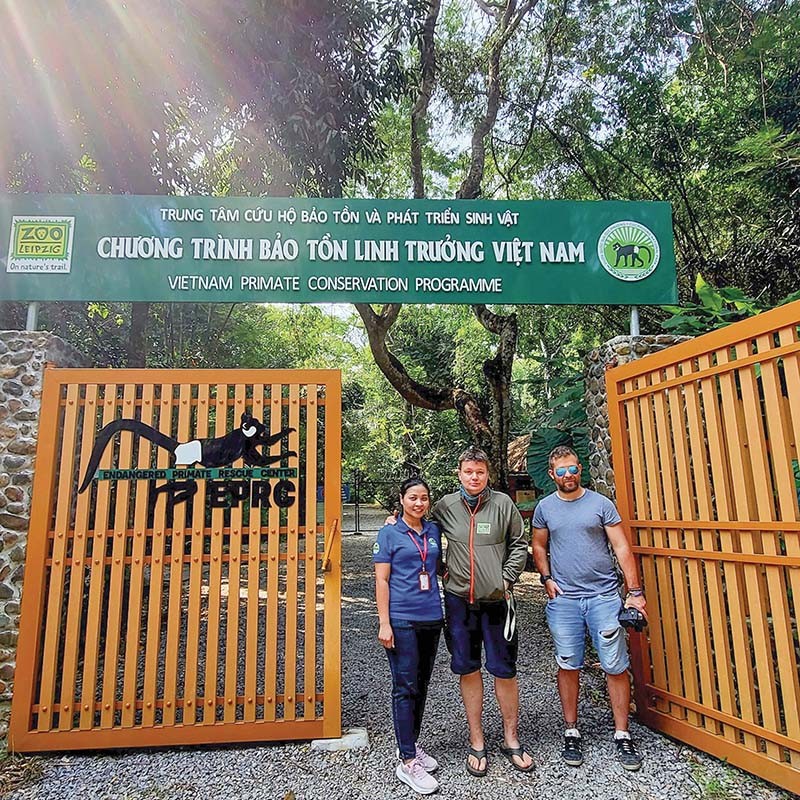 |
| Ms. Hoang Thi Thuy, Ms. Elke Schwierz (German) and Mr. Nicolas (French tourist) at the Endangered Primate Rescue Center (EPRC) in Cuc Phuong. (Photo: MH) |
Normally, to visit a place like Cuc Phuong National Park, people usually plan many days in advance, sometimes months or even a year, as foreign tourists often do. But my trip to Cuc Phuong was accidental and unexpected when I joined a backpacking group led by Nicolas (a Frenchman). Nicolas has traveled to nearly 50 countries around the world , and Cuc Phuong National Park was his final destination on this backpacking trip in Vietnam.
Asia's green jewel
The weekend was bathed in brilliant sunshine. Our car sped along the beautiful Ho Chi Minh Highway, like a silken ribbon, on our way to Cuc Phuong National Park. I felt immense admiration for composer Tran Chung as his poignant and wonderful lyrics echoed in my mind: “Remembering a primeval time, when the forest had no name, through endless rain and sunshine, the young trees grew into a vast forest. How old is the forest? The forest doesn’t remember. Why do we keep calling it ‘my dear,’ when the country has given the forest a name?”
We met Mr. Do Hong Hai, Deputy Director of the Environmental Education and Services Center of Cuc Phuong National Park, right after entering the forest. With a radiant smile, he shared: “Most tourists, especially international visitors, want to visit Cuc Phuong during their trip to Vietnam because it is a ‘green gem’ with an ecosystem that ranks among the best in Asia. Inside, visitors can discover even more.”
According to Mr. Hai, nestled on a majestic limestone mountain range, Cuc Phuong National Park stretches from Hoa Binh province through Thanh Hoa province to Ninh Binh province. It is also the first national park in Vietnam. The World Travel Awards selected and honored this landmark as Asia's leading national park for five consecutive years (2019-2023). Over time, the forest has not only preserved its grandeur but has also become a home for endangered plant and animal species.
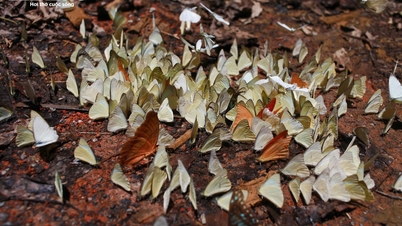
Ms. Hoang Thi Thuy, a young Muong female officer with over 10 years of experience working here, guided us on a tour. The Center's vehicle glided along the cool, dreamlike road, more than 10km long, like a winding silk ribbon, to the center of the forest. The members couldn't hide their admiration and awe at the beauty of Cuc Phuong. This season, Cuc Phuong is truly vibrant with blooming wildflowers, along with swarms of yellow and white butterflies fluttering in the sunshine. The "natural swings" made from the Barringtonia vines made everyone feel like they had stepped into a fairyland.
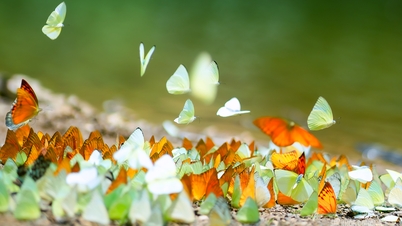
Ms. Thuy's voice rang out: "In late summer and early autumn, we'll have the chance to admire flocks of colorful butterflies fluttering throughout the forest. Cuc Phuong has nearly 400 species of butterflies, such as white butterflies, citrus butterflies, swallowtail butterflies, and more, in a variety of colors and sizes. At night, you don't need to look up at the sky to see the stars; you can still gaze at them because of the dreamlike swarms of fireflies flying throughout the forest."
Stopping at Cuc Phuong Botanical Garden, Ms. Thuy explained that this area was built to collect and cultivate rare plant species from Cuc Phuong, Vietnam, and the world.
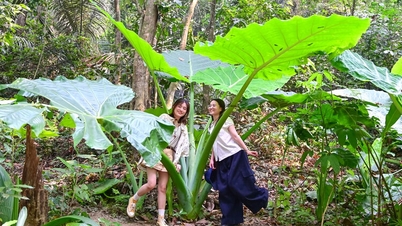
Nicolas leaned over and whispered to me, "It's like being lost on an island in a science fiction movie." He excitedly asked me to take pictures with the giant wild taro plant, as big as a banana tree, and the wild banana tree, as tall as a casuarina tree, growing from the cool forest air.
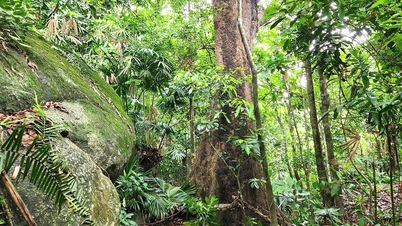
Upon arriving at Cuc Phuong National Park, every visitor is eager to see the thousand-year-old Dipterocarpus trees. Although some ancient trees have passed away, many still remain, some over 700 years old, with a circumference large enough for six or seven people to embrace. Surprisingly, many of the ancient trees in Cuc Phuong grow on rocky mountains, so their roots are often large and wide, several meters across, rather than round like the roots of trees growing in clay soil.
The female guide, who had spent a decade working in Cuc Phuong National Park, enthusiastically explained to us countless interesting things about the forest: "Look at these climbing vines. We can't tell the difference between the stem and the top, because they grow from the ground, climb up, then fall down, root from the stem, and climb up again... If you follow a vine like that, you'll see them climbing, falling, and climbing again for up to 2 kilometers." Nicolas became even more fascinated by the story of the "bang" tree – a plant with starch in its trunk, which looks like a wild coconut tree. He nodded in agreement when the reason was explained why Vietnamese soldiers were able to survive in the forest for so long throughout the two long wars of resistance.
We continued our exploration of thousands of plant species in the forest until the sun was almost setting, and the more we walked, the more joyful we became. Here and there, we heard the scattered chirping of birds in the evening. Thuy then imitated their voices: "Co ruc, co ruc..." and immediately afterwards, the air was filled with the music of the mountains and forests as the sounds of birds chirping echoed one after another...
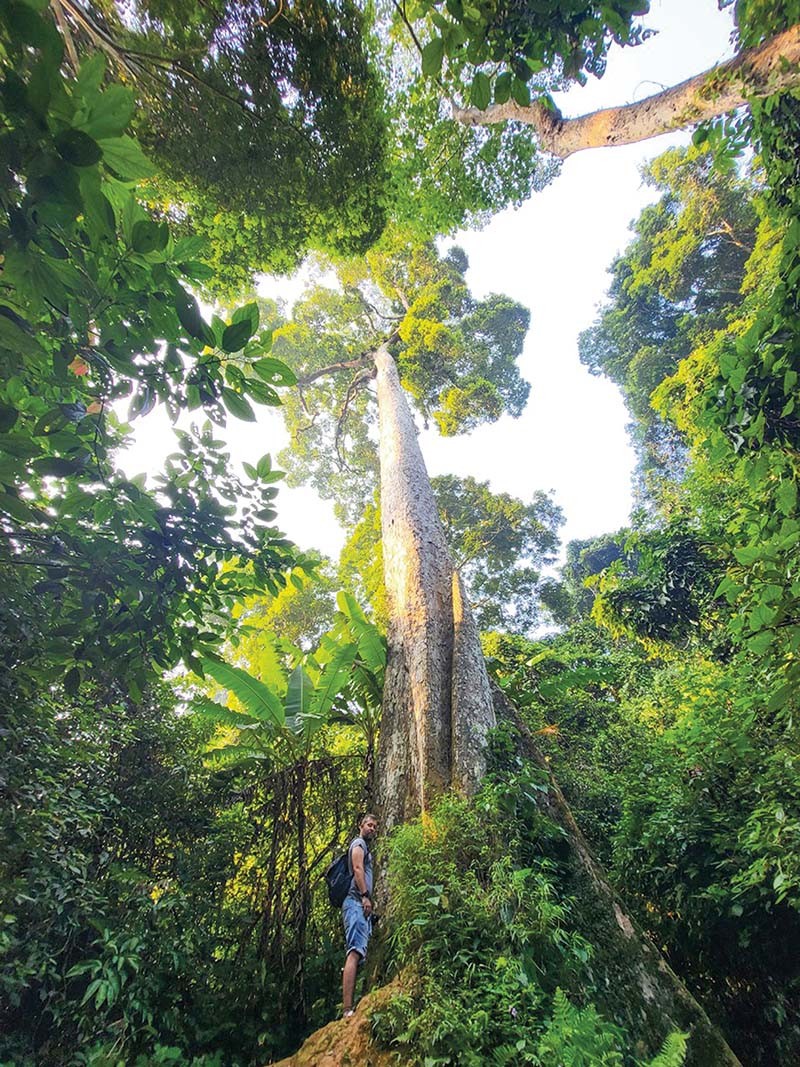 |
| This approximately 700-year-old Dipterocarpus tree has a trunk so wide that it would take six people to encircle it. (Photo: MH) |
Stay with Cuc Phuong
To the left of the entrance gate to Cuc Phuong Forest is a conservation area for wild plants and animals, including the Primate Rescue Center, the Carnivore and Pangolin Conservation Center, and the Turtle Conservation Center...
According to Mr. Do Hong Hai, established in 1993, the Cuc Phuong Endangered Primate Rescue Center (EPRC) is considered a common home for primate species. It is the first rescue center in Indochina to undertake the mission of rescuing, rehabilitating, breeding, conserving, and reintroducing rare and endangered animal species.
With wide eyes, Nicolas exclaimed, "This animal is so beautiful!", gazing in amazement at the colorful langur being cared for in its cage. I, meanwhile, excitedly brought my camera close to the cage to take pictures. Suddenly, I was startled to hear a voice from behind the door say, "Chăng pỉ." Thúy quickly pulled me aside and introduced me to Elke Schwierz, a German woman. She had just spoken in the Mường language, meaning "No," because being too close to the langurs would mean they'd snatch visitors' belongings very quickly. Therefore, tourists should only walk along the marked lines and not get too close to the cage.
From that moment on, Elke Schwierz became our main "guide," leading us on a tour from one langur enclosure to another. She shared: "I've worked at the Primate Conservation Center since 2002. More than 20 years ago, it was very different here. Before, people used to go into the forest to collect plants and catch animals to sell or eat... but now, if they catch rare animals or animals in distress, they bring them to the Center for care. Currently, the Center is conserving 190 individuals of langurs, gibbons, and slow lorises. Of those, there are 120 langurs, and they are also the most difficult species to care for. Langurs only eat leaves, and we use more than 400 kilograms of leaves to feed them three times a day."
“I studied at the Berlin Zoo, then worked for the Leipzig Zoo in eastern Germany. I love being friends with wild animals. I love solitude, and when I came to Cuc Phuong, I felt like it was my second home. I could spend all day in the animal enclosures; I couldn’t stand half an hour in the office,” Elke confided.
Speaking about her work, she expressed her concerns: "Due to conservation issues affecting both the flora and fauna of the forest, we face many difficulties in finding leaves for the langurs. We have to go out into the forest to collect leaves. The problem is that around here, people have cleared the land to plant pineapples and sugarcane, so finding enough leaves (300 kg) each day for the langurs is quite challenging, especially in winter."
Rescuing baby langurs keeps Elke as busy as raising her own children. For baby langurs without mothers, not only is completing the paperwork for each one time-consuming and laborious, but caring for them like newborns keeps her incredibly busy all day long. “Sometimes, I don’t know if I have the strength to work all day and all night because baby langurs need to be fed milk every two hours. Once, we took in six baby langurs, which was like raising six children – very difficult. But my colleagues and I support each other, and we get through it,” Elke said.
The more I talked to Elke, the more I admired her love for nature, a woman from a faraway place who chose to "sleep among the grass, trees, and flowers, whispering through the moonlit season" in Cuc Phuong.
Leaving Cuc Phuong National Park, the melodies of composer Tran Chung's song still echoed in my heart: "Being with you just once, and then remembering you forever, the love of the green forest lasts a thousand years, the gentle melody of love brings joy to life."
Thank you, Cuc Phuong, thank you to the staff, employees, and international friends who have always been dedicated to preserving and protecting Cuc Phuong, for today and for the future.
Source



![[Photo] General Secretary and President To Lam visits and delivers a policy speech at Tsinghua University.](https://vphoto.vietnam.vn/thumb/1200x675/vietnam/resource/IMAGE/2026/04/14/1776164592318_vna-potal-tong-bi-thu-chu-tich-nuoc-tham-va-phat-bieu-chinh-sach-tai-dai-hoc-thanh-hoa-trung-quoc-8700658-5437-jpg.webp)
![[Image] Expediting land clearance at Alley 310 Nghi Tam to facilitate the construction of Tu Lien Bridge](https://vphoto.vietnam.vn/thumb/1200x675/vietnam/resource/IMAGE/2026/04/14/1776160406551_ndo_br_z7724148990408-9e5d4777e3c4504998b4286178b2e66e-jpg.webp)









































































Comment (0)