

 |
| The Gong Ensemble of Bu Gia Map Ethnic Boarding Secondary and High School, Dong Nai province, is preparing to perform at the Binh Phuoc Marathon - Truong Tuoi Group 2023 event. |
Today, as modern life sweeps away many traditional values, it is touching to learn about a young man who has been quietly "keeping the flame alive" for his ethnic identity. That is Dieu Hai, born in 2001, living in Hamlet 1, Village 23 Lon, Tan Quan Commune, Dong Nai Province. In the heart of this young man, the sound of the S'tieng people's gongs still resonates with pride.
Keep the S'tieng culture shining brightly.
Anh Điểu Hải was discovered by choreographer Hà Nhung when she participated in the reconstruction of the Rain Prayer Festival for the local area.
“While Hai was performing the crane dance – one of the traditional dances of the S'tieng people – I was surprised because she danced so beautifully, in the exact style of the women of the past. Upon further inquiry, I learned that not only was she a graceful dancer, but Hai also knew how to play drums and gongs, and was even the creator of unique and creatively patterned brocade fabrics,” choreographer Ha Nhung recounted.
Not content with just possessing talents rarely seen in men, Dieu Hai also proactively expressed to Ha Nhung his desire to contribute to preserving the cultural values of the S'tieng people.
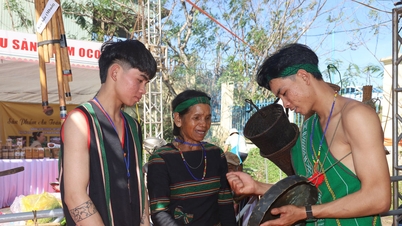
Mr. Dieu Hai shared that he came to gongs out of deep admiration: "I know how to play gongs because I am very passionate about the musical instruments of my people. The opportunity came to me naturally. During a family wedding, my grandparents let me try touching a gong, and since then, the sound of the gongs has resonated in my mind."
Although he hadn't received formal training, Điểu Hải's love for the gong was enough to convince choreographer Hà Nhung to introduce him to the S'tiêng Cultural Club in the commune, where he could learn the traditional way of playing.
Mr. Dieu Hai is also involved in the craft of brocade weaving. He shared: Brocade weaving is a traditional craft that was once reserved only for S'tieng women. However, witnessing the neglect of his people's traditional craft, he was determined to revive it. He learned weaving from his grandmother, who passed on to him not only the technique but also a love for the patterns and colors on the brocade fabric.
New vitality from gongs and drums.
In 2005, the Central Highlands Gong Culture Space was honored by UNESCO as a "Masterpiece of Oral and Intangible Heritage of Humanity"; in 2008, it officially received the title of Intangible Cultural Heritage of Humanity. This is the second intangible cultural heritage of Vietnam recognized by UNESCO. However, amidst the hustle and bustle of modern life, where market-driven entertainment culture prevails, the S'tieng gong music is gradually becoming less popular and risks being forgotten. Teaching it to the younger generation is difficult, as young people tend to distance themselves from traditional values and ancient gong melodies. This concern is not only shared by the village elders but also by the entire community and those working in cultural preservation in Dong Nai province.
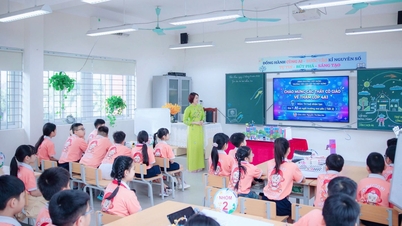
In its journey to preserve the sacred sounds of the S'tieng ethnic group, Bu Gia Map Ethnic Boarding Secondary and High School in Dong Nai province has become a "small cultural space" for the gong heritage. Here, teaching goes beyond extracurricular activities and ignites a flame of aspiration in the hearts of young people.
What sets the S'tieng gongs apart from those of many other ethnic groups is their unique performance technique. Instead of using hard wooden or soft bamboo mallets to strike the gong, the S'tieng prefer to directly punch the outer surface of the gong with their right hand while simultaneously using their left hand to block or interrupt it. This technique creates a distinctive overtone, making the gong sound a hazy, mystical "bum bum," free from the harshness of the clanging or rattling of brass. This evokes the sound of the deep forests, underground streams, and epic tales.
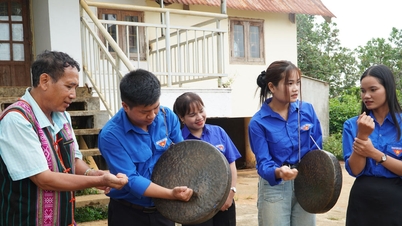
Mr. Le Van Cong, a music teacher, has dedicated his heart and soul to reviving the gong music in schools. To teach gong music to his students, Mr. Cong spends time talking to and connecting with local artisans. From simple gong pieces, he has put a lot of effort into arranging and combining them with S'tieng folk melodies (in the same tone), making the gong pieces and performances more lively and engaging for the children. When the children begin to love the sound of the gong, Mr. Cong guides them to appreciate the beauty, artistry, and significance in each gong piece so that they can be proud of their ethnic culture. For Mr. Cong, teaching gong music is not just about teaching children how to play the instrument, but also about teaching them to understand the communal nature of this musical instrument. Each person plays a gong, but they must blend together into a common piece, expressing unity and solidarity.
From her time spent learning to play the gong, Thi Xuyen, a 7th-grade student at Bu Gia Map Ethnic Boarding Secondary and High School, has grown to love this musical instrument even more. Xuyen said: “Now, every time I hear the sound of the gong, I feel like I’m returning to my village, to home during festivals when the elders play the gongs around a large bonfire. The sound of the gong is both majestic and unique, making me love the traditional culture of my ethnic group even more.”
From the warm and affectionate atmosphere of the Bu Gia Map Ethnic Boarding School for Secondary and High School students, where the sound of gongs and drums resonates daily under the guidance of teacher Cong, to the silent but resilient efforts of Dieu Hai, the flame of S'tieng gong music continues to be lit in Dong Nai province. The sound of the gongs is now not just the sound of the past, but the sound of the future, of hope. It is a powerful affirmation of ethnic identity, a heartfelt message from the mountains conveyed through the hands and minds of the younger generation.
Phuong Dung
Source: https://baodongnai.com.vn/dong-nai-cuoi-tuan/202512/loi-tu-tinh-cua-dai-ngan-d9e0f9f/

































































































Comment (0)