

Deep in the northern mountains of Kon Tum, inside the old wooden house of village elder Brol Vẻl (Đăk Răng village, Đăk Nông commune, Ngọc Hồi district; now part of Quảng Ngãi province), two time-worn gongs were brought out before the entire village. No one dared touch them; only village elder Brol Vẻl (70 years old) carefully held these treasures. These are Nỉ gongs, considered by the Triêng people as the "nobility" of gongs, the soul and the lifeblood of the entire community.
ESTABLISHING A SHELTER AND PLAYING GONGS IN THE DEEP FOREST
Under the simple wooden roof of his house in Dak Rang village, village elder Brol Vel quietly keeps a "treasure trove" of dozens of traditional Central Highlands musical instruments that he himself crafted and plays skillfully. The stringed instruments, flutes, and mouth organs hang densely against the wooden walls. Elder Brol Vel says that these are his possessions that have been with him since his youth.
Spreading out a mat to invite his guests to sit, he slowly recounted how he came to music . At the age of 17 or 18, seeing his father playing the ta lẹch (a type of bamboo flute), he was captivated and begged to learn. In those days, he always carried his ta lẹch with him wherever he went. At home, in the fields, or even during his years on the battlefield, whenever he had free time, he practiced playing. That sound accompanied him, dispelling fatigue, calming fear, and conveying the feelings of a mountain boy to the mountains and forests.
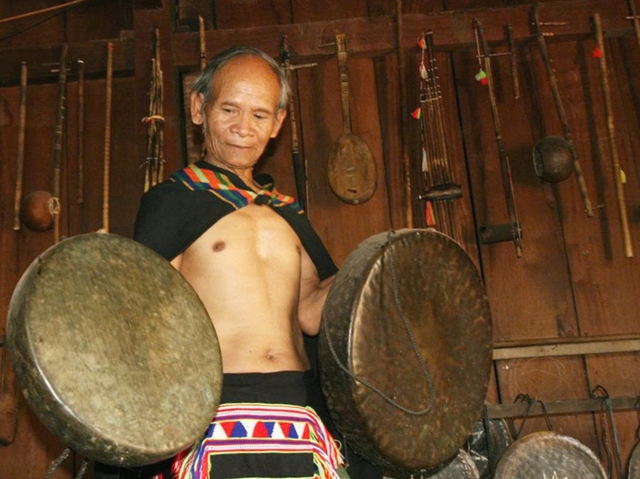
The two remaining felt gongs
PHOTO: PHAM ANH
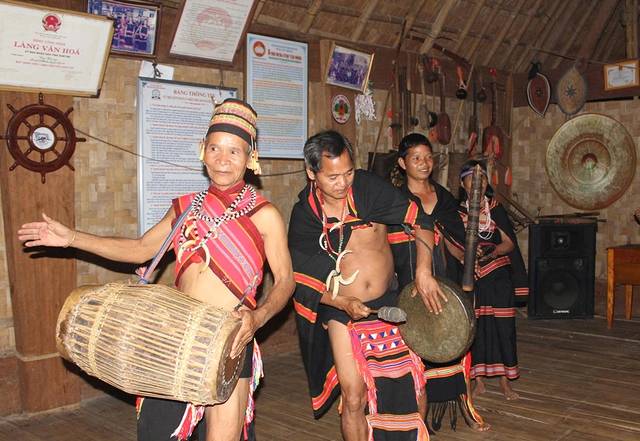
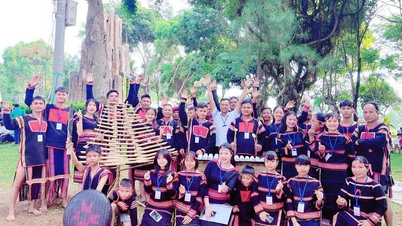
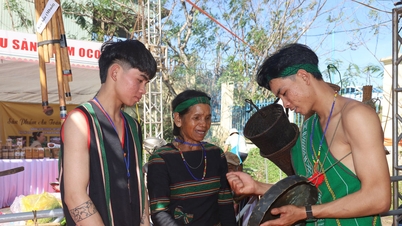
Elder Brol Vẻ (leading the group) performs with the artisans in Đăk Răng village.
PHOTO: PHAM ANH
Starting with the first ta leh instrument, Brol Vel taught himself to play other instruments such as the bin long, eng ong ot, gor, khen, ong eng nham, long gia ling ling… To date, he is proficient in playing more than 15 types of musical instruments and has even invented his own. For village elder Brol Vel, every sound produced is not just the sound of a stringed instrument or a flute, but the very breath of Central Highlands culture.
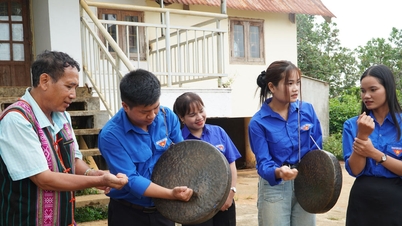
Pointing to the seven-leaf set of gongs hanging on the wall, village elder Brol Vẻl slowly said, "This set is truly precious, used for village festivals. But the whole set is still not as valuable as the two gongs I have stored in my house." Then, the elder went into the inner room and brought out two gongs. One was about 50 cm in diameter, the other smaller, about 40 cm. "In both Đăk Dục and Đăk Nông communes, there are only this many left," elder Brol Vẻl said, his voice lowering.
These are the last remaining Nỉ gongs of Đăk Răng village. For the Triêng people, Nỉ gongs are not the kind commonly hung in communal houses or placed in individual homes. In the past, gongs weren't even kept in the village. The owner had to take them deep into the forest, build a separate hut, and choose the cleanest, most beautiful place for the gongs to "rest." Only the person entrusted with keeping the gongs knew where they were hidden; even members of the same family weren't allowed to know. Once a year, during the village's biggest festival, the Nỉ gongs were brought from the forest to the communal house, and then quietly returned to their original place after the festival ended.
According to the recollections of elder Brol Vẻl, the original set of Nỉ gongs consisted of four pieces, named Ko, Kon, Tray, and Sao, symbolizing grandfather, father, son, and son-in-law. The Triêng people could not make these gongs themselves, but had to trade buffaloes for them in Laos. The Nỉ gong set of elder Brol Vẻl's family was once traded for eight buffaloes – a significant asset for any mountain family.
War and historical upheavals caused the gong set to gradually get lost. In 1962, the "son-in-law" gong was lost, and the villagers had to use bamboo tubes as a replacement. By 1972, when Elder Brol Vẻl inherited the gong, the largest piece – the Ko gong – was also gone. Today, only two pieces of the Nỉ gong set remain. For major ceremonies, the village has to borrow additional sum gongs and bamboo tubes to play in place of the others.
RECORD OF THE BLOOD-TAKING CEREMONY
In the afternoon at the home of elder Brol Vẻl, the elderly and young people arrived one after another, gathering around to listen to stories about the Nỉ gongs. Everyone watched attentively, but absolutely no one dared to touch them. "Everyone knows to protect themselves and their place in the face of the sacredness of their people," elder Brol Vẻl said.
According to the Trieng people's beliefs, the Ni gong is inhabited by Yang (the spirits). In the past, during conflicts between villages, the village that possessed the Ni gong believed it would win the battle. The gong is not only a musical instrument but also a symbol of strength, protection, and prosperity. Each year, only during the New Rice Harvest Festival (around the 11th lunar month), the Ni gong is brought out and placed in the highest position in the communal house. When the sacrificial buffalo is tied to the ceremonial pole, the first drops of blood are brought and smeared on each side of the gong, while praying for the gong to "eat," to inform Yang that the Trieng people always respect the spirits and pray for abundance and peace.
The Nỉ gongs only have two pieces: one celebrating the buffalo feast and the other celebrating the new rice harvest. Once played, they are put away; no one is allowed to play them again. Only after the Nỉ gongs have sounded can other gongs, then the khaen and flutes, be allowed to join in the festival atmosphere… “In the past, the village of Đăk Răng had three sets of Nỉ gongs, now only this many remain,” the old man Brol Vẻl’s voice softened. The Triêng people do not sell their Nỉ gongs. The gongs are passed down from generation to generation, like a part of the people’s soul.
Mr. Tran Vinh, former Deputy Director of the Department of Information and Communications of the old Kon Tum province (now deceased), who spent many years researching Trieng culture, once suggested that the Ni gong is considered a miniature family, symbolizing three generations of direct lineage and their interdependent relationship. The gong-playing techniques are not widely taught, limited only to the family that keeps the gong, because it is a sacred place, where the spirits reside.
As evening falls over Dak Rang village, the Ni gong still lies silently "sleeping" somewhere deep in the forest, waiting for the day it will be heard. (to be continued)
Source: https://thanhnien.vn/vat-thieng-cua-lang-bi-an-chieng-ni-18526022722013401.htm

![[Photo] The courage of new recruits of Brigade 144 on the training ground.](https://vphoto.vietnam.vn/thumb/1200x675/vietnam/resource/IMAGE/2026/05/27/1779881651341_anh-man-hinh-2026-05-27-luc-18-32-52.png)
![[Photo] The heat at the fireworks display site on the opening night of the Da Nang International Fireworks Festival 2026](https://vphoto.vietnam.vn/thumb/1200x675/vietnam/resource/IMAGE/2026/05/27/1779889741485_ndo_br_z7872039145157-fecaba5112f39e8352544099d7ef4738-5140-jpg.webp)





















































![[Photo] The courage of new recruits of Brigade 144 on the training ground.](https://vphoto.vietnam.vn/thumb/402x226/vietnam/resource/IMAGE/2026/05/27/1779881651341_anh-man-hinh-2026-05-27-luc-18-32-52.png)























Comment (0)