

According to historical records, about 500 years ago, our ancestors came to the area that is now Long Hung to cultivate the land, settle, and establish Long Doi village. Later generations changed the name of Long Doi village to Long Hung, and that name has remained to this day. Through many changes and transformations, Long Hung village, Hai Phu commune, Hai Lang district, has increasingly developed, taking on the appearance of a modern rural area...

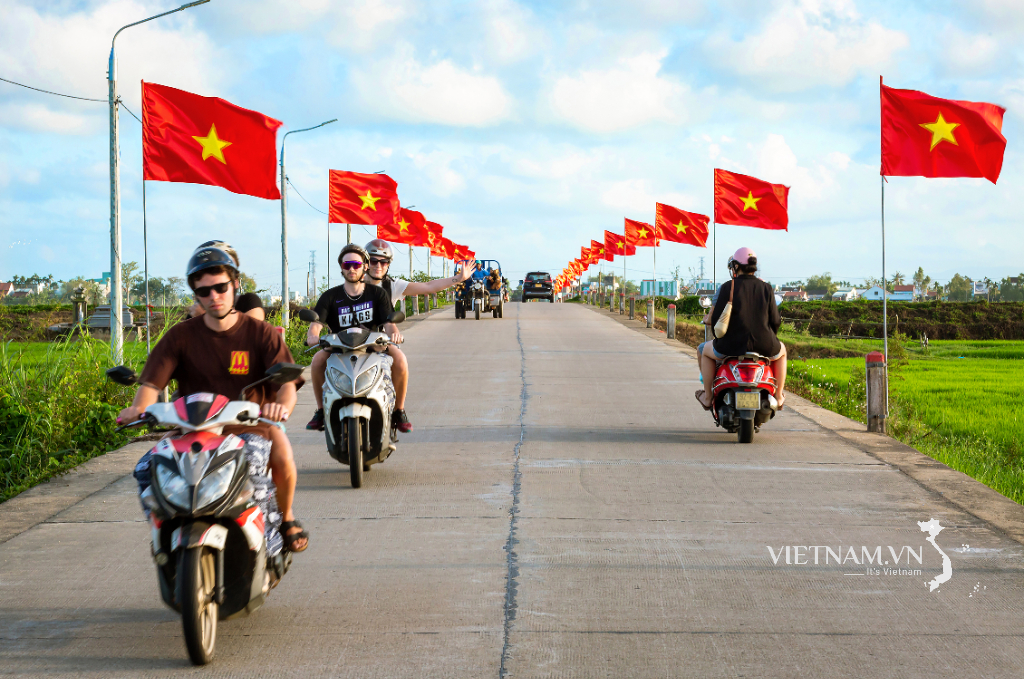
The appearance of Long Hung village is becoming increasingly more attractive - Photo: NB
Along National Highway 1, which runs through Hai Lang district, there are many prosperous rural areas, but perhaps Long Hung village leaves the strongest impression with its modern appearance, resembling a miniature "urban area".
Despite being a rural area, the infrastructure here has been developed comprehensively in a modern and spacious manner. Numerous flower-lined streets, model gardens, green spaces, and cultural facilities within the residential areas create a very livable environment. Alongside this are modern, imposing, and multi-story houses springing up close together.
According to Tran Kim Vinh, Party Secretary and Head of Long Hung village: “Currently, Long Hung village has 711 households with approximately 2,760 inhabitants. Although it is a rural area, the main source of income for the people is from business, trade, and services, with agriculture being only a secondary activity.”
Currently, the trade and service sector in Long Hung village accounts for approximately 67% of the economy. Over the past five years, the appearance of Long Hung village has changed rapidly, with a fairly quick rate of urbanization. Rural roads are now as wide as 6.5 meters in many places, cultural facilities have improved, and the living standards of the people have continuously increased. The average per capita income in 2023 was 77 million VND/person/year.”
In Long Hung, the cooperative economy is developing very strongly, mainly in services such as: contracting fish ponds for production and trading of fish fry to supply the market; renting kiosks and premises for business development; garbage collection; irrigation; production management, etc.
Among its notable initiatives is the property leasing service. Long Hung Cooperative has maintained lots of kiosks and production and business facilities for its member households to lease, creating jobs and increasing household income. Simultaneously, Long Hung Cooperative also organizes land leasing for rice paddies and other agricultural land, and leases out premises to further increase the cooperative's revenue.
Although agricultural production accounts for a much smaller proportion compared to trade and services, the people and members of Long Hung Cooperative still focus on cultivating two rice crops per year, with each crop covering approximately 108 hectares. The average yield reaches 50-52 quintals/hectare, resulting in a total production of 540-560 tons per crop. Farmers have introduced rice varieties such as ST25, Dai Thom 08, HN6, Khang Dan, and RVT, which produce high-quality rice that is well-received and in high demand in the market, bringing considerable economic benefits.
Besides rice production, the people of Long Hung also grow cassava and corn, and raise livestock and poultry to develop their economy.
In Long Hung, the aquaculture area is only 35 hectares, but the economic efficiency per unit area is very high. On average, the annual production of commercial fish is about 125 tons, and the market is supplied with 900,000 fingerlings and 2 million fry.
The local people have also boldly combined the farming of high-economic-value fish with the development of recreational fishing services. This combined model has brought relatively high and stable income to fish farmers, while also opening up new avenues for the people and related services.
Over the years, the people of Long Hung have boldly invested in planting K4 - Hai Phu oranges. Currently, the entire village has 14 households growing oranges on a large scale with a total area of 25 hectares, averaging an income of 250 - 300 million VND per hectare.
Simultaneously, the orange growing cooperative has applied VietGAP standards to cultivation to improve quality and expand the market. Taking advantage of the favorable soil conditions, the people of Long Hung have developed production forests covering up to 139 hectares. The planting of FSC-certified production forests and intensive forest management, linking production with the market, has brought significant income to the people, contributing to improved income and a higher quality of life.
In 2023, Long Hung Cooperative's total social income reached 205 billion VND, with an average per capita income of 77 million VND/person/year. Building on these successes, in 2024, Long Hung Cooperative has developed a business plan with the goal of achieving a total social income exceeding 210 billion VND and an average per capita income of 80 million VND/person/year.
To achieve these results, the Party branch, the village committee, and the Long Hung Cooperative intensified propaganda and mobilization efforts to encourage people and members to actively exploit the available potential in the locality to transform the economic structure, thereby improving production and business efficiency and contributing to the implementation of the national target program on building model new rural areas in the locality.
Commenting on the development of Long Hung village in recent years, Chairman of Hai Phu Commune People's Committee Nguyen Nhac said: “After many years of building new rural areas, Long Hung village has developed rapidly and comprehensively in many fields. As a village geographically adjacent to Quang Tri town, the urbanization rate in Long Hung is quite fast. In addition, trade and service industries in Long Hung are developing strongly, and the lives of the people are constantly improving. In the coming time, the locality will focus resources to support villages, including Long Hung village, to continue developing the economy, improving infrastructure, especially building model roads, model gardens, model hamlets, and other cultural institutions.”
Van Trang
Source


![[Photo] National Assembly Chairman Tran Thanh Man meets with General Secretary and President of Laos Thongloun Sisoulith](/_next/image?url=https%3A%2F%2Fvphoto.vietnam.vn%2Fthumb%2F1200x675%2Fvietnam%2Fresource%2FIMAGE%2F2026%2F01%2F26%2F1769424443676_ndo_br_bnd-2007-jpg.webp&w=3840&q=75)


![OCOP during Tet season: [Part 1] Ba Den custard apples in their 'golden season'](/_next/image?url=https%3A%2F%2Fvphoto.vietnam.vn%2Fthumb%2F402x226%2Fvietnam%2Fresource%2FIMAGE%2F2026%2F01%2F26%2F1769417540049_03-174213_554-154843.jpeg&w=3840&q=75)




Comment (0)