

The teacher in a military uniform.
As the first rays of the new day begin to fade, the special classroom in Ia Mơr commune, Chư Prông district, Gia Lai province, lights up. We call it a special classroom because the teachers are soldiers in green uniforms, and the students are of diverse ethnicities and ages. Due to the struggle for survival and for various other reasons, elderly people over 70 years old, as well as young men in their late teens and early twenties, come to class hoping to learn to read and write.
Having weathered many historical ups and downs, Ia Mơr commune has formed a residential area with 103 households and 561 people, belonging to 7 ethnic groups. Lieutenant Colonel Nguyen Van Thanh, Political Officer of the Ia Lốp Border Guard Post, said that in the area where the Border Guard Post is stationed, there is a residential area called Suoi Khon where 71 Jrai people are currently illiterate. After many attempts at persuasion, the people understood the hardship of not being able to read and write and therefore wished to be educated. Therefore, the Party Committee and the unit's command developed a plan, reported it to the Command Headquarters, and received approval to open this literacy class. The class consists of 15 students, attending 3 sessions per week, studying 2 subjects: Mathematics and Vietnamese.
Teaching literacy classes are soldiers in green uniforms: Lieutenant Colonel Vu Van Hoang, a professional soldier, teaches Mathematics, and Captain Nguyen Van Luan, the team leader of the community mobilization team, teaches Vietnamese. Captain Nguyen Van Luan said that in this border region, the weather conditions are harsh, the land is barren, and the people's lives are still difficult, so the people are not very enthusiastic about learning. Thanks to the border guards going door-to-door to spread the word, the people clearly saw the importance of education and enthusiastically responded to attend the classes.
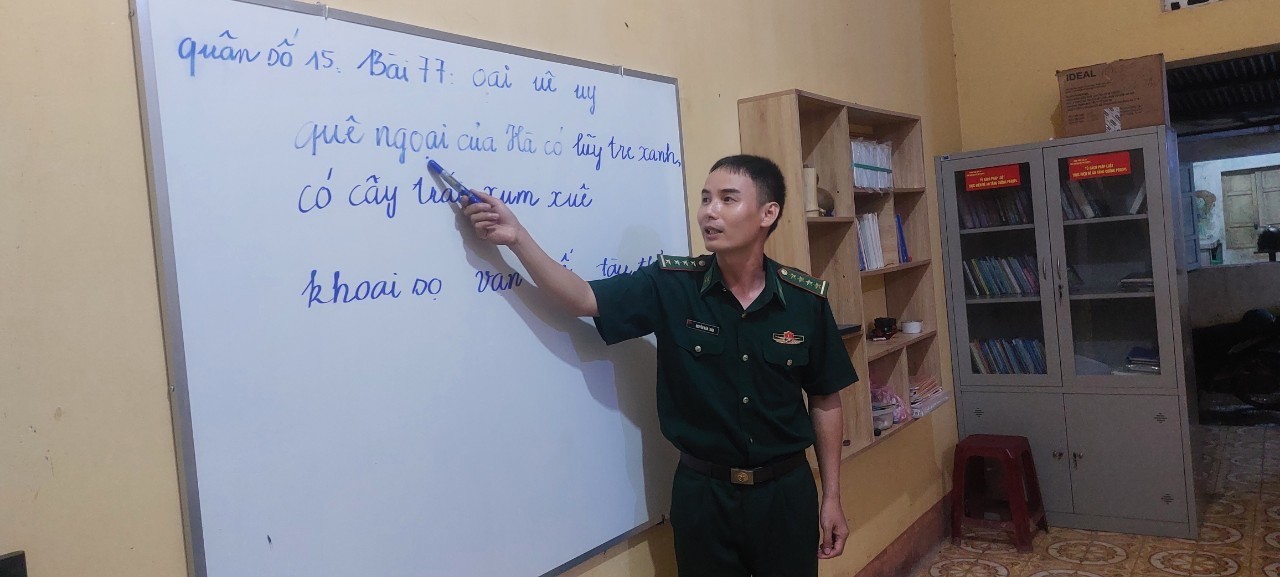
Captain Nguyen Van Luan hopes that the local people will learn to read and write so that their lives will be less difficult.
Lieutenant Colonel Vu Van Hoang shared his concerns with us: “Opening the class was difficult, but maintaining and developing it in the long term is even more challenging. During the harvest season, people are busy with farming, so to ensure a consistent class size, our officers stationed in the area have to go to people's homes to bring them to class. The age range of participants is diverse, with the oldest being nearly 50 years old and the youngest 15, so the teaching methods are also different. In school, we might scold them, but not in this class. We have to be patient, encouraging, talking while teaching, understanding their psychology, and avoiding anger. Only with sincerity will the people be willing to learn.”
Returning from the fields, Mr. Kpah Choan, born in 1962, quickly washed up and then took his son, Kpah Vot, born in 2004, to school. Mr. Choan confided: “I have eight children, Vot is the youngest. He didn't want to go to school when he was young, so I felt very sorry for him. Now, the Border Guard has opened a class, and it took a lot of encouragement for him to finally agree to go. It's strange, he only goes to class if his father takes him; otherwise, he stays home. Therefore, I have to take him to school on schedule, no matter how busy I am, I have to let him learn to read and write so he won't be at a disadvantage later.”
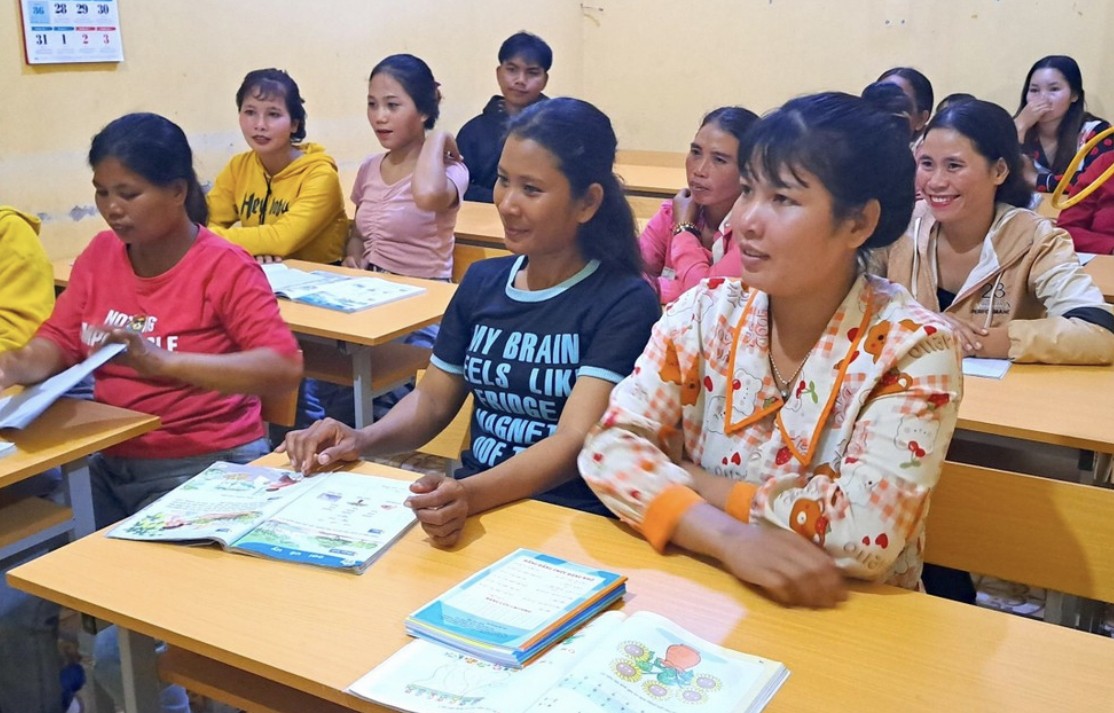
Since the literacy classes opened, many people have learned to read and write.
Special Class
At the end of the Vietnamese lesson, Kpah Vớt's face lit up: "I know how to read and write now, so I won't be afraid of being ridiculed by friends wherever I go. Sometimes, when there's a party in the village, I feel sad watching my friends sing karaoke because I can't read. Now that I know how to read and do math, I'll try to read books and newspapers to learn about how to make a living, hoping to have a more prosperous life."
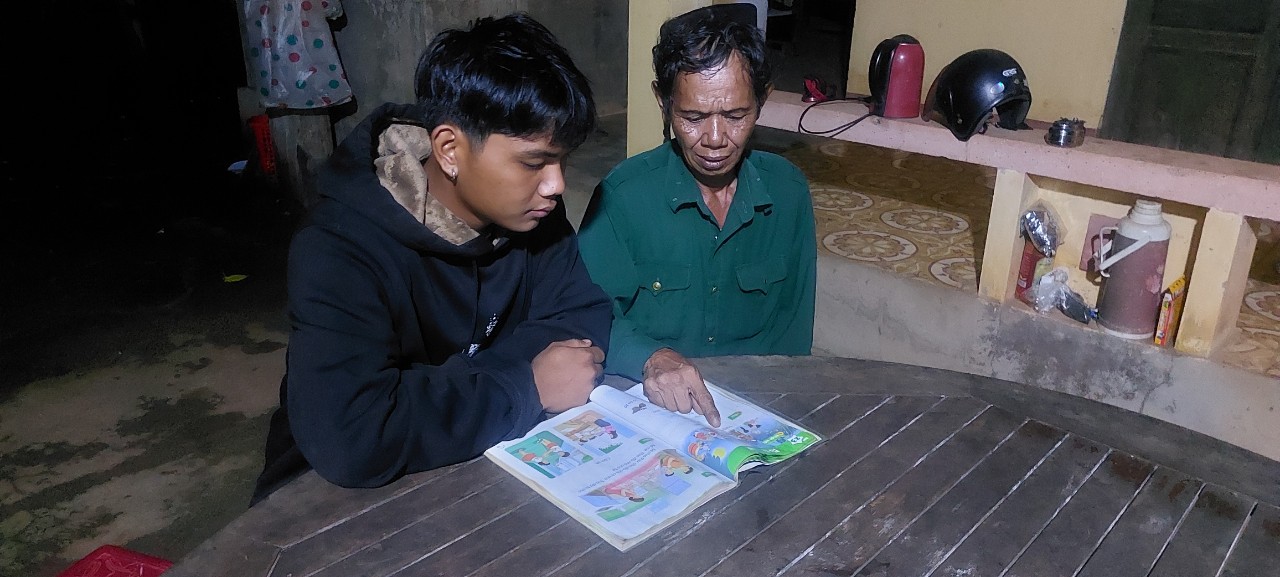
Kpah Vớt proudly showed her father that she had learned to read and write.
Siu Nghinh, born in 2003, excitedly said: “Before, I was illiterate, so every time I bought or sold something, I used my fingerprint, which sometimes led to people cheating me. My family has four siblings, and they are all literate, but I was too lazy to learn, so I dropped out early. I want to learn to read and write, firstly so I won't be cheated, and secondly so I can teach my children. Before, I was worried about the money for school, books, notebooks, and pens. But here, the teachers provide all the necessary school supplies and books, and sometimes when I don't have transportation, the teachers come to pick me up, which makes me very happy. Studying here is very enjoyable because the teachers care about us; if we don't understand something, we can ask them, and they explain it to us patiently, so we are very happy.”
Sitting in the classroom, Siu H' Nghen shared, while reading aloud to her child and pointing out each picture, teaching her Vietnamese: “My child is only four years old. When the Border Guard encouraged us to send our child to school, my husband initially didn't want to go because he had to stay home to look after the child. But I told him I would take our child to school with us, and he agreed. At school, my child learns both reading and math, and the border guards give her candy and snacks. Sometimes, when my child cries during class, the border guards comfort her, so I'm very happy.”
The wall clock chimed, signaling the end of the lesson, and the warm farewells between soldiers and civilians filled the air. Captain Nguyen Van Luan further shared: “In a residential area with over 70 illiterate people, their lives are still very disadvantaged. Therefore, we are willing to do whatever we can for them, even though the unit's budget is limited, we will open more classes. Eradicating illiteracy is necessary, but preventing relapse is the most difficult challenge that we need to focus on maintaining.”
Bidding farewell to the teachers in military uniforms, we left in the pouring rain. The border region is harsh, with howling winds and muddy roads. We wish the teachers in military uniforms strength and resilience, and we wish their classes much success.
Source
































































Comment (0)