The group of students fromFPT University started the project with the desire to combine traditional Vietnamese pottery with regional cultural identities.
According to Bui Thao Nguyen, a member of the design team. Furthermore, ceramic vases on the market often feature familiar motifs such as flowers, leaves, dragons, and phoenixes. These are all beautiful motifs that have their own place in the market, but this very popularity also made it difficult for the group to come up with ideas, so they diverged in a different direction.
Instead of mere decoration, they wanted to create products with a clear story, so that viewers could immediately recognize a slice of Vietnamese culture, history, and people. Therefore, the group chose landmarks to create the designs for their first collection. For them, landmarks have a much stronger recognizable power than conventional patterns. Just seeing the image of a familiar building can evoke associations with a region, a historical depth, or even a part of collective memory.
In the ongoing collection, the North is opened with the image of the One Pillar Pagoda. The next stages will feature the Hue Imperial Palace for the Central region and the Independence Palace for the South. These three images, standing side by side, not only represent the three regions but also evoke a spirit of unity and solidarity.
The message the group wants to convey is quite clear: Preserving Vietnamese culture in contemporary living spaces. Therefore, ceramic vases are not just objects for holding flowers or decorating interiors. They are also expected to become objects carrying cultural stories, helping familiar Vietnamese values become more accessible in everyday life. The group hopes that when viewers see these vases, they will feel proud, recognize famous landmarks, and see that traditional culture is not distant or outdated, but can integrate into today's life in a new form.
However, to achieve the desired product, the team had to go through a considerable preparation period. The brainstorming and design sketching alone took about 3-4 months. The members had to refine ideas, research the story, choose locations, find characteristic images, and then try many different hand-drawn sketches to see which one best suited the vase's shape. On paper, everything might seem quite clear, but transferring that image onto the curved surface of a ceramic vase is a different story. It is at this transition from drawing to the actual product that the difficulties become most apparent.
"Because we are students and lack experience, we couldn't anticipate many aspects of the initial production process. The difference between a flat design and a three-dimensional surface made image layout much more complex than we imagined," Thao Nguyen said.

|
The group's ceramic vases have attracted much attention and affection from young people. (Photo provided by the subject) |
There were nights when the members had to sit and revise every detail, considering whether the placement truly suited the location, which parts needed emphasis, and which parts needed to be toned down so that the overall design of the vase wouldn't look cluttered.
The main material of the product is clay. The drawings on the vase are mainly done with acrylic paint, then sprayed with a topcoat to finish the surface. But the important thing is not just the material, but also the skill of the craftsman. Because it was their first time working on a ceramic product depicting a landmark, the group sought out artisans from Bat Trang pottery village to learn and collaborate. These experienced craftsmen, based on the group's design, transformed it into detailed drawings on the vase's body. The combination of youthful ideas and skilled craftsmanship became one of the key elements in bringing the product from concept to reality.
The biggest challenge for the team lay not only in the design or technical aspects, but also in finding a suitable production workshop. The deadline for completing the product coincided with the upcoming Lunar New Year in 2026, a time when many workshops were busy with their own orders. It wasn't until after the holiday that the team found a suitable partner. The first batch turned out quite well, largely thanks to the assistance of skilled ceramic artists. Each vase takes approximately 5-10 days to complete, depending on the complexity of the design.
This process is not just about creating a product, but also about learning. They learn about pottery making, the production process, and the difference between an idea conceived in class and a finished product in real life. This project demonstrates a remarkable approach by young people to traditional culture. Instead of simply talking about preservation as a slogan, the students chose to engage in concrete creativity. They didn't simply copy old patterns, but sought to connect tradition with the modern market, with the aesthetic and practical needs of contemporary life.
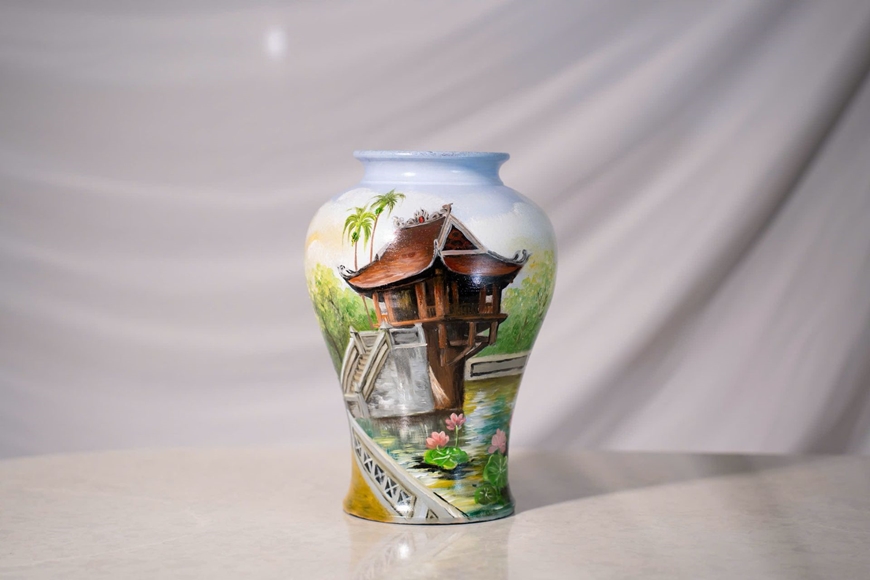
|
The ceramic vase is painted with an image of the One Pillar Pagoda. Photo provided by the subject. |
It is in this spirit that the ceramic vase depicting the landmarks of the three regions of Vietnam is not merely a design product. It also suggests a direction: Vietnamese culture can be retold in new forms, provided the creator has sufficient respect and perseverance.
From the One Pillar Pagoda of today, then the Hue Imperial Palace and the Independence Palace of tomorrow, the group plans to continue expanding to other provinces, cities, and famous landmarks. Further afield, they also want to incorporate technology into the product experience, such as trying out products via the website using AR technology.
But even now, perhaps the most noteworthy aspect is the beginning: from ceramic vases, from hand-painted designs, from a still-developing idea by students, a story about Vietnam has been inscribed onto the ceramic surface, so that someone can hold a vase in their hands and feel as if they are touching a part of their homeland's identity.
Source: https://www.qdnd.vn/van-hoa/doi-song/gom-ke-chuyen-ba-mien-1032414



![[Photo] General Secretary and President To Lam presides over a meeting on assessing national development resources.](https://vphoto.vietnam.vn/thumb/1200x675/vietnam/resource/IMAGE/2026/05/20/1779253785852_a1-bnd-2943-8519-jpg.webp)
![[Photo] National Assembly Chairman Tran Thanh Man working with the Standing Committee of the Economic and Financial Committee](https://vphoto.vietnam.vn/thumb/1200x675/vietnam/resource/IMAGE/2026/05/20/1779249584387_ndo_br_1-jpg.webp)






























![[Workers' Month 2026] Spreading love on the Vinh - Dong Hoi frontline: Nearly 1 billion VND spent on caring for the lives of workers.](https://vphoto.vietnam.vn/thumb/402x226/vietnam/resource/IMAGE/2026/05/20/1779237885217_img_8650.jpeg)






















Comment (0)