|
| Back in the village, children have more opportunities to connect with people. |
Weekend in the countryside
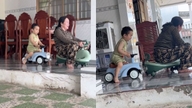
On a weekend morning, as Mr. Nguyen Viet Thang's motorbike stopped in front of his house in Vinh Loc commune, his two sons, Bao Quoc and Bao Nguyen, quickly jumped off and ran towards the fields ahead. For the two boys, aged 5 and 7, this was the most anticipated trip of the week. Within minutes, the two brothers had joined the other children in the neighborhood. The grassy roadside, the front yard, or the lush green fields all became attractive playgrounds. Simple games like playing soccer, catching grasshoppers, watching dragonflies, or flying kites made the morning in the countryside lively and vibrant.
Hearing her grandson's voice from the gate, the two brothers' grandmother hurried out to greet them. The house, usually quiet, suddenly became lively with the children's laughter and chatter. "I love coming back to the countryside. There are so many friends to play with here, and fields to run around in. What I like most is catching grasshoppers and flying kites in the afternoons," Bao Nguyen excitedly recounted.
Sitting on the porch watching his children play, Mr. Thang said that for many years his family has maintained the habit of bringing their children back to their hometown on weekends or holidays. "In the city, the children mainly go to school and then come home. There aren't as many spaces for them to play as in the countryside. I want them to have the opportunity to exercise, explore nature, and learn more about everyday life," Mr. Thang shared.
For him, trips back to his hometown are not simply pleasure trips. They are also opportunities for his children to bond with their grandparents and relatives, to better understand the place where their parents grew up, and to relive childhood memories amidst the fields, orchards, and village roads.

Lessons beyond textbooks
The childhood environment for children today is vastly different from the past. With urbanization, open spaces, lawns, and natural playgrounds are shrinking. Meanwhile, smartphones, tablets, and online games are becoming increasingly prevalent in children's lives.
Many parents admit they struggle to balance their children's screen time. After school, many children choose to stay indoors rather than participate in outdoor activities. This worries parents as their children become less active, have less direct interaction, and lack opportunities for real-world experiences.
According to education experts, exposure to nature and participation in daily life activities are crucial for children's development. These experiences not only enhance physical health but also contribute to the development of observation skills, communication skills, independence, and a connection with their surroundings.
For many families, the countryside becomes a suitable option for children to have such experiences. Spending time with grandparents watering plants, picking vegetables, feeding chickens, or simply playing with friends in the neighborhood all offer new experiences that children don't always have the opportunity to encounter in urban environments.
What's valuable is that these experiences come naturally. Children don't learn through books or electronic screens, but through observation, through stories from adults, and through their own direct participation. From this, they gain a better understanding of life, learn to appreciate hard work, and develop a love for nature and family.
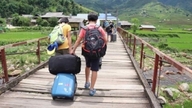


A few days in the countryside may not offer exciting activities or modern amusement parks, but it provides children with peaceful and memorable times. Laughter in the fields, kites soaring in the summer afternoon, or meals shared with grandparents are simple things that leave a lasting impression on their memories.
Source: https://huengaynay.vn/doi-song/lop-hoc-mua-he-166750.html
![[Photo] Opening Ceremony of the 13th National Congress of the Ho Chi Minh Communist Youth Union](https://vphoto.vietnam.vn/thumb/1200x675/vietnam/resource/IMAGE/2026/06/24/1782286753905_ndo_br_1-8510-jpg.webp)
![[Photo] General Secretary and President To Lam attends the Central Public Security Party Committee Conference](https://vphoto.vietnam.vn/thumb/1200x675/vietnam/resource/IMAGE/2026/06/24/1782302063612_a1-bnd-9302-9166-jpg.webp)
![[Photo] The 13th National Congress of the Youth Union conducts personnel work.](https://vphoto.vietnam.vn/thumb/1200x675/vietnam/resource/IMAGE/2026/06/24/1782299943080_ndo_br_1-6868-jpg.webp)