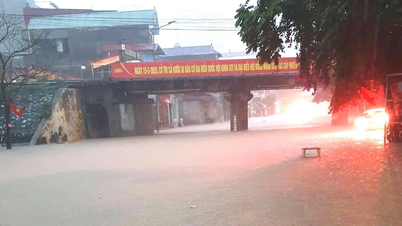
Rising floodwaters paralyze traffic.
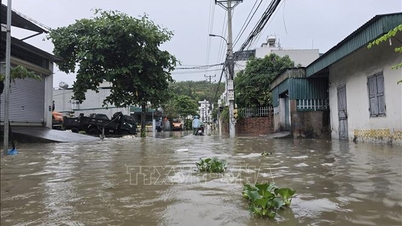
From the night of November 19th to the afternoon of November 20th, many areas of Khanh Hoa province continued to be severely affected by heavy rain and flooding. Throughout the province, 162 locations across 54 communes and wards were flooded. Many families in the West Nha Trang, South Nha Trang, Dien Khanh, Dien An, and Dien Dien areas experienced flooding up to their rooftops. Many residents had to climb onto attics or rooftops to await rescue; some even had to break through their roofs to escape.

The Vinh Diem Trung urban area (Tay Nha Trang ward, Khanh Hoa province) is submerged in water. Photo: TIEN THANG
In Tay Khanh Vinh commune, more than 1,000 people are temporarily sheltering in a church but lack food, forcing many to climb mountains to escape the floodwaters at night. By the evening of November 20th, floodwaters had risen in most key wards and communes in the western and southern parts of Khanh Hoa province, paralyzing urban traffic. The Command of Naval Region 4 deployed nearly 400 officers and soldiers along with 21 vehicles of various types, coordinating with thousands of local forces to participate in rescue and assistance efforts for flood-affected people in Khanh Hoa.
Khanh Hoa Provincial Party Secretary Nghiem Xuan Thanh requested the mobilization of maximum resources and personnel for rescue efforts, ensuring the safety of the people. Rescue forces have been deployed directly to the scene, focusing on evacuating residents, combating hunger and cold, and protecting vulnerable groups.

Police forces are reaching deeply flooded residential areas downstream of the Ha Thanh River ( Gia Lai province) to rescue elderly people and women who have been trapped in the flood for two days. Photo: Xuan Huyen
In Lam Dong province , on the afternoon of November 20th, Colonel Le Xuan Binh, Deputy Commander and Chief of Staff of Military Region 7, stated that 100 officers and 20 lifeboats were deployed that same evening to support emergency rescue efforts across various areas. Military Region 7 also mobilized nearly 1,000 officers and soldiers ready to depart to assist in rescue operations and disaster relief in Lam Dong province.
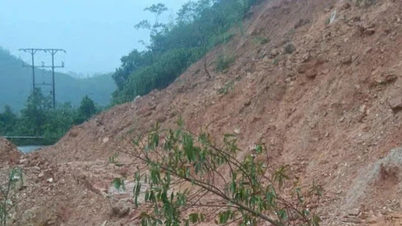
Early that morning, a serious landslide occurred on Mimosa Pass, spanning approximately 70 meters in length and 40 meters in depth, completely cutting off National Highway 20 in the Xuan Huong ward of Da Lat. As of the afternoon of November 20th, four out of six mountain pass routes leading to Da Lat had been completely blocked by landslides. The Lam Dong Provincial Department of Construction has banned all trucks weighing over 3.5 tons from traveling through the remaining two passes, Ta Nung and Sacom, to ensure safety.
By the afternoon of November 20th, many communes and wards in the eastern part of Dak Lak province were still deeply submerged, and thousands of police and military personnel were deployed to provide assistance. Authorities are making strenuous efforts to search for and rescue victims in dangerous areas. Colonel Nie Ta, Commander of the Dak Lak Provincial Military Command, stated that canoes have been deployed to heavily flooded areas in Song Cau ward to provide rescue and food supplies to isolated residents. The military has also provided 1 ton of dried food to residents in Tuy An Dong, Tuy An Tay, and Dong Xuan communes.
Later that afternoon, numerous high-powered boats carrying essential supplies and hundreds of police officers from Dak Lak province fanned out in multiple directions to conduct rescue operations in the areas of Hoa Thinh and Hoa My communes.
Providing relief and support to people in severely flooded areas.
On November 20th, according to observations by reporters from SGGP newspaper, rainfall in the eastern part of Gia Lai province has decreased, and floodwaters are receding slowly. Taking advantage of this time, thousands of soldiers, police officers, and local forces are deploying supplies of food and water to the people. In heavily flooded areas such as Quy Nhon Dong, Quy Nhon Bac, and Tuy Phuoc, functional forces are using canoes, boats, and fisheries patrol vessels to reach deeply flooded areas to provide relief. Along Hung Vuong Street, the new National Highway 19, and National Highway 1D, many relief convoys are continuously arriving to assist people in clearing flood debris.

Soldiers deliver blankets and clothing to flood victims in Quy Nhon Bac ward (Gia Lai province). Photo: NGOC OAI
In the western communes and wards of Gia Lai province, such as Ia Hiao, Sró, Ia Pa, Pờ Tó, Ayun Pa, An Khê, Uar, Phú Túc, and Ia Rsai, floodwaters have receded, and many houses are no longer submerged. However, many areas remain isolated due to flooded or damaged roads leading to villages and hamlets. As of the afternoon of November 20th, in Ia Pa commune, most residential areas had been drained, leaving behind mud, debris, and many collapsed fences; belongings were scattered everywhere. Some schools were still flooded. Local authorities mobilized police, commune militia, and local security forces to assist in clearing mud and debris in areas where the water had receded.
In Ia Hiao commune, floodwaters have receded in the villages and hamlets, and 700 houses that were previously flooded are now dry. Residents are cleaning up their homes and bringing livestock back to their shelters. Mr. Pham Van Phuong, Secretary of the Party Committee of Ia Hiao commune, said that the local authorities have organized the cleaning of schools so that students can return, and have sprayed disinfectant in previously flooded areas to prevent disease outbreaks.
Mobilize all resources to evacuate people to safe areas.
On the evening of November 20th, in Khanh Hoa province, Deputy Prime Minister Ho Quoc Dung chaired a meeting, both in person and online, with the provinces of Khanh Hoa, Gia Lai, Dak Lak, and Lam Dong, to direct efforts to mitigate the consequences of the ongoing and complex flooding in these localities.
Deputy Prime Minister Ho Quoc Dung urged police, military, and local authorities in the affected provinces to quickly access deeply flooded and isolated areas to rescue people and prevent them from remaining in critical situations. He requested that provinces, especially Dak Lak and Khanh Hoa, mobilize all resources to evacuate people to safe areas. He also requested that police and military personnel be prepared to use their headquarters as temporary shelters, organize cooking, and provide drinking water and dry food for households, especially in isolated areas, to prevent hunger and thirst. The Ministry of National Defense and the Ministry of Public Security were instructed to maintain forces and deploy the nearest available equipment to support the affected localities; the Ministry of Information and Communications was urged to quickly restore communication and ensure uninterrupted information flow. The Ministry of Construction was instructed to quickly coordinate with Lam Dong province to address the affected transportation routes.
In the communes of Pờ Tó and Ia Rsai, receding floodwaters have freed over 880 households with 4,250 people from isolation. However, Mơ Nang 2 village (Ia Pa commune) with 341 households remains cut off. In Buôn Nu (Uar commune), hundreds of residents are still taking refuge in schools because their homes are still flooded.
In Luat Le village (Tuy Phuoc commune), the epicenter of the flooding, heavy rain and the strong rise of the Con River caused a section of the dike to collapse, creating immense water pressure and submerging many residential areas. Ms. Vo Thi Luoi (Luat Le village) recounted: “The flood rose so quickly, submerging all our possessions. More than 100 pigs, both fattening and breeding, were swept away; our herd of 6 cows was also lost to the flood. My husband and I could only wait for the rescue forces to arrive. Thanks to the soldiers, the villagers were safely evacuated; otherwise, we don't know what would have happened.”
Colonel Nguyen Xuan Son, Deputy Political Commissar of the Gia Lai Provincial Military Command, said: “Heavy rain and strong currents have made evacuation very difficult; soldiers have to use ropes to secure life rafts to reach people. Currently, forces from Military Region 5 and Corps 34 are continuing to survey deeply flooded areas, prioritizing assistance to the elderly, children, women, and providing essential supplies. In Luat Le alone, 150 officers and soldiers are stationed at checkpoints to provide relief and mitigate damage when the floodwaters recede.”

Rescue workers evacuate a mother and her newborn baby from the floodwaters in western Nha Trang, Khanh Hoa province. Photo: Hieu Giang
In Quy Nhon Bac ward, Mr. Nguyen Thai Dien, Chairman of the Ward People's Committee, said that four neighborhoods (1, 2, 3, and 4) are still deeply flooded, with water levels reaching 2-3 meters. The full extent of the damage cannot yet be assessed; preliminary statistics show significant property damage; casualties are awaiting compilation and reporting. “The water is receding gradually, and the police, military, and local forces are making efforts to reach deeply flooded areas to assist residents. Military Region 5, along with other forces, is deploying personnel, equipment, and food supplies to people in heavily flooded areas,” Mr. Dien informed.
According to Mr. Nguyen Tuan Thanh, Vice Chairman of the Gia Lai Provincial People's Committee, the recent floods resulted in 3 deaths, 19,200 households (71,086 people) being flooded and isolated, including 7,500 households with water levels reaching 2-3 meters; estimated damages exceeded 1 trillion VND. The province mobilized 20,000 officials, soldiers, and local forces to participate in rescue and recovery efforts. Immediately after the floods, the province provided emergency assistance to approximately 5,000 poor, near-poor, and particularly disadvantaged households, with each household receiving 2 million VND for 3 months (a total of 6 million VND per household). The province requested the central government to provide 2,000 tons of rice and 60 million VND in support for each household whose house collapsed; households with damaged houses will also benefit from provincial policies…
According to the Department of Dike Management and Disaster Prevention (Ministry of Agriculture and Environment), as of late afternoon on November 20th, the natural disaster in Central Vietnam had caused 41 deaths (2 in Hue, 2 in Da Nang, 3 in Gia Lai, 16 in Dak Lak, 14 in Khanh Hoa, and 4 in Lam Dong) and 9 people were missing. By the afternoon of November 20th, 52,056 houses were still flooded (mostly in Dak Lak and Gia Lai). Local authorities from Quang Tri to Lam Dong evacuated 18,837 households with 61,793 people. Reports indicated that 1,010,720 customers were without electricity; by the afternoon of November 20th, power had been restored to 614,580 customers, while 396,140 customers remained without electricity in Gia Lai, Khanh Hoa, Dak Lak, and Da Nang.
The Ministry of National Defence directed and deployed 18,066 personnel and 441 vehicles to assist the people in responding to and overcoming the consequences of floods and landslides; it also deployed 4 helicopters ready to take off along with 2 tons of food and other necessities to support people in areas isolated by floods. The Ministry of Public Security directed police forces in provinces and cities to mobilize 41,767 officers and soldiers and 3,207 vehicles to respond to floods and mitigate their consequences.
REPORTER TEAM
Source: https://www.sggp.org.vn/luc-luong-vu-trang-cung-dan-chong-lu-post824594.html

































































































Comment (0)