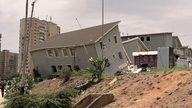
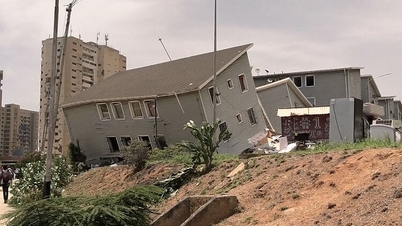
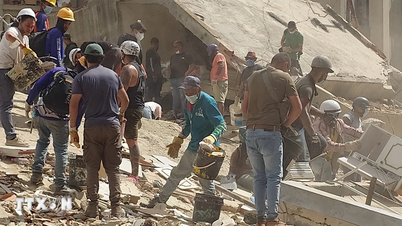
The earthquake caused many buildings to collapse in Venezuela (Photo: AFP).
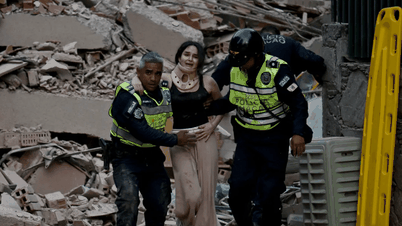
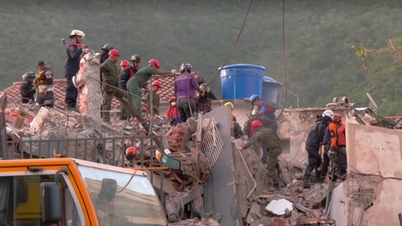
Venezuelan authorities said on June 26 that the June 24 earthquake had killed more than 900 people, injured over 3,000, and left around 50,000 possibly still missing. Experts warned that the death toll would rise as rescue teams continued searching through the rubble.
Based on these initial statistics, the double earthquake in Venezuela on the afternoon of June 24th is likely to go down in the country's modern history as one of the most devastating and deadly natural disasters.
The U.S. Geological Survey (USGS) reported that Venezuela was shaken by a "double earthquake" with magnitudes of 7.2 and 7.5, occurring close together in both time and location.
Double earthquakes are different from aftershocks. The first earthquake relieves stress on one fault but increases stress on an adjacent fault. When the second fault is in a near-fracture state, the increased stress and tremors from the first earthquake trigger another large fault.
Venezuela lies along the Caribbean tectonic plate. The country is not part of the "Ring of Fire," a belt that winds around the Pacific Ocean, where earthquakes, especially high-intensity ones, are relatively common.
That's why an earthquake of this magnitude causes more damage in a place like Venezuela than in Japan , because Japan is much better prepared for these kinds of events due to its inherent risks along the Ring of Fire.
Nevertheless, major earthquakes still occur along the southern side of the Caribbean Plate. There have been five earthquakes above magnitude 7 in this region in the last 100 years.
In September 2025, a double earthquake with a magnitude of 6.2-6.3 struck northern Venezuela, killing at least one person and injuring more than 100.

Although a 6.3 magnitude earthquake is significant, it rarely causes widespread and serious damage.
Meanwhile, a magnitude 7.5 earthquake is exponentially more powerful, causing catastrophic damage to poorly constructed or unreinforced buildings.
Based on intensity and energy release, this year's event is at least 63 times more powerful than last year's.
According to the USGS assessment of the earthquake-affected area in northern Venezuela, "in general, people in the area live in structures vulnerable to seismic vibrations, although some more resilient structures remain. The predominant vulnerable building types are unreinforced brick structures and interlocking clay brick structures."
In 2018, a magnitude 7.3 earthquake struck offshore, far north of a sparsely populated area in northwestern Venezuela (outside the Caracas region). The event resulted in moderate damage and some fatalities.
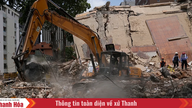
Buildings were "crushed" in the century's earthquake in Venezuela ( Video : Venezuela VTV)
Meanwhile, the earthquake earlier this week struck inland in densely populated areas of Venezuela, lasting longer than a typical single earthquake, and therefore was far more destructive than any other natural disaster in the past century.
The USGS estimates that the death toll is likely to exceed 1,000 and has the potential to surpass 10,000.
The area most severely affected is the capital Caracas and its surrounding regions.



Vashan Wright, a geophysicist at the University of California, San Diego, explains that the capital city of Caracas is situated in a deep sedimentary basin, which amplifies seismic waves from earthquakes.
Another reason Caracas is so vulnerable to earthquakes is that its buildings and infrastructure are not specifically designed to withstand tremors and are often built on unstable ground.
"Furthermore, there are many makeshift houses and slums in many areas across the country, and these types of structures are not prepared to withstand very strong earthquakes," the Al Jazeera reporter said.
Urban planning and appropriate building regulations, taking into account seismic activity, require significant funding.
Source: https://dantri.com.vn/the-gioi/ly-do-dong-dat-o-venezuela-co-suc-tan-pha-lon-20260627085110629.htm
![[Photo] "Hanoi Lotus Festival" honors the lotus flower that has been associated with Vietnam for thousands of years.](https://vphoto.vietnam.vn/thumb/1200x675/vietnam/resource/IMAGE/2026/06/27/1782516943048_sen-ha-noi-2026-minh-duy-1-jpg.webp)




















































![[Infographic] 16 fireworks display locations to celebrate the 50th anniversary of Ho Chi Minh City being honored with the name of President Ho Chi Minh](https://vphoto.vietnam.vn/thumb/402x226/vietnam/resource/IMAGE/2026/06/27/1782539591308_man-ban-phao-hoa-ruc-ro-dem-khai-mac-638jpg-17242995540161175940469.jpeg)