Besides helping Iran maintain its deterrence capabilities, its missile forces also play a crucial role in limiting the risk of escalation from adversaries.

Iran's Kheibar missile system. (Source: TIRNA)
Currently, Iran possesses one of the most diverse and modern missile arsenals in the region, including multiple-warhead missiles, missiles with maneuverable re-entry vehicles, and even hypersonic glide vehicles. Many other components of the Iranian military, such as its armored forces, artillery, combat air force, and surface navy, are still considered significantly more outdated.
A noteworthy perspective on this strategy was shared by General Amir Ali Hajizadeh, Commander of the Air Force of Iran's Islamic Revolutionary Guard Corps (IRGC), in a recently widely circulated interview. General Hajizadeh was killed in clashes with Israeli forces on June 13, 2025.
He stated that the foundation of Iran's missile program was laid in the 1980s, following the Iran-Iraq War. "After the war, Supreme Leader Ali Khamenei emphasized the need for self-reliance, self-sufficiency, and the localization of defense capabilities. But it's not just about producing weapons domestically, but also about choosing the right weapons to invest in and develop. For decades, especially since around 1984, missiles have consistently been a top priority," Hajizadeh explained.
During the Iran-Iraq war, Tehran began purchasing Hwasong-5 and Hwasong-6 ballistic missiles from North Korea. Subsequently, the two countries continued to cooperate closely in the missile sector. Iran not only imported complete missiles but also manufactured them under license, receiving technology, components, and various system parts from Pyongyang.
According to sources, thousands of North Korean missile experts have worked in Iran for years to support missile development programs, as well as participate in building fortified underground facilities for missiles and nuclear weapons. These constructions are seen as crucial to Iran's ability to maintain its deterrence capabilities against efforts by the US and its allies to neutralize its arsenal.
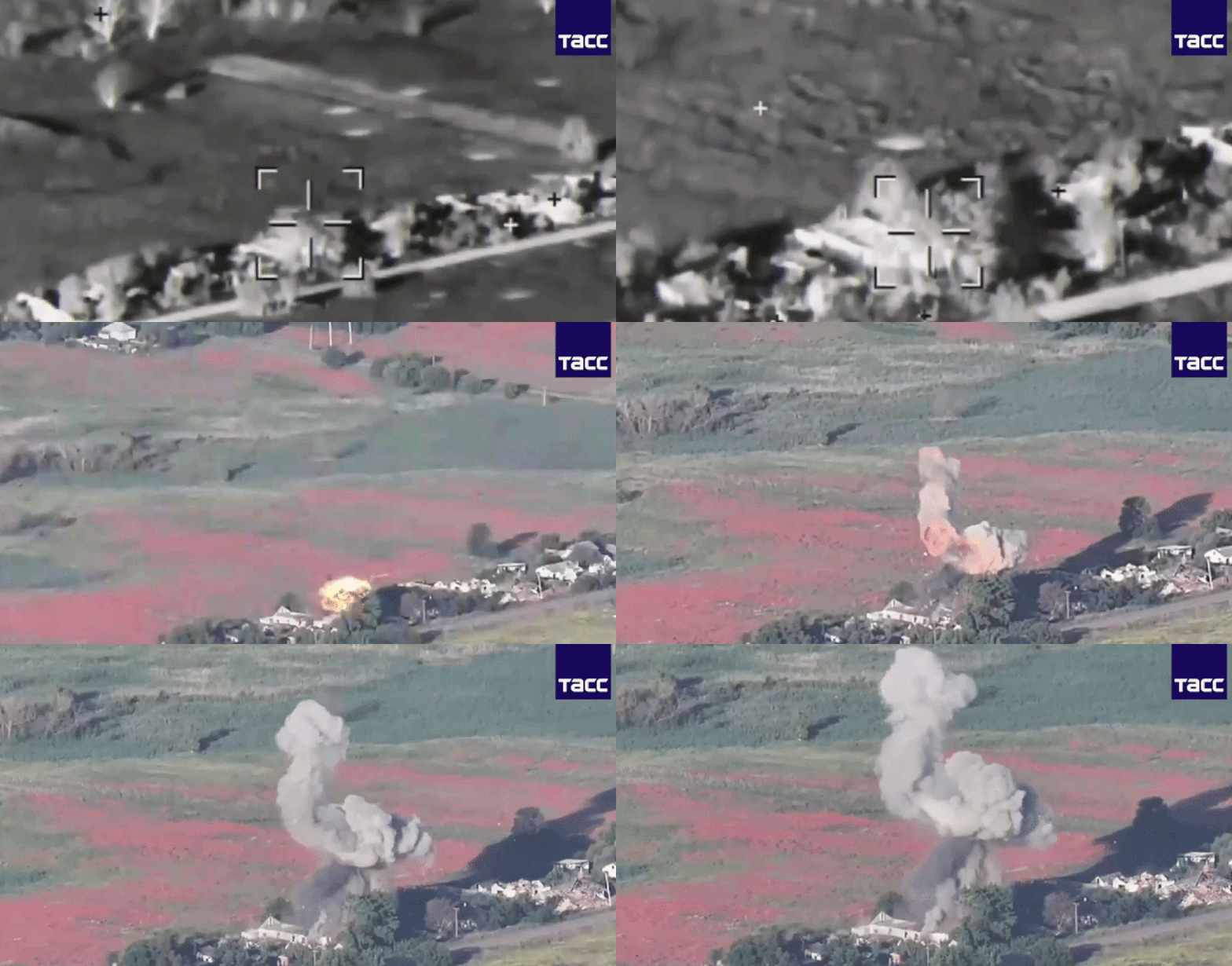
According to Mr. Hajizadeh, focusing on developing ballistic missiles yields far greater national security benefits than investing in fighter jets.
He argued that if Iran followed the path chosen by most military powers, which is to focus on developing modern fighter jets, it would always be in a backward position.
"If we follow the same aircraft development path as other countries, where they already possess fifth-generation fighter jets, we might still be struggling with third-generation aircraft. This means we will always be decades behind them and will never catch up," he said.
Instead of pursuing a arms race that Tehran is unlikely to win, Iran has chosen to develop weapons that can directly counter the threats it faces.
"We chose a different path, one that allows us to confront the enemy directly with capabilities that are appropriate to the real threats," the Iranian general emphasized.
This assessment partly reflects the reality that only the US, China, and Russia currently possess the capability to develop fifth-generation fighter jets. Among them, the US F-35, along with the Chinese J-20 and J-35, are considered the leading designs today.
Given its significantly smaller economy , lower technological level, and inferior industrial capabilities, Iran is almost incapable of developing a fighter jet capable of competing with the world's most advanced aircraft, even with Russia's Su-57.
Tehran's strategy is therefore seen as a form of asymmetrical military investment, focusing on areas that can generate the greatest deterrent effect at a lower cost.



This approach is not unique. After the Cold War, many countries considered potential targets of military campaigns led by the US and the West also chose a similar path.
North Korea and Syria, unable to access modern Russian fighter jets after the collapse of the Soviet Union, shifted their focus to developing missile forces and other strategic deterrent weapons. Russia also prioritized maintaining its nuclear power and tactical missile forces, despite being constrained by the Intermediate-Range Nuclear Forces (INF) Treaty for many years.
The US-led attacks on Iran in June 2025 and the subsequent conflict from February 2026 are seen as the first large-scale real-world test of the asymmetrical missile defense model that Tehran has pursued for decades.
Source: https://suckhoedoisong.vn/ly-do-iran-phat-trien-ten-lua-thay-vi-may-bay-chien-dau-169260612101323731.htm








































































![[Infographic] Details of 6 toll stations on the North-South Expressway through Ha Tinh](https://vphoto.vietnam.vn/thumb/402x226/vietnam/resource/IMAGE/2026/06/29/1782685020813_fb_anh-dai-dien-infographic-khanh-phuong-1-png.webp)