

 |
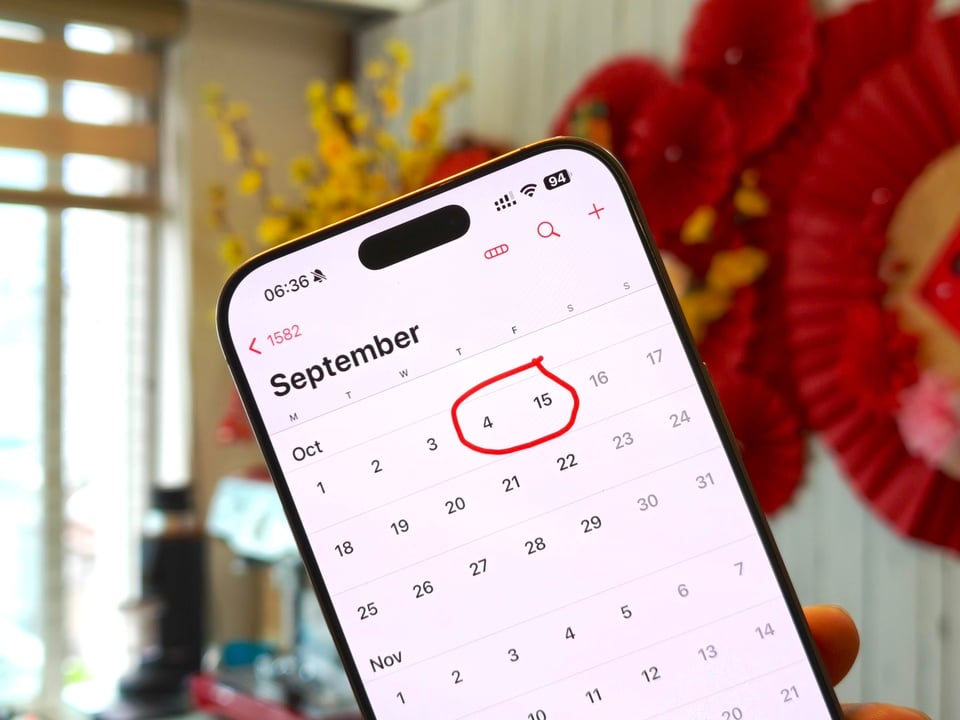
An interesting "bug" was discovered on the iPhone calendar, where October 4, 1582, is followed by October 15. Photo: Apple Insider . |
If you use calendar apps on your smartphone and rewind to 1582, you'll see that October of that year is missing 10 days. Immediately following Thursday, October 4th, is Friday, October 15th, 1582.
This isn't a programming error or someone intentionally playing a prank; these 10 days simply don't exist in the calendar. The reason lies in a change in how days, months, and years were calculated in the 16th century.
At that time, Pope Gregory XIII, presiding over the Catholic Church, issued the decree "Inter gravissimas," officially proclaiming the Gregorian calendar. Prior to this, the whole of Europe still used the Julian calendar, established in 46 BC under the direction of Supreme Leader Julius Caesar.
These two types of calendars are quite similar. Both are solar calendars, consisting of 12 months with the number of days ranging from 28 to 31. The total number of days in a year is usually 365, and in certain years there will be an extra leap day in February.
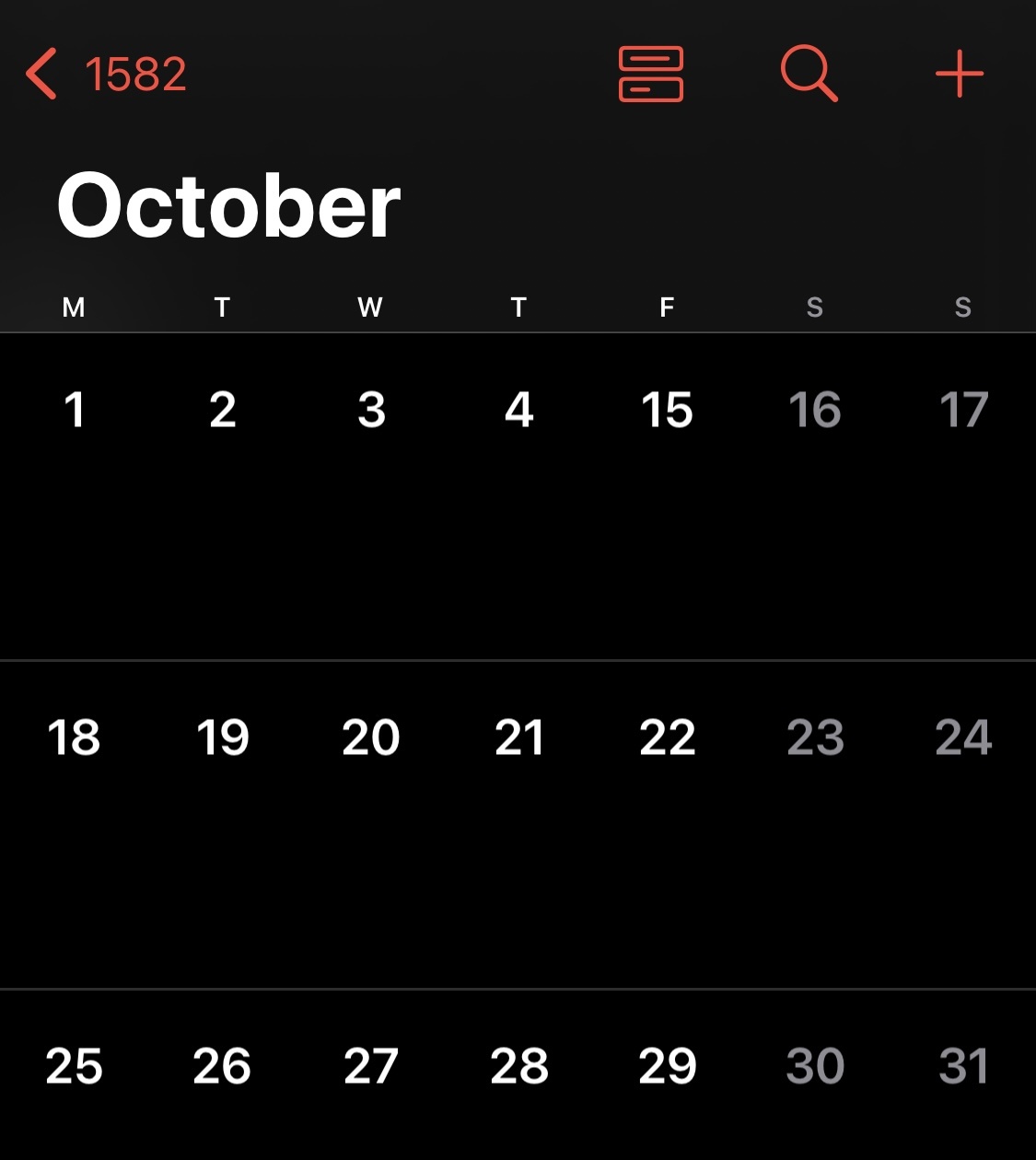 |
October 1582 on the Calendar app on iPhone. |
The main difference lies in how leap years are determined. The Julian calendar adds a day every four years, as does the Gregorian calendar, but with the added condition that the year must be divisible by both 100 and 400. For example, the years 1900 and 2100 are divisible by 4 and 100, but not by 400, so they are not leap years.
To put it simply, the Julian calendar calculates each year as having 365.25 days (with one leap day each year). However, the actual solar year (the time it takes for the Earth to orbit the Sun) is only about 365.2422 days long.
This discrepancy (approximately 11 minutes per year) resulted in the Julian calendar being off by one day every 128 years compared to the solar cycle. While this may sound minor, it was a major problem for the Catholic Church because it severely disrupted the timing of Easter celebrations.
The Church stipulated that Easter should be celebrated on the first Sunday after the first full moon following the spring equinox, which is March 21st. Over time, by the 16th century, this phenomenon had accumulated to the point where the spring equinox fell on March 11th, making the holiday's date inaccurate.
Therefore, Pope Gregory XIII introduced the Gregorian calendar. In order to adjust the new calendar to match the actual movement of the sun, it was necessary to remove 10 days, the number of days that had accumulated to be off due to errors in the Julian calendar.
October was chosen as the month to omit this number because it doesn't coincide with any major events in the Christian calendar. After the Feast of Saint Francis of Assisi on October 4th, the transition to the Gregorian calendar takes place, and the world jumps straight to October 15th.
Therefore, most calendars, when looking up the year 1582, will omit that period, including online calendars on iPhones.
Source: https://znews.vn/ly-do-lich-tren-dien-thoai-thieu-10-ngay-post1554288.html
![[Photo] Prime Minister Pham Minh Chinh receives the Chinese Ambassador to Vietnam](https://vphoto.vietnam.vn/thumb/1200x675/vietnam/resource/IMAGE/2026/04/05/1775397481797_ndo_br_dsc-5512-jpg.webp)





































































































Comment (0)