

Starting as a guard officer serving under Emperor Lý Thái Tông, Ngô Tuấn (Lý Thường Kiệt's real name) rose through the ranks to become a strategic military general, holding the positions of Thái Bảo and then Thái Phó under Emperor Lý Thánh Tông. He was adopted as a son by the emperor (Thiên tử nghĩa nam), given the emperor's surname, and thus became known as Lý Thường Kiệt.
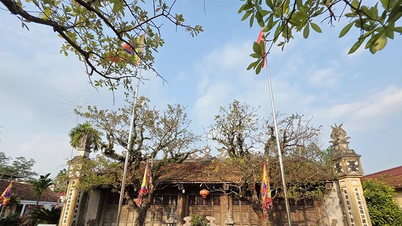
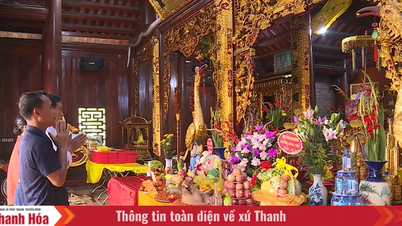
 Grand Marshal Lý Thường Kiệt is solemnly worshipped at Sùng Nghiêm Diên Thánh Pagoda (Thuần Lộc commune, Hậu Lộc district). Photo: Chi Anh
Lý Thường Kiệt served under three Lý emperors: Lý Thái Tông, Lý Thánh Tông, and Lý Nhân Tông. He fought against the Song dynasty and pacified Champa, achieving a brilliant career. He is regarded as a talented statesman, a skilled politician , an outstanding military strategist, and a great national hero. In Châu Ái (Thanh Hóa province), where Lý Thường Kiệt directly governed for 20 years (1081-1101), he became known to the people as a renowned architect who built a comprehensive and solid foundation for the southern "second frontier" of the country under the Lý dynasty.
In the autumn, in the seventh lunar month of the year Canh Tuat (1010), King Ly Thai To's royal fleet arrived at Dai La citadel from Hoa Lu. From that moment, Dai La citadel was renamed Thang Long citadel and served as the capital of the country. From then on, the Chau Ai region became a remote "camp" far from the center of the country. Due to its location, natural features, and the history of national defense and nation-building during the early years of independence under the Khuc, Duong, Ngo, Dinh, and Early Le dynasties, Thanh Hoa became a region of special interest to the Ly dynasty.
First, to consolidate the monarchy and implement unified national governance, the Ly dynasty suppressed rebellions in several localities in the Thanh Hoa region. At the same time, the Ly dynasty appointed Grand Marshal Ly Thuong Kiet to govern Thanh Hoa from 1081 to 1101.
When Lý Thường Kiệt took up the Thanh Hóa garrison, he was 63 years old and had held high positions of power such as Thái Bảo and Thái Phó under Lý Thánh Tông; Nguyên Soái (Marshal) in charge of the vanguard in 1069 when Lý Thánh Tông went to fight Champa; Phụ Quốc Thái Úy (Deputy National Grand Marshal) holding military power and the soul of the resistance war against the Song Dynasty (1075-1077). This shows the extremely important strategic position and location of the Châu Ái region for the Đại Việt nation. To consolidate and increase his power, in 1082 King Lý Nhân Tông “gave Lý Thường Kiệt an additional district in Thanh Hóa, allowing him to be granted a fiefdom; the provincial governors all admired his reputation, and the people all loved his virtuous rule” (1).
During his 20 years as governor of Chau Ai, with supreme power and the title of "Son of Heaven," Ly Thuong Kiet was able to make all decisions in the province. To develop the economy , in addition to focusing on agriculture, plowing, and harvesting to ensure that people did not suffer from crop failures, Ly Thuong Kiet also directly supervised the digging of the Le Dynasty canal (Dong Co Canal dug during the Le Hoan era) to connect the Ma River with the Luong River in Yen Trung commune (Yen Dinh today) and established the A Do village during this period. Then he hired skilled stone carvers - Cham prisoners - to reclaim barren land and establish villages in Thanh Hoa and other places in Dai Viet country (2). Ly Thuong Kiet also directly went to Boi Ly hamlet (now Thieu Trung commune, Thieu Hoa district) to resolve the issue of the Thieu and To families requesting to redeem their ancestral land from the Boc Xa official (i.e., Le Luong in the 10th century). He redeemed the land, erected a stone stele, and divided the land for the two hamlets. Ly Thuong Kiet also went to A Loi swamp and divided half of the swamp for Boi Ly hamlet and half for Vien Dam hamlet... These actions encouraged people to boost production and build the country (3). In this century, handicrafts such as stone carving in Nhoi village, bronze casting in Boi Ly hamlet, weaving, pottery making, basket weaving, and seafaring in villages and communes made significant progress. Regarding commerce, although Thanh Tu Pho was no longer the provincial capital, it was still a large commercial center. Boi Ly hamlet became a large commercial center with distinctive products of bronze casting. Duy Tinh was the capital of Thanh Hoa during the Ly dynasty, located right at the Lach Truong seaport, so it became the largest commercial center in Thanh Hoa during this period... contributing to the appearance of a fairly comprehensive and stable developed economy.
Along with economic development and nation-building, Ly Thuong Kiet also focused on developing culture to educate the people in all aspects. Inheriting the cultural achievements of the Van Lang - Au Lac period and of more than 1,000 years of struggle against the invading rule of the North, the folk culture and arts of this period had the conditions to develop. Traditional customs and folk beliefs of the agricultural population, such as ancestor worship and the veneration of those who contributed to the homeland and country in combating floods, establishing villages, and fighting foreign invaders, were distributed in many villages and communes in the province, such as Dong Son, Tho Xuan, Cam Thuy, Hau Loc, Thieu Hoa, Quang Xuong, Nga Son, and Ha Trung.
A prominent feature of Ly Thuong Kiet's time as governor of Chau Ai was the flourishing of Buddhism, evidenced by its exemplary architectural works. A series of temples and pagodas were renovated and built under Ly Thuong Kiet's direction, notably Huong Nghiem Pagoda (Thieu Trung, Thieu Hoa), Linh Xung Pagoda (Ha Ngoc, Ha Trung), and An Hoach Pagoda (An Hoach ward, Thanh Hoa city)... These are cultural frontier landmarks, and even today, reading the inscriptions on the steles erected nearly 1,000 years ago reveals the immense achievements our ancestors made in nation-building.
Evaluating Ly Thuong Kiet's virtues, Master Hai Chieu Phap Bao - a person who worked under him during the years he was the governor of Ai Chau - wrote: "Using power to eliminate evildoers, using righteousness to resolve lawsuits, so the punishments were not excessive. The Grand Marshal knew that the people prioritized well-being and the country relied on agriculture, so he did not let the harvest season be missed. He was talented but not boastful, and he cared for the elderly in the countryside, so he was able to live in peace. Such principles can be called the foundation of governing the country, the art of pacifying the people, and all the beauty and goodness are here. He helped the government of three dynasties, quelled border rebellions, and in just a few years, the eight directions were peaceful, his achievements were truly great" (4).
After 20 years of governing the border region of Chau Ai, Ly Thuong Kiet successfully completed the task assigned to him by King Ly Nhan Tong. Upon returning to Thang Long (Hanoi), he was old and passed away in 1105 at the age of 86. In the Dai Lai area (formerly Chau Ai, now Ha Ngoc commune, Ha Trung district), south of Nguong Son mountain, next to the Ma River – where Ly Thuong Kiet had Linh Xung Pagoda built, and below it, Luong Muc Duong (his residence when he was the governor of Chau Ai) – has become a national temple dedicated to the great benevolent deity of Chau Ai, Thanh Hoa province, and has remained so for nearly a thousand years.
Pham Van Tuan
(1), (2) Inscription at Bao An Pagoda (Thanh Hoa City).
(3) Inscription of Huong Nghiem Pagoda (Thieu Hoa district).
(4) Linh Xung Pagoda stele (Ha Trung district).
Source: https://baothanhhoa.vn/ly-thuong-kiet-with-the-ai-region-of-thanh-hoa-217976.htm





















































Comment (0)