

Of all the MacBook models currently available, the MacBook Air is one of the most anticipated due to its best price and fresh design. But the question is, is it the right choice for everyone, at least this year?
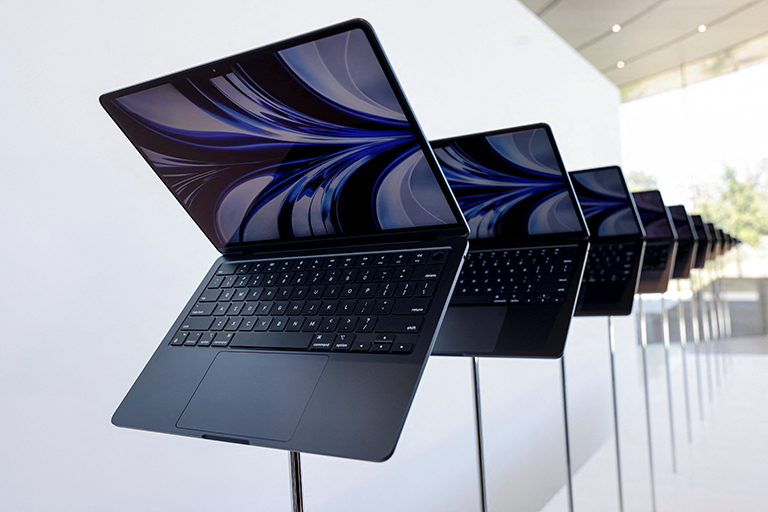
The MacBook Air is not the right choice if users truly prioritize performance.
The latest generation MacBook Air comes with Apple's own M2 chip, offering excellent performance and energy efficiency. Both of these benefits allow users to work on video editing, graphic design, software development, engineering, and database simulations. With all the capabilities this Mac offers, it's arguably the ideal device for everyone.
However, there are several aspects to consider that put the device at a great deal of limitation, so it would be best for users to take the next step and upgrade to a higher-end Mac model.
The first drawback is that the MacBook Air has completely eliminated ventilation in its components, leaving only passive ventilation to cool the device. This passive mechanism results in quieter operation and less dust accumulation. At first glance, this seems like an advantage, but it's not really, because without heat dissipation, reducing temperature during heavy workloads becomes much more difficult.
Therefore, if you want to use a MacBook Air for the processes mentioned above, you will only be able to handle simple tasks. Meanwhile, with heavy workloads, the device will quickly reach high temperatures in a short time and reduce performance.

If performance is truly a priority, consider upgrading to higher-end Mac models.
The second aspect to consider is task performance, as users will face hardware limitations. For RAM, users can only choose a maximum of 16 GB, a very small amount for professionals – who need at least 16 GB and ideally 32 GB. Storage space is also an issue, although this can be addressed with external drives or iCloud.
Finally, for users who like to connect to a wide range of ports and peripherals, they will find the limitations on the 2023 MacBook Air. With only two Thunderbolt 4 ports and a 3.5mm headphone jack, those requiring additional connectivity will have to invest in adapters and hubs.
Source link







































































































Comment (0)