

Malaysian Prime Minister Anwar Ibrahim's visit to China reflects a desire to strengthen comprehensive bilateral relations, particularly in the economic and trade sectors.
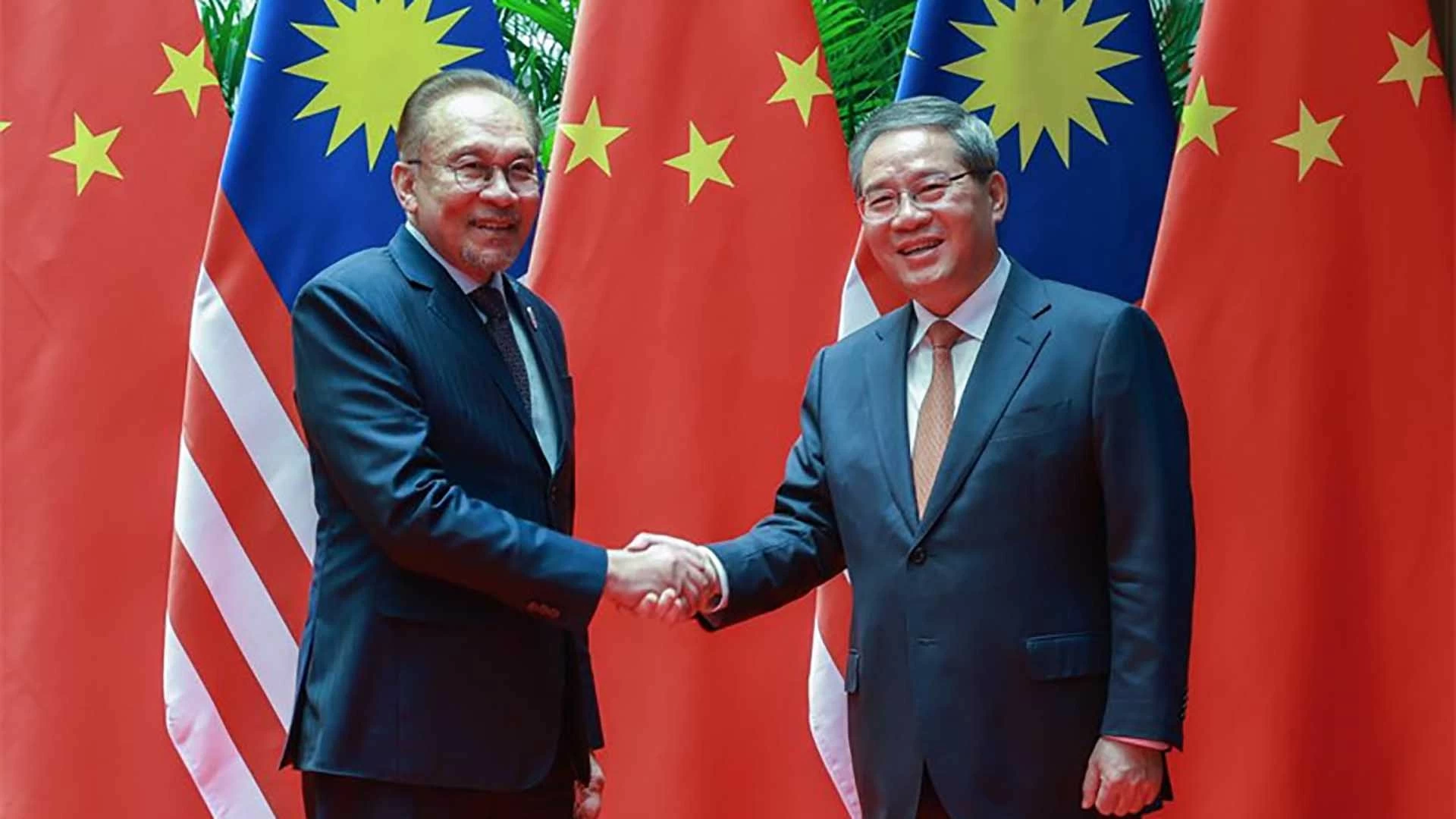 |
| Chinese Premier Li Qiang and his Malaysian counterpart Anwar Ibrahim in Shanghai, November 5. (Source: Xinhua News Agency). |
During his working visit to China from November 4-7, Malaysian Prime Minister Anwar Ibrahim met with Chinese Premier Li Qiang and attended the 7th China International Import Expo (CIIE) in Shanghai.
Economics is the beginning of the story.
This is the Malaysian leader's third visit to China in his two years in power, with previous visits taking place in March and September last year.
Notably, just two months ago, the King of Malaysia, Sultan Ibrahim, visited Beijing to meet with President Xi Jinping. These visits not only commemorated the 50th anniversary of diplomatic relations between the two countries (1974-2024), but also reflected a desire from both sides to strengthen bilateral relations, despite existing differences.
South China Sea. Most recently, on October 17th, Prime Minister Anwar Ibrahim stated before the Malaysian Parliament that Malaysia's Petronas energy corporation will continue its oil and gas exploration activities in waters under national sovereignty; this is not intended to provoke or be hostile towards any country.
Ge Hongliang, Deputy Director of the ASEAN Studies School at Guangxi University of Nationalities, believes that the priority on the Malaysian Prime Minister's agenda this time is economic cooperation and investment. This assessment is well-founded considering the composition of the delegation, the schedule, and the content of the discussions with Anwar Ibrahim. He is accompanied by a number of key officials in the fields of diplomacy and economics, such as Foreign Minister Mohamad Hassan, Minister of Planning, Trade and Industry Tengku Zafrul Abdul Aziz, and Minister of Manpower Steven Sim Chee Keong.
In addition to meeting with the host country's leaders, the Malaysian Prime Minister attended and delivered a key speech at CIIE, where 68 Malaysian businesses had exhibition booths. He emphasized Malaysia's support for President Xi Jinping's "Community of Shared Future" initiative, affirming that this vision has propelled Malaysia to become part of the BRICS group of emerging economies.
Kuala Lumpur's push for economic cooperation with Beijing is understandable, given that China has been Malaysia's largest trading partner for the past 15 years. In 2023, bilateral trade reached US$95.47 billion, accounting for 17.1% of Malaysia's global trade.
Remove bottlenecks
This aspiration was realized by the Malaysian Prime Minister during his meeting with his Chinese counterpart in Shanghai. There, he emphasized the strong relationship with China and affirmed Kuala Lumpur's readiness to cooperate deeply with Beijing in implementing projects under the Belt and Road Initiative, promoting trade, especially agricultural products and Halal products. He stated that Malaysia is ready to learn from China's approach to poverty reduction, improving people's lives, and promoting sustainable development.
On the international stage, the Malaysian Prime Minister supports China's accession to the Comprehensive and Progressive Trans-Pacific Partnership (CPTPP). At the same time, as the Chair of the Association of Southeast Asian Nations (ASEAN) next year, Kuala Lumpur will coordinate with Beijing to address regional and international issues of common concern.
Recognizing that bilateral relations have "entered a new phase," host Prime Minister Li Qiang affirmed that China is ready to cooperate with Malaysia to realize the commitments made by the high-level leaders of the two countries.
Emphasizing Beijing's support for Kuala Lumpur's core interests and top priorities, the Chinese Premier proposed that the two countries jointly guide development strategies, share governance experience, and strengthen cooperation in various fields.
According to Prime Minister Li Qiang, high-level strategic cooperation will be key to promoting modernization in both China and Malaysia.
In particular, the Chinese leader urged Malaysia to accelerate flagship projects such as the East Coast Rail Link (ECRL) and the Malaysia-China “Two Industrial Zones, Two Countries” initiative, and to expand cooperation in emerging sectors. The ECRL had been a “bottleneck” in 2018, when then-Malaysian Prime Minister Mohamad Mahathir suspended the project, which was only resumed in mid-2019 after renegotiating construction costs.
Regarding international issues, Prime Minister Li Qiang emphasized his support for Malaysia assuming the ASEAN chairmanship next year. Beijing will work with Kuala Lumpur to strengthen regional cooperation mechanisms to promote economic integration and peaceful development in Asia. The two leaders witnessed the signing and exchange of memoranda related to the BRI project and media conglomerates of the two countries.
Prime Minister Anwar Ibrahim affirmed: "There are some issues between us, but they do not affect bilateral relations, trade relations, or the close friendship with our neighbors." His recent visit to China is clear evidence of that statement.
Source: https://baoquocte.vn/malaysia-trung-quoc-that-chat-tinh-than-292871.html
























































![[Photo] Hue: Admire the 2.4 trillion VND sea bridge, the longest in Central Vietnam.](https://vphoto.vietnam.vn/thumb/402x226/vietnam/resource/IMAGE/2026/05/24/1779614018347_anh-man-hinh-2026-05-24-luc-16-13-29.png)































Comment (0)