.jpg)
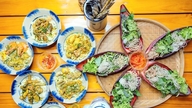
A bowl of shimmering amber-colored fish sauce sits beside a plate of steamed fish wrapped in rice paper or a plate of boiled pork still steaming. That salty taste followed the pioneers who migrated along Central Vietnam, carried by boats out to sea, and quietly became a part of the region's identity.
The taste of the sea
For a long time, the people of Quang Nam have lived by making the most of what nature provides. Seafood from the East Sea, wild vegetables and fruits from the mountain slopes, sticky rice from the plains, potatoes and corn from the hills... all make up the simple meals of the people of Quang Nam. Despite this diversity, if one had to choose the most easily recognizable characteristic of Quang Nam cuisine , it would probably be its "richness." Richness in saltiness, spiciness, and sweetness. Richness like the way the people of Quang Nam speak frankly, live with deep affection, and work wholeheartedly.
Researcher Nguyen Van Xuan once called Quang Nam cuisine "the school of satiety and richness." He explained that in this land of abundant sunshine and wind, farmers have to work hard to survive, so meals must first and foremost be filling. And to achieve "long-lasting satiety," dishes must be savory, low in liquid, and high in energy.
"A preference for salty food" is a common observation among many researchers when discussing the culinary culture of Quang Nam province, and that salty taste is closely associated with fish sauce. As early as the 17th century, the Italian missionary Cristophoro Borri, in his book *Dang Trong* in 1621, mentioned "balaciam"—a type of fish sauce made from salted fish—used daily by the people of Quang Nam. These records show that fish sauce was present very early in the culinary culture of Central Vietnam, not only as a condiment but also as an integral part of the lifestyle of coastal residents. And even today, that salty taste remains intact. From Nam O, Man Thai to Cua Khe, Binh Minh, Tam Thanh…, traditional fish sauces, fermented in earthenware jars and vats, silently release their aroma through countless fishing seasons.

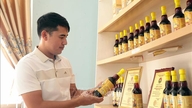
In *Understanding the People of Quang Nam* ( Da Nang Publishing House, 2003), several researchers stated: "Fish sauce stands at the heart of Quang Nam's culinary culture, making it a rich and powerful culture." Beyond the story of food, fish sauce has become a memory, a unique flavor of this land.
.png)
Fish sauce and its cultural story.
Participating in "Artisan's Kitchen," artisan Vu Ngoc Quyen chose Nam O fish salad as a way to tell the story of Da Nang's sea through taste. He said that the soul of the salad lies in Nam O fish sauce. This fish sauce, made from anchovies and sea salt, is left to ferment in earthenware jars for many months under the sun and wind of Central Vietnam, creating a unique, deep flavor that is difficult for any other seasoning to replace.
According to him, to make an authentic fish salad, the fish must be very fresh and carefully prepared to retain its delicate sweetness. But most importantly, it's the dipping sauce. Pure Nam O fish sauce is mixed with roasted sesame seeds, crushed peanuts, garlic, and Thai chili peppers to create a thick, glossy brown sauce. A roll of fish salad with fresh fish, wild herbs, and rice paper, when dipped generously into that sauce, seems to encompass both the taste of the sea and the essence of the Central Vietnamese mountains in a single bite.
Stepping outside the kitchen, fish sauce has become a cultural experience for tourists. In Hoi An, Mắm House Hoi An opens as a space dedicated to the story of Vietnamese fish sauce. In workshops lasting over an hour, visitors learn about the journey of anchovies and sea salt, the techniques of fermentation and natural aging, as well as the differences between traditional and industrially produced fish sauce. They not only taste various types of fish sauce but also create their own versions, bottling them as a way to carry a piece of coastal memory back home.
Behind these workshops is Benoît Chaigneau, a French culinary expert who was stranded in Quang Nam during the COVID-19 pandemic and decided to stay to learn the art of making fish sauce. He once hung a hammock outside a fish sauce production facility for days just to beg to learn the trade. From Nam O, Phu Quoc to Phan Thiet, Benoît traveled along the Vietnamese coast, searching for this condiment considered the "soul" of Vietnamese cuisine.

Perhaps what fascinated Benoît was not just the flavor. In fish sauce, he saw a bridge connecting culinary cultures. From the foundation of this traditional condiment, Benoît experimented with many new things such as fish sauce with pepper, fish sauce with robusta coffee, caramel fish sauce for desserts, and powdered seasoning made from fish residue for use with pasta, salads, and french fries. These variations gradually moved fish sauce out of its familiar position as a Vietnamese condiment, to become part of a global culinary language.
More profoundly, Benoît's journey also evokes the layers of cultural exchange that Quang Nam province has experienced over the centuries. From the trading ports where international ships docked, from the coastal fishing villages, from the baskets of fish sauce carried under the sun and wind of Central Vietnam… fish sauce has followed people far and wide. And perhaps, in that flow, fish sauce has never been just a condiment. It is the memory of the sea, the trace of lives lived at the forefront of the waves, and also a rich part of the cultural essence of this coastal region.
Source: https://baodanang.vn/man-ma-xu-quang-3339384.html
![[Photo] General Secretary and President To Lam receives Palestinian Ambassador Saadi Salama](https://vphoto.vietnam.vn/thumb/1200x675/vietnam/resource/IMAGE/2026/06/25/1782365384740_a1-bnd-9423-8322-jpg.webp)
![[Image] Ho Chi Minh City: Ma Lang area, Chicken-Rice Market about to change its appearance](https://vphoto.vietnam.vn/thumb/1200x675/vietnam/resource/IMAGE/2026/06/25/1782377698627_ndo_br_m1-jpg.webp)

![[Image] Schools organize meetings and introduce teaching models to students admitted to grade 10.](https://vphoto.vietnam.vn/thumb/1200x675/vietnam/resource/IMAGE/2026/06/25/1782368077271_ndo_br_z7970052192242-1ec8daeb77a6eed1a4e9f58c564ddd3e-jpg.webp)