

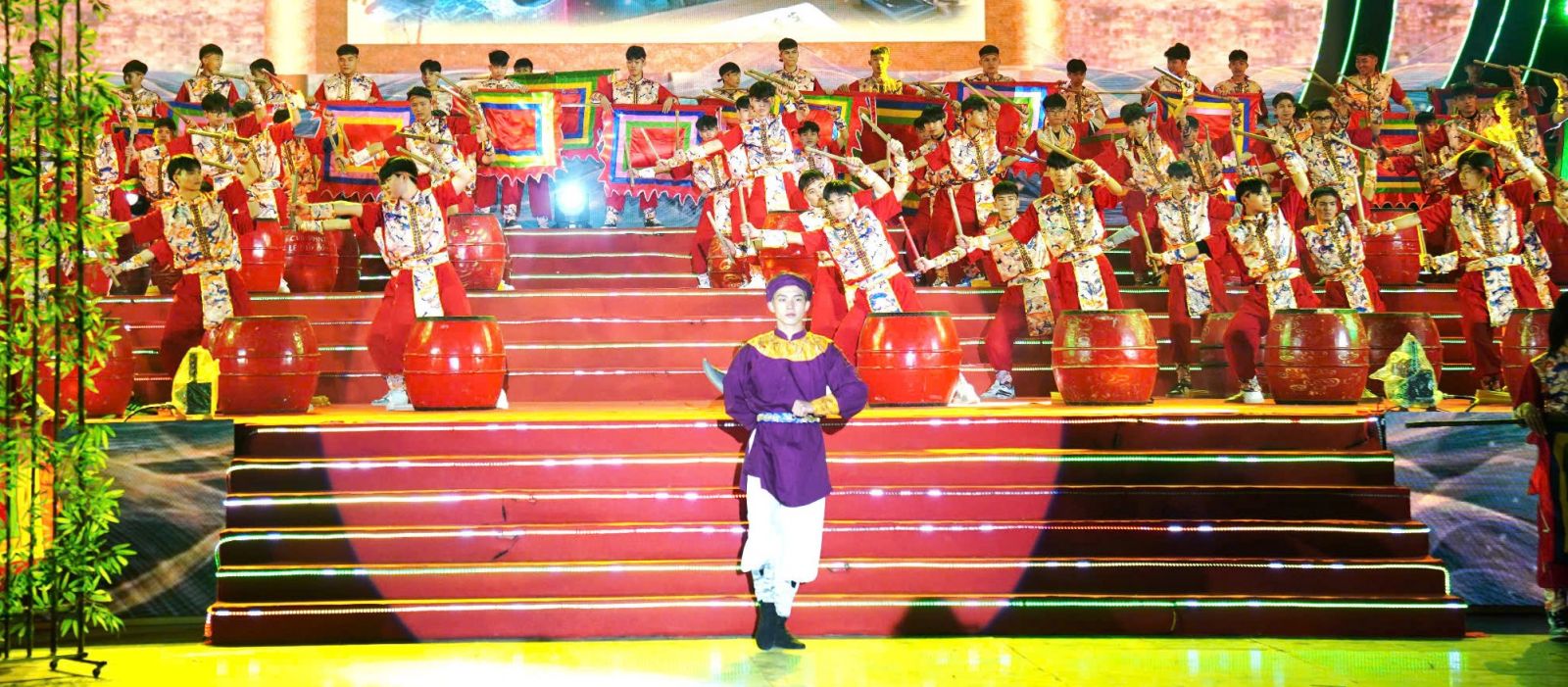
The artistic program at the opening ceremony of the Tran Temple Festival in 2025 contributes to recreating the lives of outstanding historical figures who made great contributions to their homeland and country.
As a land of "spiritual and talented people" deeply intertwined with the thousand-year history of nation-building and national defense of the Vietnamese people, from the early 40s AD, in response to the call to arms of the Trung Sisters, many heroes and valiant figures of Thai Binh rose up in unison, raising the banner of righteousness against the harsh and insidious rule of the Eastern Han army. People from all walks of life rallied under the banner of rebellion, building fortifications. Notable leaders in the northern part of the province include the female general Vu Thi Thuc, and in the southern part, the female general Que Hoa... The rebellion against the Eastern Han army led by the Trung Sisters ended after three years (40-43 AD). Many leaders of the Thai Binh rebels who refused to surrender committed suicide or died in battle; to this day, many temples still preserve their legends and resemblance with couplets that radiate heroic spirit. Having weathered the ups and downs of history, Tien La Temple in Doan Hung commune (Hung Ha district) - dedicated to General Vu Thi Thuc and Bong Dien Temple in Tan Lap commune (Vu Thu district) - dedicated to Princess Que Hoa, are national-level historical and cultural relics that are increasingly being renovated and preserved by generations of people who offer incense and prayers.
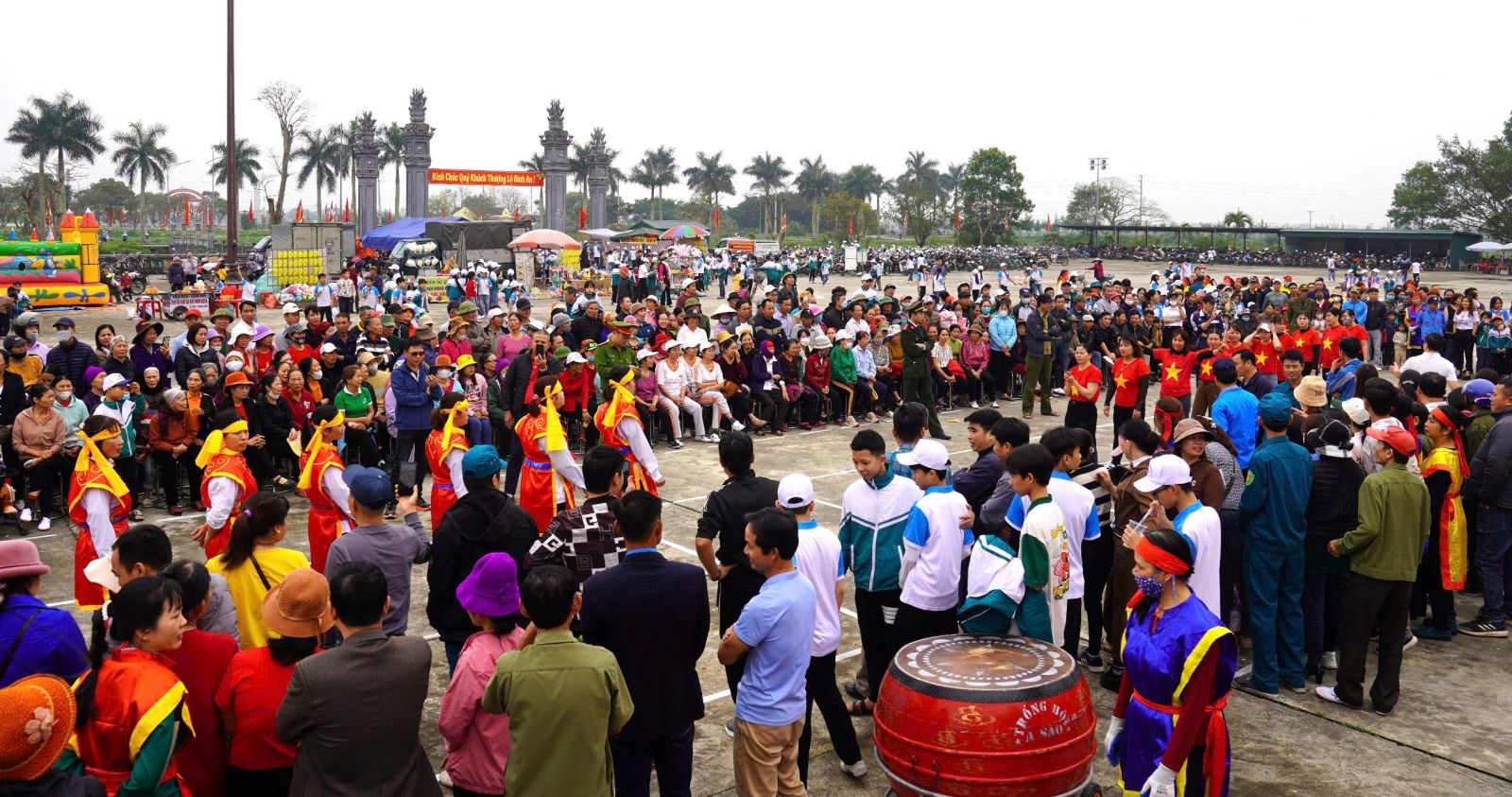
Preserving the beauty of traditional culture at the A Sào Temple festival - a place of worship for National Hero Trần Quốc Tuấn (Hưng Đạo Đại Vương).
Following the Trung Sisters' rebellion in the 6th century, Thai Binh served as a crucial base, providing manpower and resources that contributed to the brilliant victory of Ly Bi's rebellion, overthrowing the Liang dynasty's rule and establishing and defending the Van Xuan Kingdom (544-602). Among the surviving historical records, legends, and myths, the An De village in Xuan Hoa commune (Vu Thu district) stands out. According to legend, this was where leader Ly Bi recruited and trained his soldiers to defeat the invading Liang army. It was also at An De village that Ly Bi met and married Do Thi Khuong. To commemorate the king and queen's contributions to the struggle for national liberation and defense, the local people erected the Hai Thon Temple, featuring unique ancient architecture, which was classified as a national historical and cultural relic in 1986.
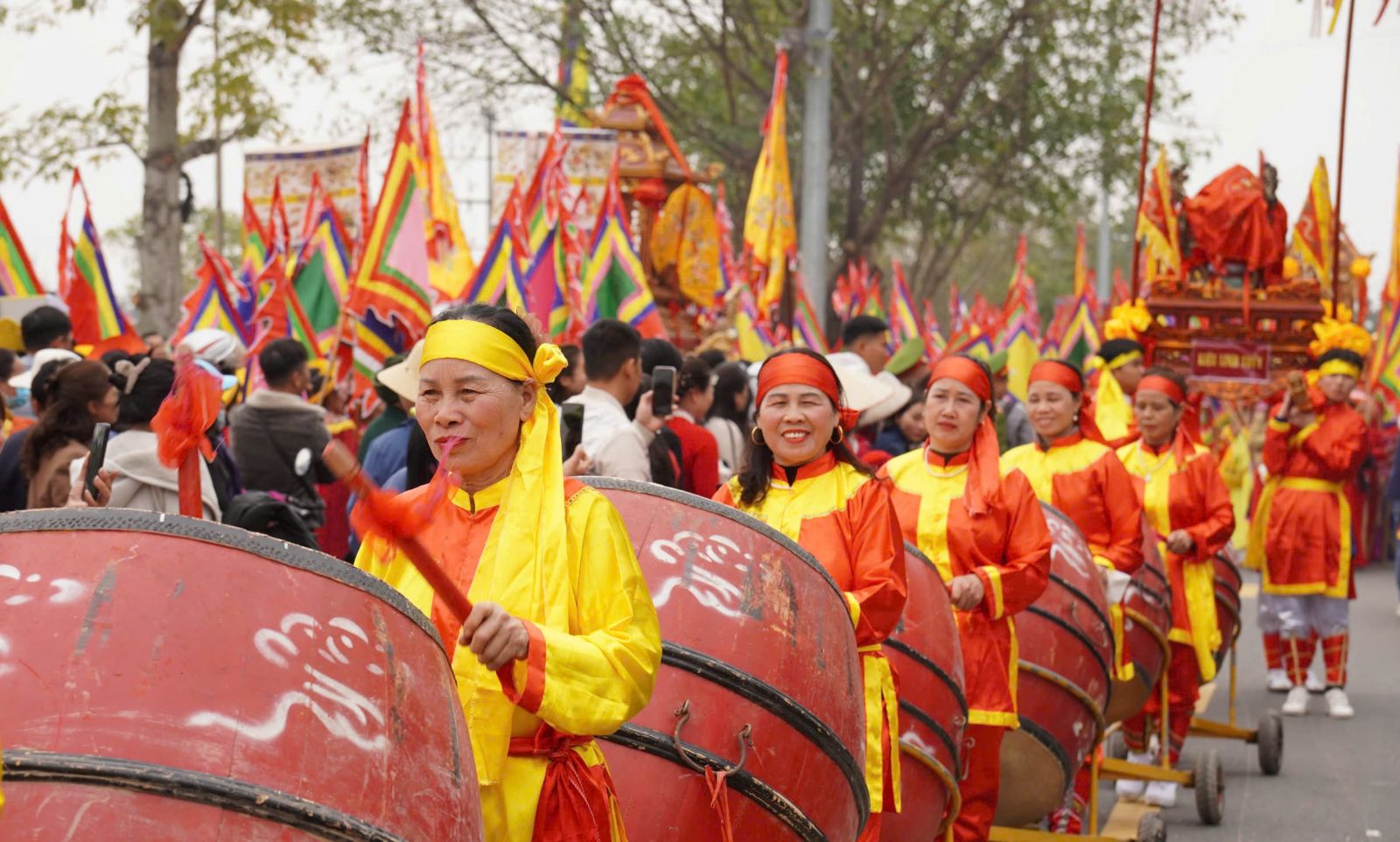
People enthusiastically participate in traditional festivals, paying tribute to the contributions of their ancestors.
In the 10th century, the country was plunged into turmoil due to the fragmentation of power among 12 warlords. Warlord Tran Lam chose Bo Hai Khau (present-day Thai Binh city) as the location to build fortifications and establish his headquarters. Knowing the strength of warlord Tran Lam and the strategic location of Bo Hai Khau, Dinh Bo Linh sought refuge there. Inheriting military power after Tran Lam's death, Dinh Bo Linh led his army to Hoa Lu, recruiting more heroes and soldiers, successively defeating the other warlords, ending the civil war, and establishing the Dinh Dynasty with the name Dai Co Viet.
In the 11th century, during the Ly Dynasty, Buddhism was considered the national religion. Famous national masters not only contributed to the court but also played an important role in the spiritual life of the local people. To this day, many religious structures in the province are still preserved as places of worship for Zen masters from this period. Among them, the Keo Pagoda in Duy Nhat commune (Vu Thu district) is a special national historical site dedicated to Zen master Duong Khong Lo, a historical figure who came from a fishing background but, with a devout Buddhist heart, became a national master and a renowned physician who cured the king of a strange illness, making many contributions to the country at the beginning of the Ly Dynasty; and the Phuc Thang Pagoda in Song Lang commune (Vu Thu district), a national historical and cultural site dedicated to Zen master Do Do - a national master of the Ly Dynasty. Although not born in Thai Binh, he moved with his parents to Ngoai Lang (now Song Lang commune, Vu Thu district) at a young age. He was the 11th patriarch, 3rd generation of the Thao Duong sect founded by King Ly Thanh Tong, and was revered as the founder of the Hoang Giang sect...
In the 13th century, thanks to the Ly Dynasty's agricultural promotion policies, Thai Binh was not only the birthplace of the Tran Dynasty but also a strategically important area. It recruited able-bodied men from villages in Long Hung and Kien Xuong districts into the trusted guard troops protecting the capital, and participated in resistance wars against the Mongol invaders, preventing their advance. Many place names, historical sites, and touching stories about the people's unwavering support and the close cooperation between the army and civilians in fighting the enemy in Thai Binh are still preserved today. In Ngu Thien - Long Hung, the people witnessed the ceremony of offering prisoners of war to celebrate victory at the mausoleums of the Tran kings. Here, King Tran Nhan Tong, moved by the event, uttered the immortal verse: “The nation has twice endured the hardships of war / The mountains and rivers will forever stand firm like a golden vessel.”
In the early 15th century, when the country fell under the rule of the Ming dynasty, a series of uprisings against the invaders broke out continuously in Thai Binh, despite all the brutal repressive tactics of the enemy. The contributions and sacrifices of the people here, along with the rest of the country, led to a complete victory, driving the Ming invaders out of the country. In the 18th century, Thai Binh again seethed with a series of uprisings against the rotten Le-Trinh feudal court. Among these, the peasant uprising led by Hoàng Công Chất, from Hoàng Xá village, Nguyên Xá commune (Vũ Thư district), had a wide scope of activity, linked many rebel forces, and lasted from 1739 to 1764. In 1785, a large number of peasants in the northern part of the province rose up again under the banner of Nguyễn Sơn, from Bứa village, Hồng Việt commune (Đông Hưng district), paving the way for the Tây Sơn army to march north and sweep away the Lê-Trịnh ruling apparatus throughout the entire Northern Delta region.
In the 19th century, under the Nguyen dynasty, the flames of peasant rebellion against the reactionary feudal court burned fiercely. The largest of the peasant uprisings in Northern Vietnam at that time was the rebellion of the peasants of Thai Binh, led by Phan Ba Vanh, from Minh Giam village, Vu Binh commune (Kien Xuong district). The rebels' activities spread throughout the region from Thai Binh, Nam Dinh, Hai Duong, Hung Yen , Kien An to Quang Yen in the Northeast, lasting from 1811 to 1827. The courage of leader Phan Ba Vanh and his soldiers wrote a glorious chapter in the history of the heroic struggle of the peasant class under feudalism, a story that will be remembered for generations to come.
With its strategically important gateway location, and alongside the struggle to conquer and transform nature throughout the history of feudal dynasties, Thai Binh province has had to confront invading forces. Through the process of defending their homeland, the people of Thai Binh have achieved countless miracles in revolutionary struggles. At the same time, this has fostered a deep love for their homeland and a resolute will to defend it whenever invading forces threaten, becoming an indomitable, resilient, patriotic tradition of resistance against foreign invaders for the land and people of Thai Binh.
Source: https://sovhttdl.thaibinh.gov.vn/tin-tuc/trao-doi-nghiep-vu/manh-dat-san-sinh-nhung-anh-hung.html


Comment (0)