

(QBĐT) - My childhood was intertwined with sunny summer afternoons, with kites soaring over the village fields, and especially with the cool, refreshing well nestled under the ancient banyan tree at the edge of the hamlet. The village well—those two affectionate words—held a whole realm of gentle memories, preserving the soul of the countryside, a place brimming with the recollections of my childhood days.
In my hometown, almost every village has at least one communal well. The wells are usually located at the edge of the village, where a source of crystal-clear groundwater flows endlessly. Around the well are weathered stones, rows of betel nut trees casting their shadows, and bamboo rustling in the wind. Every time I approach the well, I feel an unusual sense of peace, as if I'm touching the breath of the earth and sky, of peaceful times long gone.
The village well is not just a source of water, but also a witness to generations. She recounted that in the old days, her grandfather and the young men of the village dug the well, using sturdy laterite bricks to ensure the water wouldn't erode. At the bottom of the well, water seeped through the cracks in the rocks, permeating the fertile soil, becoming sweet and pure. In those days, the well was where people came to fetch water, to wash clothes, and to chat about village affairs.
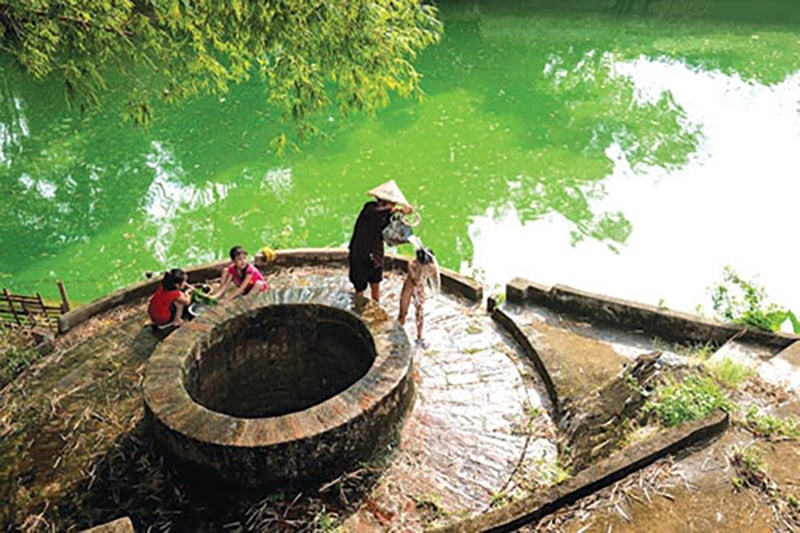 |
I still vividly remember those sweltering summer days, when the scorching sun beat down on the dry, cracked earth. Every midday, we children would excitedly call out to each other to go to the well. Some would run barefoot on the dirt path, others would wear their mothers' wide-brimmed conical hats, fanning themselves with palm-leaf fans as they went. The feeling of plunging our small hands into the cool, refreshing water, then scooping up the clear drops and applying them to our faces and necks, seemed to soothe our bodies amidst the stifling heat of the summer day.
Every morning, my mother would go to the well early, lowering a bamboo bucket in and then pulling up water to pour into an earthenware jar. The well water was crystal clear, reflecting the moss clinging to the sides of the jar. My mother said that the well water in our village was not only clean but also sweeter than any other water. Perhaps that's why the green tea she brewed with well water always had a rich aroma, and drinking it made you feel the purity from Mother Earth. Then, on cold winter days, a thick white mist covered the village road. My small hands trembled as I scooped up water to wash my face. The biting cold seeped into my fingertips, but strangely, it brought a feeling of unusual refreshment and alertness.
The village well is not just a source of water, but also a place that connects people, where community spirit is nurtured with each bucket of water drawn up. Every afternoon, the women of the village gather around the well, washing clothes and chatting animatedly. Sometimes, it's about trivial matters like what to cook for dinner, complaints about the harvest, or witty jokes about a mischievous child who climbed a tree and got scolded by their mother.
Some mornings, my grandmother would take me to the well, washing vegetable leaves while reminding me, "My son, you're all grown up now. You must learn to value clean water and take care of the village well. We have our own well, but we must still work together to maintain the shared well for the whole neighborhood." I listened, not fully understanding her meaning. I only knew that the well was something very important, very sacred. My grandmother's advice, and the stories my mother told about the village well, gradually seeped into my soul over the years.
As time passed, the village well no longer played the central role in people's lives as it once did. Every household now has a drilled well and a modern water pump. Water from the village well is no longer the sole source of water for daily life, but for those of us who have left our hometown, that well remains a symbol of memories, of a cherished place that can never fade.
Every time I return to my hometown, I always make sure to visit the old well. The well's walls are now covered in moss, and the stones around it bear the marks of time. At the bottom, the water remains as clear as ever, reflecting the sparkling sunlight. I sit quietly by the well, feeling the cool breeze, as if listening to the well recount its old stories.
Once, I asked my grandmother, "Why do you still prefer to use the village well even though we have our own well?" She smiled, her eyes gentle, and replied, "The village well water has the taste of home, my child!" Those words have stayed with me for years. The village well is not just a source of water, but also a part of the village's soul, of the traditional values our ancestors have preserved for generations. No matter how much modern life changes, I believe that deep within the hearts of every person far from home, the image of the village well remains intact, a symbol of coolness, love, and unforgettable, peaceful childhood days.
The village well—a place where pure water flows endlessly, just as the streams of memories never dry up in the hearts of those far from home.
Tuong Lai
Source: https://www.baoquangbinh.vn/van-hoa/202504/mat-lanh-gieng-que-2225567/




























































Comment (0)