In June, the summer sun in Hue blazes down. At the Hue City Martyrs' Cemetery, amidst the green pine trees and rows of silent graves, officers and soldiers are still diligently carrying out a special mission: collecting samples of the remains of unidentified martyrs for DNA testing.
Careful attention to every step.
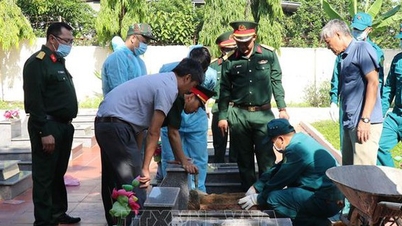
These days, the working group of the Steering Committee for the Search, Collection, and Identification of Martyrs' Remains (Steering Committee 515) of Hue City, in coordination with the People's Committee of An Cuu Ward, is carrying out the work of collecting samples from the remains of unidentified martyrs for DNA testing. This activity is part of the "500 Days and Nights Campaign to Intensify the Search, Collection, and Identification of Martyrs' Remains" (referred to as the 500 Days and Nights Campaign), leading up to the 80th anniversary of the Day of War Invalids and Martyrs (July 27, 1947 - July 27, 2027).
In the vast Hue City Martyrs' Cemetery, many tombstones have faded with time. On them, only the words "Unknown" remain. More than half a century after the war, the names, hometowns, and relatives of thousands of martyrs remain unknown.
Under the scorching summer sun of Central Vietnam, those on duty begin their work early in the morning and continue until late afternoon. They understand that behind each specimen is not simply biological data, but also the hope of reunion for countless families.
The sampling process is carried out according to a strict scientific procedure: locating the grave, comparing records, selecting samples, assigning codes, taking photographs, creating a report, packaging, storing, and handing over the samples in accordance with professional regulations. Each grave is checked multiple times to avoid errors. Data is digitized and stored electronically for future DNA testing. After completion, the remains of the fallen soldiers are reburied respectfully, and the original grave site is returned.

DNA samples were taken at the Hue City Martyrs' Cemetery.
Lieutenant Colonel Thai Su Quan, a professional soldier at the Hue City Military Command Clinic, said that before deploying for the mission, he received intensive training in Hanoi to guide the forces at the local level. Because of their camaraderie, they carried out the mission with the highest sense of responsibility, not neglecting any step and ensuring adherence to technical procedures. The campaign has profound significance, not only contributing to the identification of fallen soldiers but also helping many families find their sons, husbands, and fathers.
According to the Hue City Military Command, after completing the sampling at the Hue City Martyrs' Cemetery, the relevant authorities held a debriefing meeting and simultaneously deployed the sampling across the city. To date, Hue City has completed sampling at 6 out of 40 martyrs' cemeteries as planned.



Colonel Ha Van Ai, Deputy Political Commissar of the Hue City Military Command, shared that the goal is to complete the sampling at all 40 cemeteries before this year's rainy season. Afterward, all DNA samples will be transferred to specialized agencies for analysis and comparison with the DNA database of martyrs' relatives managed by the National Steering Committee 515.

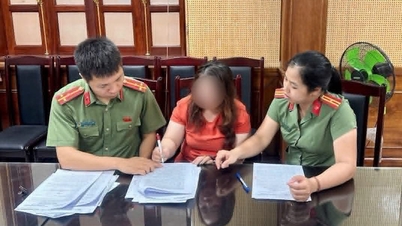
A survey was conducted at the location of the West Gate in the Hue Imperial Citadel to verify information regarding the presence of a mass grave for fallen soldiers.
Sacred Journey
The peak period for collecting DNA samples from relatives of unidentified martyrs in Hue City will continue until July 25th, with the collection of DNA samples taking place from July 9th to 11th throughout Hue City.
The implementation of DNA sample collection is expected to contribute to clarifying information about many martyrs whose identities remain unknown, fulfilling the wishes of their families, and demonstrating the responsibility and gratitude of the Party, the State, and the entire society towards those who sacrificed for the Fatherland.
If DNA sampling was a journey to restore the identities of those already laid to rest, then an equally arduous task of the 500-Day Campaign was to search for comrades who were still buried somewhere.
In Hue, the site of some of the fiercest battles during the 1968 Tet Offensive, the search for the remains of fallen soldiers is still being carried out urgently. Recently, the Steering Committee 515 issued a document requesting the National Steering Committee 515 and the Department of Social Policy to provide ground-penetrating radar equipment and an operating team to survey four suspected mass graves of fallen soldiers.
Mr. Nguyen Van Manh, Vice Chairman of the Hue City People's Committee, affirmed that the locality is implementing the 500-day campaign with very high determination, while mobilizing maximum resources to verify, review, and search. "Through propaganda work, many witnesses have provided very valuable information about mass burial sites of martyrs. We are combining many different methods to verify, assess, and develop the most scientific and accurate search plan possible," Mr. Nguyen Van Manh informed.
According to Hue City leaders, with the support of the National Steering Committee 515 and international partners, Hue has accessed several war maps kept by the US. After translation and research, these documents show that many areas around the Hue Imperial Citadel were particularly fierce battlefields during the Tet Offensive of 1968. This historical data is being compared with witness accounts and military records to identify locations with a high probability of containing the remains of fallen soldiers.
The 500-day campaign, a sacred journey, is being carried out by Hue City with the highest determination and boundless gratitude to those who laid down their lives for the peace we enjoy today.



Over 7,000 martyrs' graves need to be identified.
Currently, in Hue City, there are 40 martyrs' cemeteries with more than 7,000 graves that need to be sampled for DNA testing. The Hue City Martyrs' Cemetery alone has nearly 1,460 graves of martyrs whose information is yet to be identified, distributed across 14 different areas.
According to Nguyen Van Manh, Vice Chairman of the Hue City People's Committee, the search for and identification of fallen soldiers in Hue continues day by day, hour by hour. In cemeteries, DNA samples are collected and carefully preserved; in the field, surveys and verification work is being carried out urgently. All efforts are directed towards a sacred goal: restoring the names of those who sacrificed their lives, helping families alleviate their grief, and ending decades of waiting.
Source: https://nld.com.vn/menh-lenh-tu-trai-tim-vi-tinh-dong-chi-dong-doi-196260623203632202.htm
![[Photo] Prime Minister Le Minh Hung presides over the thematic session on promoting science and technology development and innovation.](https://vphoto.vietnam.vn/thumb/1200x675/vietnam/resource/IMAGE/2026/06/23/1782207872934_ndo_br_dsc-1724-jpg.webp)
![[Image] Paris's oldest bridge goes viral after transforming into a giant cave.](https://vphoto.vietnam.vn/thumb/1200x675/vietnam/resource/IMAGE/2026/06/24/1782283441197_ndo_br_dsc05314-jpg.webp)