



Touching history with your own hands.
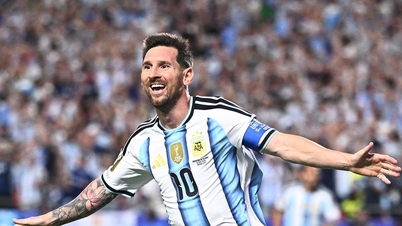
The fans in the stadium immediately chanted Messi's name, joining in respectful bows. That goal helped the Argentina captain surpass legend Miroslav Klose to become the top scorer in World Cup history. With his 17th goal at the biggest football event on the planet, Messi not only broke a long-standing record but also reaffirmed once again that he is an iconic figure of world football for generations. Even his teammates seemed unable to believe what had just happened, embracing him in astonishment and pride.
The significance of that moment is made even more special by the symbolic coincidence. Messi set this record almost exactly 20 years after scoring his first World Cup goal in 2006 against Serbia and Montenegro. At the same time, Argentinian football is also recalling another historical milestone: 40 years since Diego Maradona's famous "Hand of God" goal on the way to winning the 1986 World Cup. These details make the match in Dallas not just another victory for the reigning champions, but a new chapter extending the glorious tradition of Argentinian football.
It's worth noting that this wasn't an easy match for Argentina. Despite being considered the stronger team, the South American side struggled against Austria's tight and disciplined defense. For much of the game, they couldn't create enough space to mount coherent attacks. In a match like this, the difference often comes from individual genius, and once again, the name that made that difference was Lionel Messi. But before making history, he had to overcome a challenging moment.
From the very beginning of the match, Argentina had a great opportunity to open the scoring and help Messi break a record. Lautaro Martínez broke through after a skillful pass, before colliding with Stefan Posch and Xaver Schlager. After a lengthy VAR review, the referee awarded Argentina a penalty. Everything seemed to be set up for a perfect scenario: Messi stepped up to the penalty spot, the spectators simultaneously raised their phones to capture the historic moment, and the stadium fell silent. But then his shot went wide of the goal. The explosion of excitement was replaced by a feeling of stunned silence.
That moment showed the harsh realities of football at the highest level. Even a legend can make mistakes at what seems like the surest moment. Documents show that Messi missed three of seven penalties at the World Cup, not including penalty shootouts. This proves that even a player as exceptional as him cannot escape the pressure of the big stage. After the missed penalty, Messi himself had some shaky moments, shooting inaccurately and sometimes losing the ball in midfield, while the morale of the entire Argentina team was also noticeably affected.



It was at that moment that Austria saw their opportunity. They pushed forward, bringing the ball close to Argentina's penalty area and forcing goalkeeper Emiliano Martínez to make saves. However, the European team's momentum didn't last long enough to create a turning point. In top-level football, failing to capitalize on the opponent's moment of weakness often comes at a high price. Argentina held firm after the most difficult period, gradually regaining control of the game after the water break in the first half. Once again, the resilience of the world champions was clearly demonstrated.
When the team needed the greatest moral support, Messi was the one who stepped up. Speaking after the match, coach Lionel Scaloni emphasized that when Messi shines, the whole team is inspired. He praised the captain's determination, tackling ability, and dedication, even when the team was struggling. This is an important observation, as it shows that Messi's influence lies not only in his goals or assists, but also in the emotional weight he brings to those around him.
For his part, Messi admitted after the match that he was very angry with himself for missing the penalty, and felt that he had taken the shot poorly. However, what makes him great is his ability to react after mistakes. Instead of letting disappointment drag him down, he and his teammates turned the situation around, took control of the game, and went on to win. A great player is not someone who never makes mistakes, but someone who knows how to overcome those mistakes in the game to continue making a difference. Messi did exactly that in Dallas.
The record-breaking goal wasn't his only highlight of the match. In fact, Messi scored a second goal for Argentina in injury time, surpassing even women's football legend Marta to become the highest-scoring player in World Cup history for both men and women.
This milestone holds significance beyond a single league or gender, as it places Messi's name at the pinnacle of history in the world's biggest competition. No longer a mere generational debate, this is a symbolic statistic representing a career that is virtually impossible to replicate.
Rare perseverance
It's even more remarkable considering his long journey. From his first World Cup goal in 2006 to his 17th in 2026, Messi has participated in six World Cups, a record in itself. This kind of endurance is rare in modern football, where physical fitness, pressure, and the intensity of competition at the highest level can wear anyone down. Not only has he maintained his form, but he has also elevated his status with each World Cup, and at nearly 39 years old, he's still leading the race for the 2026 Golden Boot.
Another crucial detail is that Messi has scored all five of Argentina's goals in this World Cup so far. This speaks volumes about the team's reliance on their captain's inspiration. In big matches, where tactics often counteract each other and opportunities are scarce, the team possessing a player who can decide the outcome with a moment of genius always has a huge advantage. Argentina currently has exactly that kind of player, and that's why they continue to be considered a strong contender to defend their title.



His teammates couldn't hide their admiration either. Lisandro Martínez said Messi deserved all the praise for what he showed in every match. Leandro Paredes admitted that he never stopped surprising everyone. These words weren't just empty flattery after a victory; they reflected the collective mindset of the entire Argentinian team before such an outstanding leader. When the players look to their captain with absolute faith, it's a source of energy that's difficult to measure but incredibly important on the journey to conquering major titles.
The victory against Austria also secured Argentina's place in the round of 32, with two wins out of two matches. This provides an ideal foundation for the defending champions to continue dreaming of defending their title. But beyond the result, this match once again reinforced the belief that Lionel Scaloni's team is still built around the brilliance and influence of Messi. It's no coincidence that the crowd of over 70,000 spectators in the stadium greeted his and his teammates' celebratory run with special admiration after the final whistle.
Source: https://baovanhoa.vn/the-thao/messi-va-khoanh-khac-khang-dinh-vi-the-239707.html


![[Image] Paris's oldest bridge goes viral after transforming into a giant cave.](https://vphoto.vietnam.vn/thumb/1200x675/vietnam/resource/IMAGE/2026/06/24/1782283441197_ndo_br_dsc05314-jpg.webp)
![[Photo] Prime Minister Le Minh Hung presides over the thematic session on promoting science and technology development and innovation.](https://vphoto.vietnam.vn/thumb/1200x675/vietnam/resource/IMAGE/2026/06/23/1782207872934_ndo_br_dsc-1724-jpg.webp)