On the morning of June 15th, Lionel Messi played his first match at the 2025 Club World Cup not like an ordinary player. He appeared on the Hard Rock Stadium pitch as a living icon – a surreal figure stepping out of the pages of football history.
Quiet, unassuming, just a calm demeanor and a deep, penetrating gaze – qualities that have accompanied Messi from Rosario to Barcelona, from Paris to Miami. But behind that facade lies an unquenchable fire.
Greatness lies in each action.
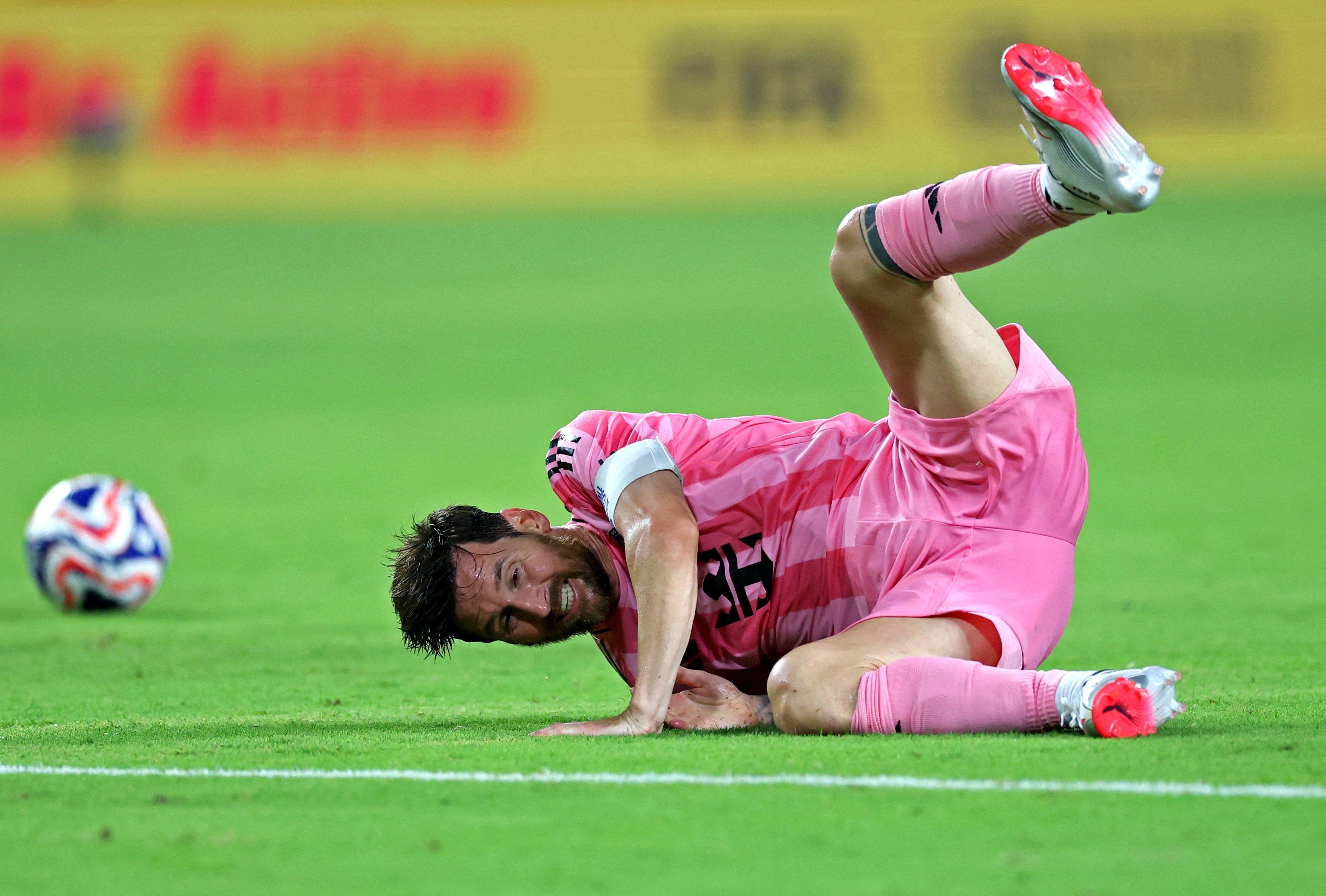
At 37, Messi is no longer the whirlwind that swept away every defense he was in his prime. He doesn't sprint like before, he doesn't play the gegenpress style of pressing, but he still plays football in his own way – slower, but smarter, more experienced, and most importantly: full of inspiration.
The 0-0 draw against Al Ahly left many disappointed, but it also marked a moment that will be remembered for a long time. In the 95th minute, when most players stopped waiting for the final whistle, Messi still dropped deep, launching himself to stop a final counter-attack – a defensive move that wasn't part of his "job description".
At an age when many legends have chosen to sit on the sidelines to receive applause, Messi still tirelessly runs, still sweats for the team. That's not measured by goals, but by spirit. And that spirit – that's what makes him great.
Statistics can tell a lot. Messi still created Inter Miami's best chances in the match. A neat control before a shot forced the opposing goalkeeper to make a save. A free kick that curved perfectly before hitting the post. A delicate through pass mishandled by a teammate. And finally, a shot in the 95th minute that half the stadium celebrated – before being blocked at the very last second.
But more importantly, Messi still plays with the mindset of someone who has nothing left to prove, yet always has something to offer. He doesn't need to race against age, because the ball still obeys him as before – only Messi is no longer in a hurry.

|
Messi attracts all the attention. |
Messi's presence at this tournament is not simply about his professional skills. It's hard to deny that FIFA "bent the rules" to invite Inter Miami to the Club World Cup – despite them not winning the MLS. Why? Because they have Messi. And because FIFA needs Messi.
It's necessary to attract audiences. It's necessary to draw global media attention to a tournament that has been largely overlooked. It's necessary to prove that the Club World Cup can become a global product like the World Cup, if it has enough stars.
The problem was: even with Messi, the opening game wasn't sold out. Tickets were being sold for as much as $349 – unaffordable for many. Add to that the immigration worry: rumors of ICE presence made many immigrants hesitant.
The organizers then had to drastically lower prices and launch special promotions for students. The result: 60,927 spectators in a 64,000-seat stadium – not a bad number, but not enough to create a "frenzy".
The most controversial moment came during halftime. An entertaining performance featuring legends like Del Piero, Djorkaeff, and Kaká, along with iShowSpeed, Agüero, and Pepe – and a challenge to hit the crossbar.
It's fun, but it's hard to take seriously. This is an official match, not an entertainment stage. Imagine Michael Jordan, Roger Federer, or Shaquille O'Neal being dragged out to perform in the middle of an NBA or Roland Garros final – would that make sense?
If FIFA wants the Club World Cup to be taken seriously, then they must treat it like a top-tier tournament – not a theatrical festival.
Inter Miami's problem
Javier Mascherano – Messi's teammate for two decades – said before the match: “We are not at this level, Al Ahly is the team with more international experience.”
But the match proved otherwise: Inter Miami were not weaker at all. In fact, when Messi switched to "inspiration mode," the American team controlled the game better and created more clear-cut chances.
However, their problems remain: a lack of squad depth, over-reliance on veterans who once played for Barcelona. And Messi, while still extraordinary, cannot be the savior for every game forever.
|
The FIFA Club World Cup needs Messi. |
The 2025 Club World Cup could be Messi's last international club tournament. He hasn't renewed his contract with Inter Miami, and rumors of a departure are starting to surface, despite the club's management stating they want him to "end his career here."
The problem isn't just with Inter Miami, but with American soccer in general. Messi was expected to do with MLS what Beckham did – but on a deeper, more sustainable level. Yet so far, what Americans have seen is increased viewership, jersey sales, and attendance – while on the pitch, success remains a big question mark.

Vietnam encourages US businesses to expand investment in high technology.On the morning of June 26th, at the Government Headquarters, Deputy Prime Minister Ho Quoc Dung received Mr. Jeff Place, Supply Chain Director of Coherent Group (USA). During the meeting, the Deputy Prime Minister affirmed that Vietnam encourages US businesses to expand investment, especially in high-tech, innovation, and semiconductor industries. If Messi leaves without winning a major title – like the MLS Cup or the CONCACAF Champions League – will the “Messi effect” still exist? Or is it all just a fleeting commercial wave?
Messi is still playing, still inspiring, still great. But the Club World Cup is more than just a tournament – it's a test for an entire campaign to build American soccer around one man. And if the draw against Al Ahly was a warning, then that 95th-minute burst of speed was the answer: Messi is still here, still fighting, and still not giving up.
Greatness, perhaps, lies not in the titles he will win, but in his never-ending spirit of dedication – even as he approaches the final years of his immortal journey.
Source: https://znews.vn/messi-van-vi-dai-post1560990.html










![[Image] National conference summarizing one year of operation of the overall organizational model of the political system, the three-tiered government model.](https://vphoto.vietnam.vn/thumb/1200x675/vietnam/resource/IMAGE/2026/07/01/1782882811691_ndo_br_1-jpg.webp)