

Parking spaces are a resource that needs to be exploited, but the question is how to exploit them in a way that brings optimal benefits to the State and the community, while also harmonizing with the interests of the people.
The number of passenger cars increases by about 10% annually, with traffic congested in the urban core, leading to an increasing scarcity of parking spaces. Many solutions have been proposed, but their effectiveness has been limited.
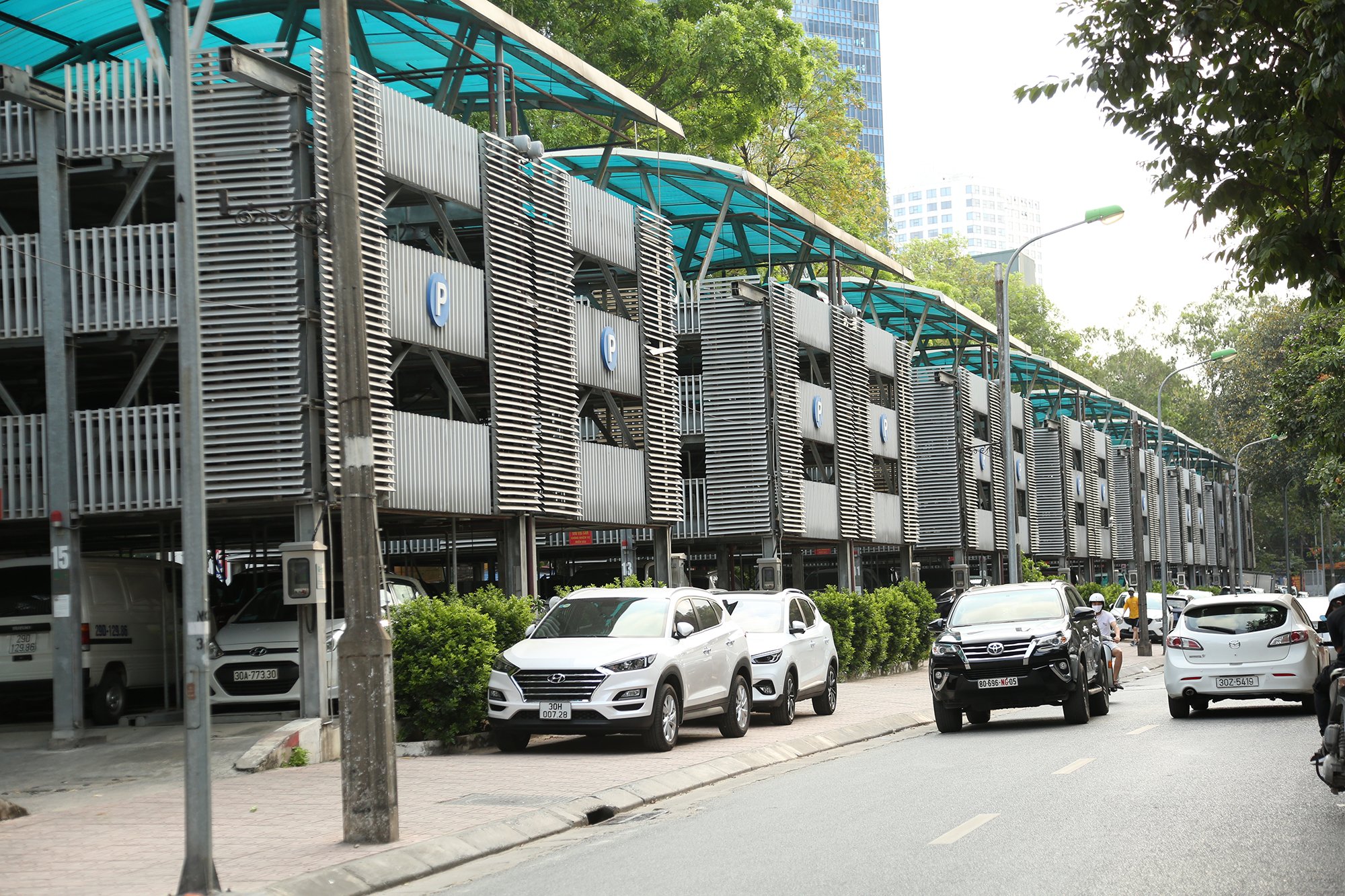
Smart parking lot on Nguyen Cong Hoan street, Hanoi (illustrative image).
For example, Hanoi has implemented an odd-even parking system on seven streets since 2016, but there has never been a comprehensive review or evaluation of the results.
In 2022, Hanoi planned for 1,620 parking lots, but by the end of 2023 only 57 had been completed, with 66 still under construction. Many areas of land designated for parking lots remain abandoned...
According to the parking lot plan, the city also planned to build 73 underground parking lots; however, none have been constructed to date due to difficulties in balancing investment costs with projected revenue.
Parking fees are also a controversial issue, due to the arbitrary application of rates and the inconsistent collection methods in different locations, giving parkers the feeling that each parking lot has its own "rules."
Currently, the licensing of street parking lots in urban areas is decided by the district level, but some parking lots are also licensed by the city, leading to differences in operational methods.
To address the issue of transparency in parking fees, many parking lots will implement cashless payment methods starting in 2024.
However, in reality, many drivers encounter problems due to errors such as multiple deductions, deductions even after only a few minutes of stopping, or deductions from their account but still being charged cash.
The regulation setting the parking time (block) at 60 minutes is problematic because if a parking session exceeds 1 minute (1 block + 1 minute), customers have to pay for two sessions, causing dissatisfaction.
In the Linh Dam urban area (Hanoi), a car owner reported that even though they hadn't gotten out of their car, hadn't turned off the engine, and had only stopped for a few minutes to reply to a text message, a parking attendant used an ETC card reader to scan their account and deduct money.
Many car owners say that it's perfectly normal to park in the wrong place and have to leave immediately. Charging a fee right after parking is completely unreasonable.
Another example: at a parking lot in the Hoang Cau area, despite signs clearly stating that cars and taxis are allowed to park for no more than 5 minutes, many drivers were immediately charged 20,000 VND from their ETC payment card account as soon as they parked. The conflict between the signs and the ETC payment machine is also illogical and needs to be adjusted.
On the other hand, observing how shopping malls like Big C, Aeon Mall, and Mipec utilize free parking for less than 3 hours (with a fee for exceeding 3 hours), it has a significant commercial appeal and is increasingly recognized as a reasonable solution.
Some urban areas have adopted technology to regulate parking spaces within their premises, in the basement, based on time blocks, usually every 30 minutes.
This approach should be implemented by parking service businesses so that car users don't end up being unfairly charged when entering and exiting locations for short periods.
Recently, General Secretary To Lam suggested that Hanoi consider allowing people to park for 30 minutes free of charge to encourage them to conduct business during that time; exceeding 30 minutes would incur a progressive, tiered fee.
This approach helps car owners become more aware of saving time and money when it comes to parking.
The General Secretary 's suggestion deserves careful study, and if implemented, it will certainly be met with approval and support from the people.
Source: https://www.baogiaothong.vn/mien-phi-do-xe-30-phut-la-van-minh-192250317234350078.htm
![[Photo] General Secretary and President To Lam presides over a meeting on assessing national development resources.](https://vphoto.vietnam.vn/thumb/1200x675/vietnam/resource/IMAGE/2026/05/20/1779253785852_a1-bnd-2943-8519-jpg.webp)

![[Photo] National Assembly Chairman Tran Thanh Man working with the Standing Committee of the Economic and Financial Committee](https://vphoto.vietnam.vn/thumb/1200x675/vietnam/resource/IMAGE/2026/05/20/1779249584387_ndo_br_1-jpg.webp)






![[Photo] General Secretary and President To Lam receives Indian Defense Minister Rajnath Singh](https://vphoto.vietnam.vn/thumb/402x226/vietnam/resource/IMAGE/2026/05/19/1779184046302_anh-man-hinh-2026-05-19-luc-16-46-58.png)











































































Comment (0)