Following the trucks from the source to the sea, young jackfruit regularly makes its way to the city, and in the same direction, fresh, salty seafood with a taste of the countryside returns.

Sea fish come upstream
Before the year 2000, provincial road DT604 (now National Highway 14G) from Tuy Loan (Hoa Vang commune) to the center of the former Dong Giang district was still a chaotic stretch of rocky slopes. Only one bus trip a day traveled in both directions, carrying people and all kinds of essential goods. Some days, the entire bus was packed with baskets of seafood sent by traders from the lowlands to sell to the people in the mountainous areas.
When we were children, around midday, we would follow the mountain slope to the "main road" to catch a bus, just to catch a glimpse of the unfamiliar faces and wait for the baskets of shimmering sea fish to be unloaded onto the village's drying yard. Surprisingly, the smell of the sea fish wasn't as strong as we'd imagined. In the bamboo baskets were all kinds of fish, from mackerel, scad, tuna to barramundi and stingray…
Mrs. Cá was a fish trader specializing in distributing fish in the mountainous region at that time. Although over 60 years old, she was still agile. Almost every day, she would follow the slow-moving buses up the mountain slopes. As soon as she got off the bus, she would busily distribute fish to small traders to take to the highland villages. Some traded it for bananas or jackfruit, others for bamboo shoots, reeds, or other products they found in the fields or forests. In this way, sea fish traveled up the mountain on these buses, becoming a familiar dish for the mountain people for a long time.
One time, after school, my friends and I deliberately lingered at midday just to wait for the bus carrying fish. After a slow climb up the hill, the blue bus screeched to a halt in front of the village's general store. Baskets of fish were unloaded from the bus and placed right in front of us. We happily touched the cool, frozen fish with our hands. Occasionally, we were chased away by adults, but we still lingered until the "makeshift market" closed, searching for small ice cubes to wash in the stream and then sucking on to cool ourselves down.


Before the national power grid, ice was a rare commodity. Only a few tea stalls had it, and even then, there weren't many. Back then, mountain children craved the feeling of "eating ice" more than... going to school. I remember one time, as soon as we found a piece of ice left under the grass next to a fish tank, we all scrambled to take it to the stream in front of the village, washed it clean, and then chewed it vigorously. That icy cold taste remains vividly in my childhood memory.
During the cold winter months, when seafood is scarce, the salty taste of the sea still lingers in the meals of mountain families. Dried flying fish, fish sauce, and even the pristine white salt saved up beforehand have helped many families get through the lean months. In years of severe natural disasters, when rice crops are lost due to floods, it is dried fish and fish sauce – simple, rustic gifts from the coastal region – that have helped many households survive the cold and hunger…

Gifts delivered by the vehicles.
When my father was alive, every weekend he would tell my siblings and me to go to the garden to pick young jackfruit, cut bunches of bananas, and choose a few pineapples to give as gifts to our esteemed guest. That guest was Uncle Son, the bus driver on the Da Nang - Hien route. As usual, around 8 a.m. on Saturday, Uncle Son would stop his bus on the other side of the "main road" and then trudge into the house to pick up bunches of bananas and young jackfruit to take back down south. Sometimes, my father and I would even carry the gifts from our hometown all the way to the provincial road to leave them with the bus, and then quickly buy some fish sauce and salt to bring back.
Some time later, when the DT604 road was paved, the buses gradually stopped operating. But the daily journeys carrying seafood up the mountain continued. At that time, some Kinh traders used motorbikes with baskets attached to both sides to transport fish, weaving through the villages. To catch a fresh haul, they had to go to town at dawn and then rush back to the mountains. Their stopping point was usually the courtyard in front of the village gate; sometimes they would drive right up to the porch of a house so people could choose their fish.
People in the mountains often call them "two baskets." In the morning, they carry fish up the mountain, and in the afternoon, they haul jackfruit, bananas, and pineapples back to the city. The baskets are constantly filled and emptied, just as people from the mountains and the coast have shared the flavors of their homeland with each other throughout years of poverty.
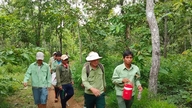
The other day, we trekked up the mountains, following the old "salt road" to retrace the footsteps of our ancestors. Called the "salt road," it was actually a route for transporting food, including salt, from the lowlands to the mountains. Along the old route, many traces of the past remain. People from both the lowlands and the highlands, whenever they recall the old days, still feel a pang of nostalgia, remembering a time of close ties and sharing through those journeys carrying goods across the mountains and the arduous carts struggling up the steep, rocky slopes.
Young jackfruit was regularly sent down, and flying fish were diligently brought up. That simple act of kindness remains vivid in the memories of many even now…
Source: https://baodanang.vn/mit-non-gui-xuong-3339836.html
![[Photo] General Secretary and President To Lam attends the Central Public Security Party Committee Conference](https://vphoto.vietnam.vn/thumb/1200x675/vietnam/resource/IMAGE/2026/06/24/1782302063612_a1-bnd-9302-9166-jpg.webp)
![[Photo] The 13th National Congress of the Youth Union conducts personnel work.](https://vphoto.vietnam.vn/thumb/1200x675/vietnam/resource/IMAGE/2026/06/24/1782299943080_ndo_br_1-6868-jpg.webp)
![[Photo] Opening Ceremony of the 13th National Congress of the Ho Chi Minh Communist Youth Union](https://vphoto.vietnam.vn/thumb/1200x675/vietnam/resource/IMAGE/2026/06/24/1782286753905_ndo_br_1-8510-jpg.webp)