

Abolish or reduce more business conditions than required.
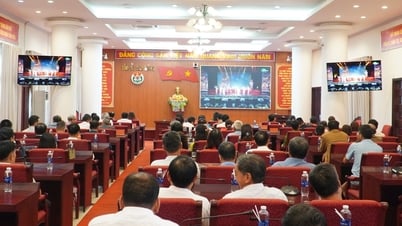
At the seminar "Opening the Highway" for the Private Economy organized by Tien Phong Newspaper on the morning of May 28th, Ms. Bui Thu Thuy - Deputy Director of the Department of Private Enterprise and Collective Economy Development, Ministry of Finance , stated that many policies in Resolution 68 are not new but have been mentioned during policy research over the past 20 years.
However, policies haven't yet addressed the problems faced by businesses. We have many laws, resolutions, and decisions on supporting small and medium-sized enterprises, and providing special investment support for businesses seeking technology transfer. Policies exist, but they are vague and fail to reach the needs of businesses.
With Resolution 68, which received the highest level of attention and whose guiding principles, as outlined in General Secretary To Lam's speech, the drafting committee dared to address the issue more strongly. For example, the clarification regarding the non-criminalization of economic relations, despite being mentioned long ago, had not been implemented for decades to ensure a level of reassurance for the private sector.
Immediately after Resolution 68 was passed, the drafting committee prepared draft resolutions for the National Assembly and the Government. The National Assembly issued Resolution 198 within 11 days. Within one week, the drafting committee submitted two resolutions to the Government for the Government to assign responsibilities to each agency.
Currently, the draft Government Resolution clearly stipulates the policy and timeframe. Ministries, sectors, and localities are to issue implementation plans in the second quarter of 2025. Given the current momentum, I hope that ministries and sectors will implement the plan as quickly as possible, and that localities will begin developing action plans.
The policies in Resolution 68 are relatively clear and not difficult to understand during implementation. We expect that the content will be institutionalized by June or July 2025 and implemented in the second half of 2025.
At the seminar, Mr. Phan Duc Hieu, a member of the National Assembly's Economic Committee, suggested that more business conditions could be abolished or reduced than required. He argued that fully implementing the spirit of Resolution 68 would create a historical turning point in the development of the private economy.

The problem is how to fully and effectively implement the contents of the resolution. Because the process from the Party's policy to institutionalization and putting it into practice is very difficult, even more difficult than drafting the resolution itself. If it cannot be institutionalized, then the resolution remains just a resolution.
Institutionalizing these measures requires amending laws, repealing laws, and abolishing decrees and circulars, which takes time. However, with the determination of the Government and the National Assembly, within 11 days of Resolution 68's issuance, the Government submitted a draft resolution, and the National Assembly issued Resolution 198 on some special mechanisms and policies for the development of the private economy to institutionalize some of the contents of Resolution 68.
This is considered the first and most urgent legal action to implement Resolution 68. Many provisions in Resolution 198 of the National Assembly can be implemented immediately, such as tax exemptions and reductions, bidding procedures, inspections, and audits. However, many more provisions need to be further implemented to institutionalize them.
The resolution also sets a timeline for government action, including prioritizing the implementation of laws on investment and business to create a more favorable environment for enterprises.
For example, Resolution 198 requires that by December 31, 2025 at the latest, the review and elimination of unnecessary business conditions, overlapping regulations, inappropriate regulations, and those hindering the development of private enterprises must be completed; administrative procedure processing time, compliance costs, and business conditions must be reduced by at least 30%, with further significant reductions in subsequent years. However, the government can completely reduce administrative procedures and business conditions at a higher rate, even abolishing them entirely or reducing them by 60-70%.
If a highway has been opened, it should be open for the majority to use.
According to Mr. Mai Son, Deputy Director of the Tax Department, Ministry of Finance, in recent years, the lump-sum tax system has been applied as a support solution, suitable to the management conditions and compliance capacity of business households.
However, in the context of an increasingly developing economy and growing demands for transparency, fairness, and modernization of management, the contract-based system has revealed some limitations and has not provided the necessary incentives for business households to expand their production and business scale.
It can be said that the abolition of the lump-sum tax system is a revolutionary turning point in tax management for household businesses. The transition from the lump-sum to the declaration-based system is not only a change in tax calculation methods, but also a fundamental shift in management thinking, in how tax authorities work alongside taxpayers.
The abolition of the lump-sum tax system for household businesses has significant implications for the development of the private economy as well as for state management.
Mr. Nguyen Kim Hung, Vice President of the Vietnam Association of Small and Medium Enterprises and Chairman of the Board of Directors of Kim Nam Group, stated that the small and medium-sized enterprise community is the final service provider for consumers in society. Resolution 68 has created a new impetus.
We hope that with institutional breakthroughs, small and medium-sized enterprises (SMEs) will be able to operate more professionally and efficiently, offering better quality products and services at more reasonable prices.
In addition to enacting regulations, communication efforts need to be strengthened, not only through disseminating Resolution 68 but also by sharing successful experiences of small and medium-sized enterprises, so that the business community can embark on the private economic highway.
Besides Resolution 68, we could consider issuing a specific resolution or institutional framework to promote the development of small and medium-sized enterprises (SMEs). If we've opened a highway, we need to allow the majority to use it, not just large corporations and businesses. We need a separate resolution specifically for the SME community to protect them and provide them with the impetus for growth.
We need to further concretize this through resolutions and institutions to transform 5 million individual business households into sustainable enterprises.
Source: https://baodaknong.vn/mo-cao-toc-cho-kinh-te-tu-nhan-phat-trien-253865.html


![[Image] A night of light, many layers of message](https://vphoto.vietnam.vn/thumb/1200x675/vietnam/resource/IMAGE/2026/03/10/1773158812907_hoa-nhac9-jpg.webp)
























































































Comment (0)