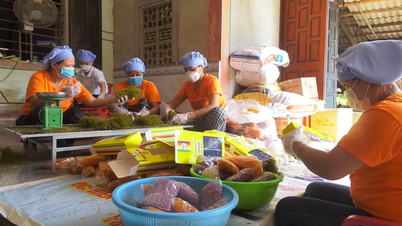
Ms. Nguyen Thi Toan prepares a meal in her social housing unit in the Northwest urban area, Rach Gia ward. Photo: KIEU DIEM
The worry about buying a house
After their afternoon shift, Mr. Phu Thanh Tam and Ms. Nguyen Thi Ngoc Giau, garbage collectors at an urban construction company in Rach Gia ward, return to their small rented room, less than 20 square meters. That room is the living space for their family of four. Their income is nearly 11 million VND per month, but rent, electricity, and water already cost 3 million VND. The remaining amount must cover food, their children's education, and other living expenses.
“My wife and I try to collect scrap metal to sell to earn extra money, saving a little each month, but we don’t know when we’ll have enough money to buy a social housing unit. To buy one, we need a down payment, while the current housing prices are very high compared to our income,” Mr. Tam said.
Every day, while collecting garbage in the Northwest urban area, Mr. Tam and his wife look at the rows of social housing that they yearn for. They have been renting for over 13 years, as buying land and building a house is beyond their means. Ms. Giau said, "I only hope to have an affordable social housing unit, with the option of obtaining a loan and paying in installments over a long period, so that our family can even think about settling down."
The story of Mr. Tam and Mrs. Giàu reflects the shared concerns of many low-income workers and laborers living and working in urban areas, industrial zones, and industrial clusters within the province. For them, housing is an essential need for a stable life. When housing is precarious, it is difficult for workers to fully commit to their jobs in the long term.

Social housing complex in the Northwest urban area, Rach Gia ward. Photo: KIEU DIEM


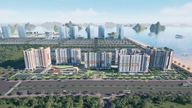
Ms. Nguyen Thi Toan in her social housing unit in the Northwest urban area, Rach Gia ward. Photo: KIEU DIEM
Supply has not met demand.
Along with urbanization and the expansion of development space after mergers, the demand for social housing in An Giang is growing. Those in need are not only industrial zone workers but also low-income urban workers, young officials and civil servants, and households without stable housing.
According to the government's targets, An Giang province plans to invest in the construction of 9,800 social housing units during the 2021-2030 period, with 2,799 units completed during the 2021-2024 period and another 7,001 units completed during the 2025-2030 period. As of the end of May 2026, the province has 13 social housing projects with approved investment plans, totaling 10,629 units, of which 9 projects have commenced construction.
An Giang has completed two projects: the social housing project in the Northwest urban area of Rach Gia ward, with a scale of 1,011 low-rise units, and the social housing project in the Tay Dai Hoc residential area, with a scale of 448 units. Currently, there are 7 projects under construction, with a scale of 6,579 units, of which 3,200 units will be partially completed in the 2021-2025 period.
The figures above show that the province is paying attention to and promoting the supply of social housing. However, based on the actual needs of workers, it is clear that the problem lies not only in how many units to build but also in the selling price, accessibility, initial payment amount, loan availability, and installment payment methods suitable to the income of workers.
For many working-class families, the biggest obstacle is not having enough initial savings. Monthly income is barely enough to cover living expenses, rent, and children's school fees, so having a down payment readily available is a huge pressure.

Mr. Phu Thanh Tam and Ms. Nguyen Thi Ngoc Giau in the rented room they have been living in for 10 years. Photo: KIEU DIEM
More opportunities for low-income earners
Thanks to preferential policies, Ms. Nguyen Thi Toan, a worker in Rach Gia ward, was able to buy a social housing unit in the Northwest urban area. To buy the house, she and her husband received some financial support from family and borrowed more to cover the down payment. Her husband's income is used to pay the monthly bank loan installments. Ms. Toan takes advantage of her free time to do hourly domestic work to supplement her income. “Thanks to the preferential interest rate and long repayment period, my family dared to buy a house. If we hadn't had the initial financial support from relatives and hadn't been able to get a long-term loan, we wouldn't have been able to buy a house,” Ms. Toan shared.



Over the past period, social housing policies have been continuously adjusted to alleviate difficulties for buyers, investors, and localities. Decree No. 54/2026/ND-CP amends and supplements many regulations in the field of housing and real estate business, including expanding the criteria for determining the condition of not owning a house, adding mechanisms for income declaration, commitment, and post-audit, and standardizing the procedures for selling, leasing, and renting social housing.
Besides accessibility, preferential credit policies are also a crucial leverage. According to the Social Policy Bank, eligible individuals purchasing or renting social housing can borrow up to 80% of the contract value; in the case of loans for new construction, renovation, or repair of housing, they can borrow up to 70% of the estimated cost or capital utilization plan, but not exceeding 1 billion VND. The maximum loan term is 25 years, and the current interest rate is 5.4% per year.
For workers, social housing needs to be not only affordable but also have an accessible payment method. If monthly installments are equivalent to or only slightly higher than rent, the dream of owning a home will be closer to reality for many working families. When policies are implemented transparently, closely aligned with needs and affordability, social housing becomes a support system for workers to stabilize their lives and commit to long-term employment.
Source: https://baoangiang.com.vn/mo-cua-giac-mo-an-cu-cua-cong-nhan-a488417.html




































![[Photo] Thousands of people participate in a run to show their support for the campaign "Sharing a common determination to build drug-free communes, wards, and special zones".](https://vphoto.vietnam.vn/thumb/1200x675/vietnam/resource/IMAGE/2026/06/27/1782554475933_0673e2a3df7b5e25076a-8283-jpg.webp)