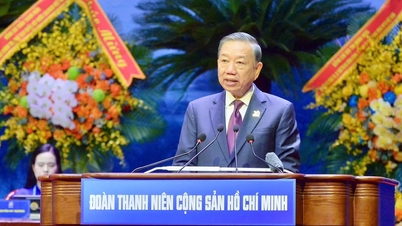
In the context where science , technology, and innovation are becoming key drivers of development, basic science is increasingly recognized as the foundation of national self-reliance. Therefore, when General Secretary and President To Lam raised the issue of building a strategy for developing basic science to become the foundation of national knowledge, it was not only a story about science but also a message about the future development of the country.
Investing in basic science is not about seeking short-term gains, but rather a strategic preparation for Vietnam to gradually master technology, enhance its competitiveness, and participate more deeply in the global value chain . A reporter from the People's Police Newspaper had a conversation with Professor Rick Bennett, Vice-Chancellor and Vice-President of the British University Vietnam (BUV), about this issue.
PV : Resolution 57 of the Politburo on breakthroughs in science and technology, innovation, and national digital transformation, especially the recent directives of General Secretary and President To Lam, all emphasize the fundamental role of basic science in the development of science, technology, innovation, and national self-reliance. In your opinion, what is the significance of this message for Vietnam's development strategy in the current period?
Professor Rick Bennett: Basic science is the foundation for a nation to transition from receiving technology to mastering, improving, and creating its own technology. The long-term goal should not only be "Made in Vietnam" but also "Designed in Vietnam," where Vietnam creates products and technologies with its own unique identity.
A country can grow by adopting technology, but if it only focuses on processing and assembly, it will be difficult to reach the highest levels in the global value chain. The core values of a knowledge-based economy, such as research, invention, intellectual property, and source technology, will remain in the hands of other countries. International experience shows that successful economies consistently invest in science and education to build independent research capabilities.
South Korea didn't become a semiconductor powerhouse solely through manufacturing plants, but through decades of persistent investment in scientific research, technical education, and an innovation ecosystem. Singapore also spent years building world-class research institutes and attracting scientific talent before rising to become a leading center for biotechnology and high technology. Similarly, Japan's post-World War II breakthrough was backed by a long-term strategy of developing scientific capabilities, laying the foundation for its leadership in electronics, materials science, and advanced manufacturing.
For Vietnam, the current requirement is not only to attract high-tech projects but also to gradually master the stages that create the greatest value in the global value chain. In fields such as AI, semiconductors, and smart manufacturing, basic science is the foundation for developing high-quality human resources and creating technologies with a Vietnamese imprint. Only then can Vietnam shift from a position of receiving technology to participating more deeply in the process of knowledge creation and innovation, thereby enhancing national self-reliance and competitiveness in the long term.
PV: Many developed countries continue to invest heavily in basic science even though this field may not yield immediate economic benefits. In your opinion, will investing in basic science be a "boost" to enhance Vietnam's national competitiveness in the future?
Professor Rick Bennett : Developed countries invest heavily in basic science because they understand that it is the foundation that determines future competitiveness. Technological breakthroughs often originate from fundamental research conducted years, even decades, ago. Artificial intelligence is a prime example. The mathematical and algorithmic foundations that fuel today's AI revolution were built long before their commercial value was realized. Thanks to early and persistent investment, many countries have accumulated high-quality human resources, research capabilities, and intellectual property systems – strategic advantages in today's technological race.
For Vietnam, the greatest value of basic science lies in building long-term competitiveness. In the context of global corporations increasingly establishing research and innovation centers in locations with high-quality scientific human resources, countries possessing a strong scientific foundation will have the opportunity to attract the highest value-added capital flows. Investing in basic science today is the process of preparing human resources, knowledge, and innovative capabilities so that Vietnam can not only attract manufacturing plants but also become a destination for R&D centers and core technology projects in the future.

PV: General Secretary and President To Lam emphasized that Vietnam cannot simply lag behind and adopt technologies developed abroad. In your opinion, how should this statement be interpreted in the context of current global technological competition?



Professor Rick Bennett: Over the past three decades, Vietnam has successfully integrated into global supply chains. However, the challenge for the next phase is to gradually become a valuable link in the global innovation chain. In strategic technology sectors such as AI or semiconductors, the greatest value increasingly lies in research, design, software development, and intellectual property rather than mere manufacturing. Therefore, Vietnam needs to build stronger capabilities in research, engineering, product development, and technology commercialization to increase the value it creates.
However, this does not mean Vietnam must compete directly with technological powerhouses in every field. Success lies in correctly identifying areas where we can build our own competitive advantage and become a crucial link in the global innovation network. Vietnam's opportunities are likely to lie in applying new technologies to areas where we already have a foundation and advantages, such as advanced manufacturing, digital services, creative industries, agricultural technology, and smart logistics.
PV: A noteworthy point in the speech by General Secretary and President To Lam is the requirement to accept risks, including failure, in scientific research. In your opinion, what changes are needed in mechanisms, policies, and the research environment to encourage innovation and create scientific and technological breakthroughs?
Professor Rick Bennett: In my opinion, first and foremost, we need to change the way we evaluate success in scientific research. If we only focus on short-term indicators such as the number of publications or patents, the system may inadvertently encourage safe, low-risk research directions. Meanwhile, major breakthroughs often stem from unanswered questions, and their value is only recognized after many years.
Secondly, research funding mechanisms need to be reformed. Many developed countries allocate a portion of their resources to high-risk projects with the potential to create breakthrough impacts.
Third, a clear distinction must be made between exploratory research and applied research in the evaluation mechanism. Research aimed at answering fundamental questions should not be judged solely on commercialization or revenue. Each type of research has different objectives and needs to be measured using appropriate metrics.
More importantly, building an environment for innovation is not just about increasing investment, but also about fostering a scientific culture that encourages experimentation, accepts controlled failure, and promotes discovery thinking. When scientists are given the space to pursue new ideas without being overly concerned about short-term risks, the likelihood of discovering inventions of great national value increases significantly.
PV: In your opinion, which basic science fields should Vietnam prioritize investing in to lay the foundation for strategic sectors such as AI, semiconductor industry, biotechnology, and cybersecurity?
Professor Rick Bennett: In my opinion, Vietnam should prioritize investment in mathematics, computational science, and creative thinking skills because these are the core foundations for most strategic technology fields of the future. Essentially, AI is built on the foundation of mathematics, statistics, and computer science. Cybersecurity relies on cryptography and advanced algorithms. Semiconductor circuit design increasingly depends on complex computational models and modern simulation capabilities. Even biotechnology is shifting strongly towards data, increasingly integrating with computational biology and machine learning. Therefore, investing in these foundational sciences not only serves a single field but also creates capabilities for many different strategic sectors.
Vietnam actually possesses a significant advantage. For many years, we have consistently made our mark in international mathematics competitions and have a workforce with strong quantitative thinking skills. However, academic achievements or international awards do not automatically translate into national scientific capacity and technological strength. The greater challenge lies in building an ecosystem capable of identifying, nurturing, and connecting talent with research, innovation, and technology commercialization. This is where universities play a particularly crucial role.

The goal is not only to train more outstanding students, but also to create an environment where learners can participate in research from an early age, work interdisciplinaryly, develop creative thinking, and access practical problems in society and businesses. Countries that succeed in fields such as AI, semiconductors, or biotechnology not only possess talent, but also build effective mechanisms to transform that talent into research capabilities, innovation, and long-term economic value.
For Vietnam, mathematics and computational science should perhaps be prioritized because they are foundational fields with enormous spillover effects. Each advance in these fields can simultaneously provide impetus to many other strategic technology sectors. Given the limited resources, focusing on areas with the potential for such significant synergistic impact will yield the highest return on investment for the long-term development of science, technology, and national competitiveness.



PV: General Secretary and President To Lam also emphasized the role of universities and research institutes as centers of innovation. In your opinion, what changes are needed for universities to truly become driving forces in creating new knowledge?
Professor Rick Bennett: In my opinion, the question isn't just how to retain talented individuals within the country, but more importantly, how to ensure they remain engaged and contribute to Vietnam, regardless of where they study or work in the world. Successful innovation ecosystems today are built on global talent networks. The important thing isn't where they are, but whether their knowledge, experience, and collaboration opportunities continue to be connected to the domestic innovation ecosystem.
To truly empower universities to generate new knowledge, three main directions need to be focused on. Firstly, strengthening the links between universities and businesses to ensure research aligns with practical needs and national development priorities. Secondly, promoting interdisciplinary collaboration, as many current breakthroughs occur at the intersection of different fields. Thirdly, strategically investing in global talent networks to maintain connections, foster collaboration, and attract intellectual resources from the Vietnamese expert community worldwide.
In the long term, the most successful nations will not be those with the most talent, but those that are most effective at connecting talent, knowledge, and opportunity. This will also be the foundation for leading future industries and technologies.
Interviewer: Thank you very much, Professor, for this conversation!
Source: https://cand.vn/moi-dot-pha-deu-bat-nguon-tu-khoa-hoc-co-ban-post815122.html