The taste of memories
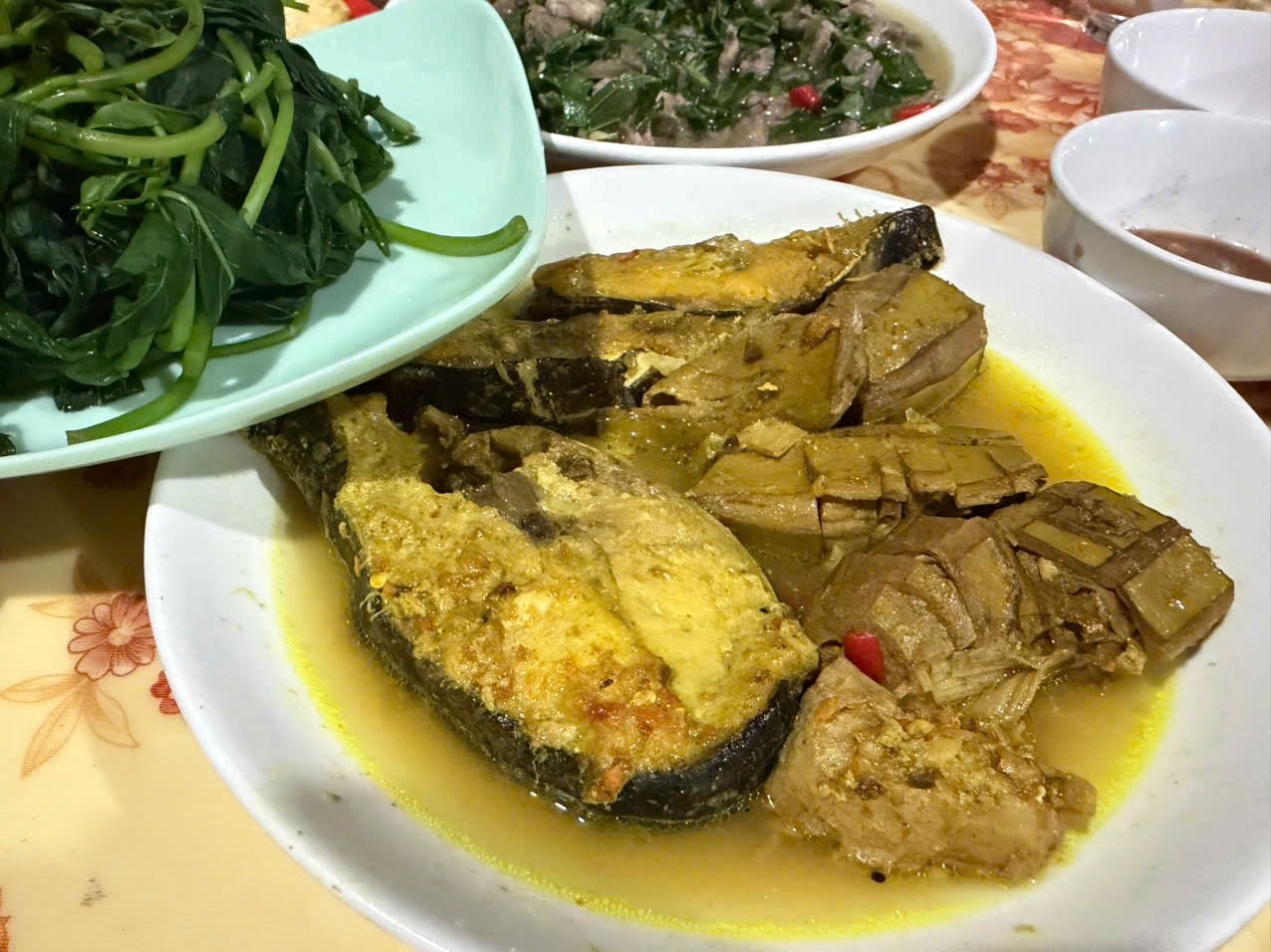
Today, Mrs. Nguyen Thi Lan (73 years old) in Dai Loc commune has guests. A group of her daughter's friends from the Mekong Delta are visiting. In the smoky kitchen, the aroma of fish stewed with unripe bananas and fresh turmeric blends together, filling the air. Mrs. Lan stands by the wood-burning stove, her hands nimbly slicing young jackfruit, occasionally glancing at her guests with a gentle smile.
"The catfish has to be fresh and firm to be delicious," Mrs. Lan said, inspecting the pot of braised fish, her eyes gleaming with a mixture of caution and pride. Beside the pot, a few vibrant green betel leaves, prepared for the young jackfruit soup, were neatly arranged in a basket, along with a few handfuls of freshly picked coriander from her garden. Mrs. Lan carefully picked each leaf, explaining, "Choose leaves with a slightly darker color for the best aroma, and young jackfruit with just-formed seeds; this will make the soup sweet and refreshing, not bitter."
I observed her skillful hands, each movement slow and graceful, as if etched into her memory over many years. Mrs. Lan recounted that her mother used to cook this dish. Back then, during the war, when everything was scarce, the wood-fired stove was always the place where the whole family gathered, eagerly anticipating each meal.
The meal was served at midday. A pot of braised fish sat in the center, still steaming, alongside a bowl of fragrant young jackfruit soup and a plate of fresh, crisp green vegetables just picked from the garden. The guests from the Mekong Delta were momentarily surprised by the simple yet cozy presentation. They took their first bite of the fish, then slowly chewed, as if to savor the richness of the fish, the earthy flavor of the unripe banana, the slight spiciness of turmeric and chili, and the unique savory taste of the fish sauce. The reason the mother from Quang Nam chose this dish to treat her young guests from the Mekong Delta today was simply because "they are from a fish-growing region, but their cooking and seasoning methods are certainly different from those of our people."


Eating a dish is about savoring its flavor, and simultaneously connecting with the spiritual values embedded in each ingredient, spice, and cooking method. Like many mothers from Quang Nam province, Mrs. Lan cooks based on experience and a deep understanding of ingredients that only time can cultivate.
Just like Mrs. Dinh Thi Mua, a woman who started her career selling noodles at the Kiem Lam intersection (Thu Bon commune), Quang Nam cuisine isn't complicated in terms of ingredients, but it demands sophistication in preparation. While Hue beef noodle soup or Hanoi pho might have only one recipe to preserve their flavor, with Quang Nam noodles, it's difficult to pinpoint a common recipe with over ten different toppings. Even chicken noodles can use young chicken, free-range chicken, lemongrass chicken, or even native chicken. Frog, eel, snakehead fish, and various mushrooms can also make up a bowl of Quang Nam noodles.
A "living archive"
From familiar ingredients like fish, vegetables, unripe jackfruit, and unripe bananas, through the hands of grandmothers and mothers, these ingredients are transformed into dishes with very unique flavors. This uniqueness doesn't lie in their sophistication, but in the way spices are combined, and in the naturally balanced levels of saltiness, spiciness, and pungency.
People from Quang Nam province eat saltier food than in many other regions, but that saltiness isn't harsh; it's subtle. It's the saltiness of fish sauce and the sea, balanced by garden vegetables, the astringency of bananas, the nuttiness of beans, and the sweetness of root vegetables. Therefore, cooking here is inseparable from experience. There's no single recipe for everyone. Even with the same braised fish dish, each household may have a different seasoning method, depending on their taste and habits. The cook must "feel" the dish, from the color of the broth and the simmering heat to the aroma. And these sensory skills cannot be learned quickly. They are accumulated over the years, through cooking experiences, and through observing those who came before. The grandmothers and mothers are the ones who preserve and pass on this unspoken language.
However, in modern life, these values are facing many challenges. As time spent in the kitchen decreases and processed foods become increasingly common, dishes that require many steps and a lot of time are gradually being overshadowed. Many young people know about traditional dishes through stories, but have few opportunities to experience the cooking process. They may remember the taste, but they don't know how to recreate it. The gap between "knowing how to eat" and "knowing how to cook" is therefore becoming increasingly apparent.



Nevertheless, the distinctive cuisine of Quang Nam province never disappears, because it still exists in the daily lives of many families. There, grandmothers and mothers persistently maintain the old way of cooking. It's not because they are unaware of new conveniences, but because they understand that some flavors are irreplaceable. This preservation happens naturally, through each meal, each lesson passed down. It might just be a reminder to add a little more salt or pepper, or showing children and grandchildren how to choose ingredients, but it is these small things that contribute to preserving the cultural identity.
Ultimately, cuisine is a part of the value of memory. A delicious dish can be remembered for a long time, not only because of its taste, but also because of what is associated with it. It is this memory that creates a connection between generations. Perhaps in the future, wood-fired kitchens will become less common, and cooking methods will change to some extent. But as long as there are people who remember, who want to learn and preserve, these dishes will still have a place.
Source: https://baodanang.vn/mon-ngon-nho-lau-3334318.html

































![[Image] Ho Chi Minh City: Ma Lang area, Chicken-Rice Market about to change its appearance](https://vphoto.vietnam.vn/thumb/1200x675/vietnam/resource/IMAGE/2026/06/25/1782377698627_ndo_br_m1-jpg.webp)