

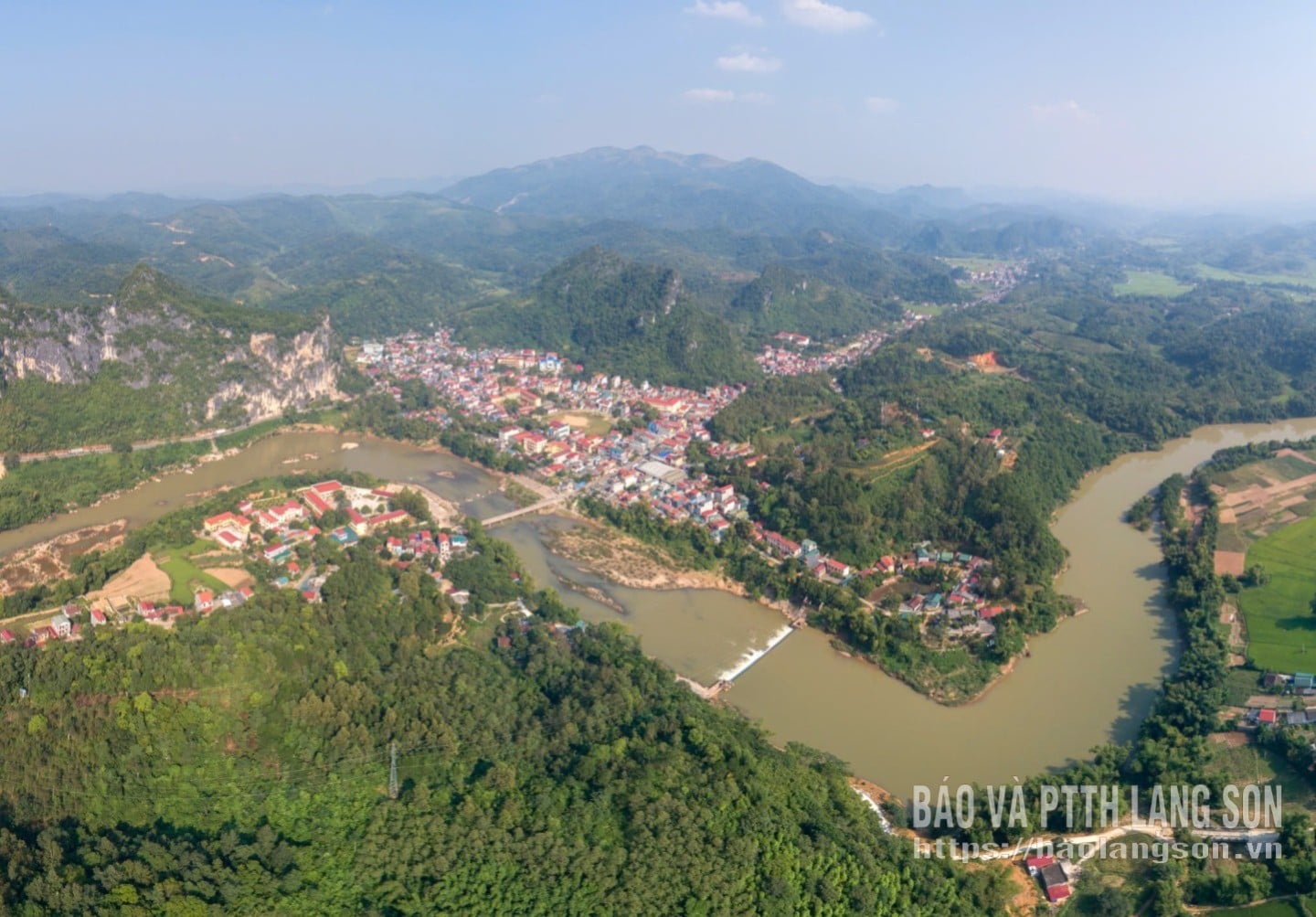
Following the northwest-southeast slope of Vietnam's topography, most rivers flow towards the East Sea. The Ky Cung River, however, is an exception. Originating in the mountainous region of Bac Xa commune at an altitude of 1,166m, the river flows primarily in a southeast-northwest direction through Lang Son city, then changes direction to south-north to Na Sam commune, before turning southeast-northwest again and heading east near That Khe commune. From That Khe, the river flows almost in an arc, then meanders in a northwest-southeast direction to the Chinese border, emptying into the West River basin (China).
At first glance, it's hard to imagine a river "flowing from low to high." But in reality, the Ky Cung River skillfully follows the slopes of the mountainous terrain of Lang Son, choosing its own unique course. Ultimately, like all other rivers, the Ky Cung still reaches the East Sea, only by a different route – winding and meandering amidst the towering mountains and peaceful villages of beloved Lang Son.
This discussion about the Ky Cung River serves as an introduction to the story of the Na Sam River, the name given to the section of the Ky Cung River that passes through the former town of Na Sam, now part of Na Sam commune.
The Na Sam River (formerly known as the Trung Son River) is approximately 2.5 km long. Starting from the south of Na Cha village, the river flows in a southwest-northeast direction, then changes to southeast-northeast, reaching Zone I and turning southwest-northeast again. At the mouth of Ban Tich stream, it changes to northeast-southwest, flowing under the foot of Phjia Mon, and at Tan Hoi, it reverses direction to northeast-southwest, leaving the town limits. The average flow rate of the river is 1300 m³/s. Previously, the river water was almost completely clear, colorless, and odorless year-round, so people could exploit it without treatment, using it directly for daily life and production for a long time, until the 1990s.
The Na Sam River is fed by the Ban Tich and Hoang Viet streams on the right bank, and the Na Cha stream on the left bank. The section from Na Cha to Zone I has a fairly wide riverbed, abundant water, and a winding course. Both banks are lined with low hills and lush green bamboo groves, making it a promising area for ecotourism , offering boat trips for visitors to enjoy the scenic river views.
The section of the river flowing through Hamlet I has a dam built to block water for irrigation. This was part of the policy of irrigating agriculture . In the late 1960s, the Na Sam hydroelectric power station was built and completed, aiming to bring water from the Ky Cung River to irrigate 85 hectares of rice paddies in Tan Lang commune, which had previously suffered from water scarcity and drought, making rice and other industrial crops difficult to cultivate. The irrigation dam also blocks water to generate electricity for lighting in the district town and to support agricultural production by supplying electricity to water pumping stations.
From the hydroelectric dam back to the mouth of the Ban Tich stream, the riverbed is full of submerged rocks, with large rock formations almost completely blocking the river. Because of the limestone mountainous area, the water level on the surface of the river is low due to water being drawn downwards; during the dry season, it is possible to walk across the river by wading along the submerged rocks.
According to an inscription carved on the cliff of Phjia Mòn mountain – a majestic mountain casting its shadow onto the river – in the 18th century, Governor Ngô Thì Sĩ once moored his boat at the foot of the mountain, commanding his soldiers in naval warfare training on the river. This indicates that at that time, the Na Sầm River was wide and deep, with the water level reaching almost to the foot of the mountain. Even further back, in the 13th century, the Kỳ Cùng River entered official history. The "Complete Chronicle of Đại Việt" records that King Trần Thái Tông personally led his army to attack the Vĩnh An and Vĩnh Bình camps (belonging to Khâm Châu and Liêm Châu) of the Song Dynasty by land, and after the victory, returned by water in light boats. Many researchers believe that the fleet passed through the Na Sầm River, upstream along the Kỳ Cùng River towards Lạng Sơn.
Later, the Na Sam River became an important transportation hub, turning Na Sam town into a bustling area with boats and ships. This was in the late 19th and early 20th centuries, when the French invested in building the Hanoi-Lang Son railway line to Dong Dang. Following this, "a 17 km section was built from Dong Dang to Na Cham, connecting to the navigable section of the Ky Cung River. This section was put into operation on November 15, 1921," and Na Cham (Na Sam) Station – the last railway station on the Hanoi-Lang Son line – was also built and put into operation.
The Nacham railway station was connected to the river port, with a bustling market and shops on the docks, and boats coming and going on the river. The book "Van Lang - Land and People" by Dr. Hoang Van Pao and the book "Na Sam - Border Town" by Vuong Toan and Pham Van Thanh both record: "There was a period when the Long Chau (China) - Na Sam river route, about 50 km long, was exploited. On days with high tides, large boats (three-plank boats with a 3-ton capacity) could reach Ban Tich. The number of boats operating in Lang Son province in 1922 was recorded as 918 boats of all types, including 8 boats with a capacity of 0.6 to 6 tons."
The bustling scene of boats and ships at Na Sam town in the early 20th century became a familiar sight in the economic activity of the Northern region during the French colonial period. From Nacham railway station, goods were transported in large quantities to the riverbank for onward shipment to Longzhou, China. Inland, several types of small boats could also travel on the river, from Loc Binh area, through Ky Lua to Na Sam, and up to Trang Dinh, serving transportation and cargo carrying purposes. Along with the railway station, the Na Sam river port facilitated the development of Na Sam town into one of the gateways to the Vietnam-China border, becoming a thriving and bustling trading center, attracting a large number of people from the lowlands and overseas Chinese to live and work there.
Over the course of a century, the town no longer bears any trace of the Nacham Railway Station or the Na Sam River Port.
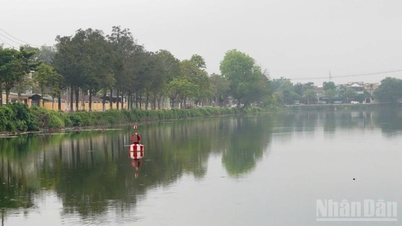
The Na Sam River now has less water and a narrower channel. The water level fluctuates seasonally each year. During the rainy season, the river turns a muddy red, and the water rises, flooding the bridge and reaching the vegetable fields on the right bank. During the dry season, the river is calm, clear, and in many sections, submerged rock formations emerge, creating a beautiful sight.
During a conversation with poet and ethnic culture researcher Hoang Choong, former Head of the Culture and Information Department of Van Lang District, I heard him recount stories about the Na Sam area and the Ky Cung River that flowed through it since childhood. He said that long ago, during a great flood, the river rose, submerging vast areas, leaving only a few high mountains above the water. Hence the saying, "Khau Kheo nhang do tu meo du, Khau Khu nhang do pu non, Phjie Mon nhang do linh khin, Khau Slin nhang tay an da, Khau Mia nhang tay an khuon." (Khau Kheo - Khau Muoi still has enough room for a cat to lie down, Khau Khu still has enough room for an old man to sleep, Phjie Mon still has enough room for a monkey to climb, Khau Slin is still the size of a sieve, Khau Ma is still the size of a basket). And that is the context in which the "Hang Slec Legend" about the story of Phjie Mon mountain was born, a legend that is still passed down to this day.
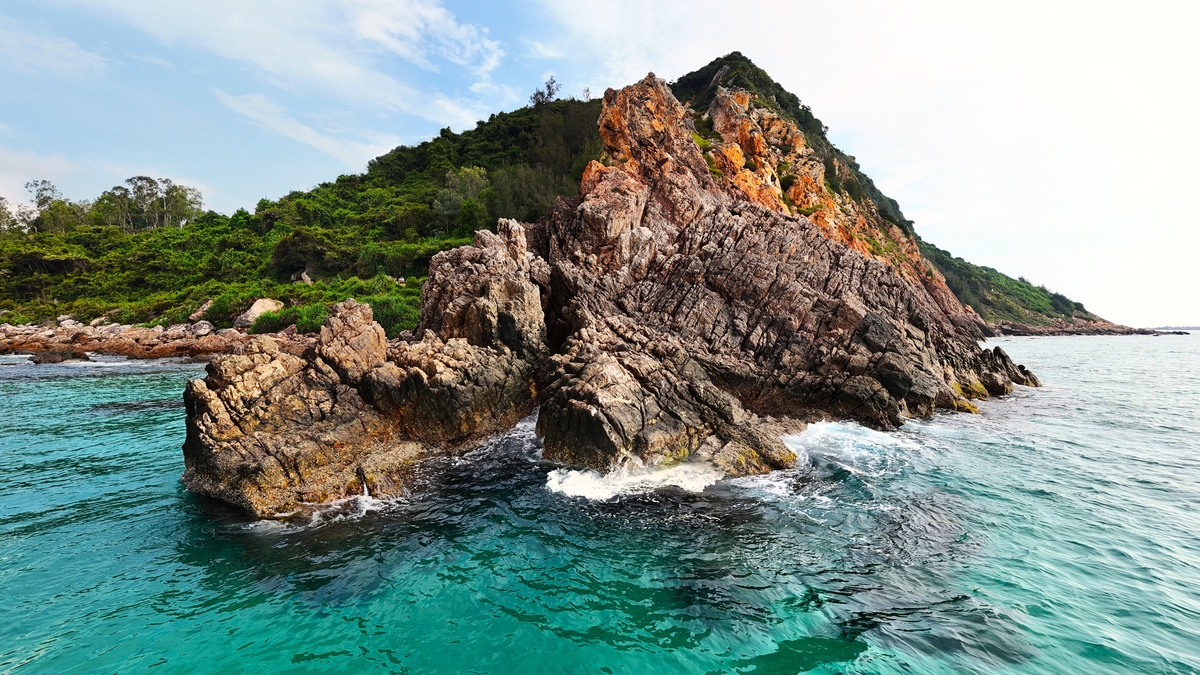
On the Na Sam River, near the mouth of the Ban Tich stream, there is a rocky island that the people of Na Sam call Doong Pha. According to Mr. Hoang Choong, Doong Pha means turtle shell, probably because the island is shaped like a giant turtle shell floating on the water.
Several decades ago, Doong Pha was very close to the shore. It was a submerged rocky island, extending deep into the riverbed, with the part above the water in winter accounting for up to two-thirds of the river's width. From the riverbank, you only needed to roll up your trousers and wade a few steps on its submerged foot to reach the island. Children and adults wearing canvas shoes or afraid of getting their feet wet could ask a friend to carry them across. It was more of a jump onto a friend's back, and with a quick turn, you were standing on the island! Now, the island is about ten meters from the shore because the Ky Cung River has eroded towards Na Sam town. When I was little, I heard adults tell stories about a Chinese engineer who came to help build the hydroelectric dam and predicted that in a few decades, Na Sam town would no longer be intact because of this riverbank erosion. It's been almost a hundred years now, and indeed, the town has been partially eroded by the river, but Van Lang district and the former Na Sam town have invested in building riverbank embankments, both to prevent erosion and to create a scenic landscape, pedestrian walkways, and picturesque river views for locals and tourists.
The Na Sam River – a section of the Ky Cung River – holds within its heart countless legends, having accompanied the history of the beloved Lang Son region for thousands of years. Many questions and concerns remain, and we hope that scientists, historians, and those who cherish their homeland will continue to research and answer them: Were the Na Sam and Ky Cung rivers one of the diplomatic routes used by the ancient Vietnamese feudal dynasties? Were they one of the migration routes of generations of people from the North seeking to settle and establish themselves in the peaceful and prosperous South? And what climate and geological changes have drained the once abundant water deep into the earth, leaving the rivers so small, gentle, and humble today?
Although the answer remains to be seen, for the people of Na Sam, that river will forever be a memory, the soul of a land that was once bustling with boats and ships.
Source: https://baolangson.vn/mot-thoi-tren-ben-duoi-thuyen-5070571.html

![[Photo] Prime Minister Pham Minh Chinh receives the Director of RMIT University Melbourne (Australia)](https://vphoto.vietnam.vn/thumb/1200x675/vietnam/resource/IMAGE/2026/04/02/1775142120087_thiet-ke-chua-co-ten-2026-04-02t214220784-png.webp)


































































Comment (0)