

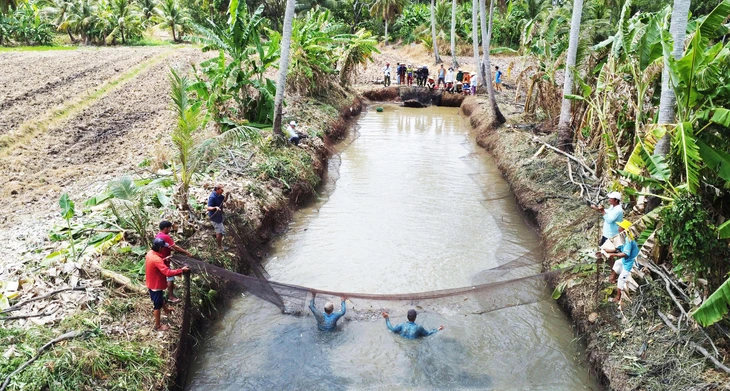
A pond is a low-lying area in a rice field where fish take shelter during the dry season - Photo: THANH HUYEN
The fertile U Minh Ha region is blessed with many natural resources, including freshwater fish that are becoming increasingly rare. The practice of working together to catch fish in ponds during the dry season is not only for catching fish but also reflects the beautiful spirit of community and neighborly love among the people of Ca Mau, a tradition that has been passed down to this day.
1. People from other regions might find the term "pond" a bit strange, but honestly, everyone in this area knows ponds as well as they know a few lines of traditional Vietnamese folk songs. Ponds (or lakes) are typically 2-4 meters deep, but depending on the size of the land, people can dig them to be 5-10 meters wide and at least twice or three times that length.
After the war, large bomb craters or double bomb craters (where two bombs were dropped next to each other) could also be called ponds if they were utilized to allow wild fish to gather or for aquaculture, as was done later.
Since the time of our ancestors, we have known the characteristics of fish species: they usually retreat to deep lowlands during the dry season to take shelter and come out to the fields to breed during the rainy season. The pond fishing season begins after the rice harvest is complete, when the fields are dry and farmers have free time to catch fish to sell and eat, as well as for recreation after the harvest.
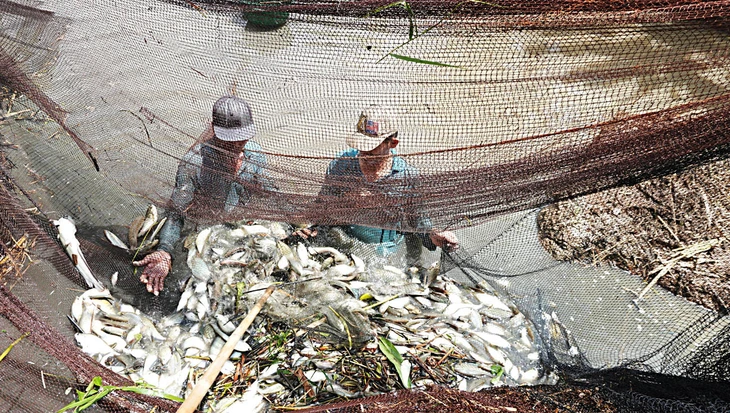
After the fish are gathered in the corner of the net, the locals will scoop them up and sort them.
Mr. Dinh Van Ut (Trum Thuat hamlet, Khanh Hai commune, Tran Van Thoi district, Ca Mau) said that in the past, the vast U Minh area, including this region, was teeming with freshwater fish. This is also the birthplace of Uncle Ba Phi, where the story of the snakehead fish eating a huge, fallen dried coconut originated.
"Nowadays, there aren't as many freshwater fish as before, but our people still maintain the traditional method of catching fish by working together to fill the ponds (one household helps another without expecting any payment, and when needed, everyone helps in return). This method suits the current labor shortage in rural areas," Mr. Ut said.
Mr. Ut's family owns 2 hectares of rice paddies. Thanks to the mechanized embankment system, the fish can swim freely during the rainy season and retreat to the ponds during the dry season. Every year, during the fish harvesting season, Mr. Ut earns about 20 million VND from his two fish ponds.
This year, too, Uncle Ut joined four neighboring families who owned ponds in a mutual assistance effort.
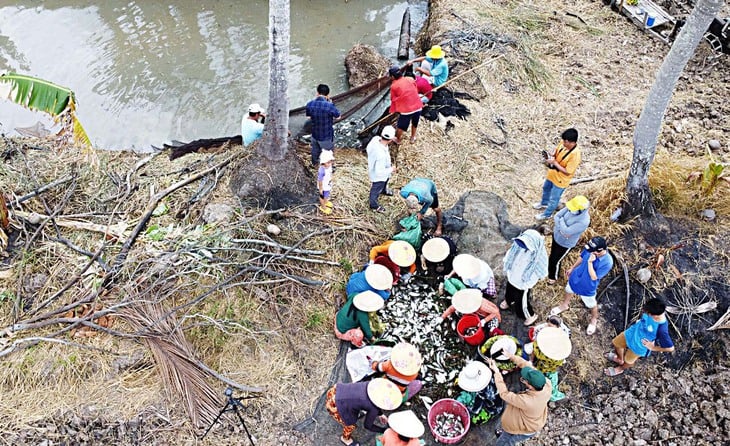
Many women gather in groups to select fish.
2. Ms. Vu Thi Hien, a neighbor, said: "After taking pictures of the fourth pond, Mr. Ut informed us that he wanted to take pictures of his own pond. Automatically, today my colleagues and I have been here since early morning to prepare and help Mr. Ut get back to work."
This woman from Uncle Ba Phi's hometown cheerfully shared another rare hobby.
"Taking pictures of the pond is incredibly fun. The pond owner has to clear away all the branches and twigs under the pond and remove the weeds around it the day before. The reed stakes must be prepared in advance, and everyone will bring the nets."
Early in the morning, they would cast their nets to catch fish to sell at the market. The men would do the heavy work like securing the nets and catching the fish, while the women would sort and prepare the fish.
In between the pond-fishing process, while waiting for the fish to come into the net, the men can enjoy a few glasses of rice wine with the snakehead fish they caught at the mouth of the pond when the net is lowered and the fish jump up. Meanwhile, the women chat about the harvest, their husbands, and children."
To catch fish in a pond, a large net, wider than the pond's opening, is used to cover the entire water surface. The net is then slowly lowered to about half a meter from the bottom of the pond, and small bamboo branches or reeds, bent in half, are used to secure the edges of the net to the pond's sides.
Setting up the nets requires a lot of experience, because you have to leave enough space near the edge of the pond for the fish to surface to breathe without falling back to the bottom.
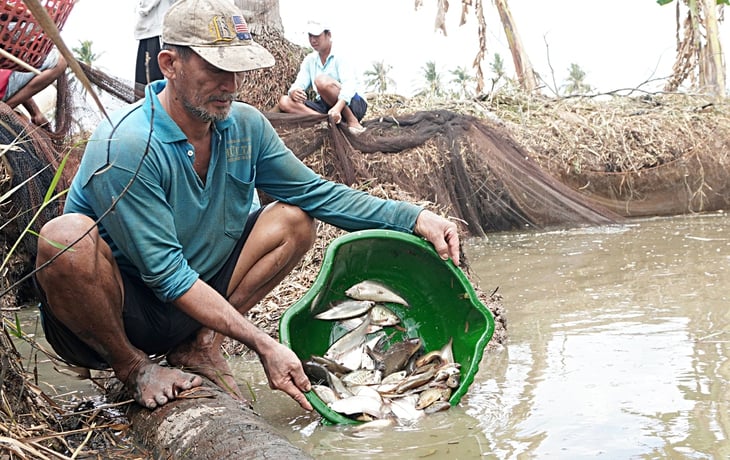
Smaller fish are released back into the environment to allow for larger fish to breed and reproduce for the next season.
After securing the net, the fisherman will wait about two hours for all the fish to come to the surface and lie neatly on the net. At this point, the fisherman will pull the two edges of the net up and secure them to the bank of the pond, then pull the net to gather the fish to one end of the pond and use a net to scoop them up.
This way, the fish smaller than the mesh size will fall back into the pond, allowing the pond owner to catch only the larger fish and leave the smaller ones for the next season.
The most exciting part was pulling in the nets because the fish would jump around frantically trying to escape. Those on shore would pick out the biggest ones that jumped up to "claim their share," intending to catch them later and grill them while chatting and gossiping. The host was always generous, choosing the biggest fish to treat the crew. The women would sort the larger fish and sell them to traders.
When leaving, the homeowner never forgets to pack some delicious fish for the neighbors as gifts for the children or the elderly who couldn't go fishing in the pond.
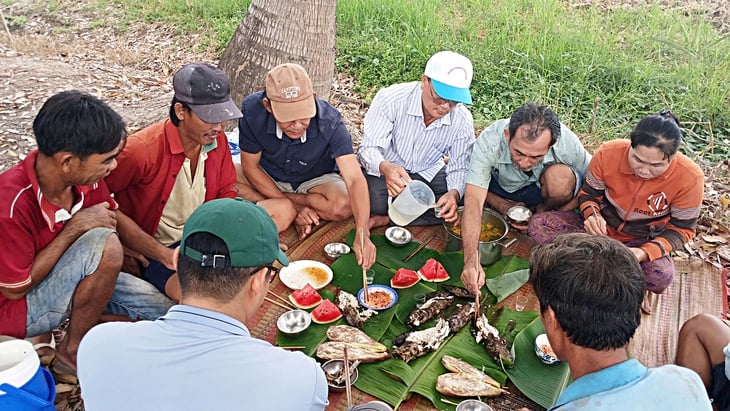
The simple yet delightful reward of grilled fish for the neighbors who helped take pictures of the pond.
The pond-shooting session concluded with a reward for the villagers: a grilled fish feast on the shore and a few glasses of strong, spicy rice wine.
After helping the pond owner clean the fish, the mothers and sisters would prepare a pot of fish porridge or a bowl of bitter greens soup that they had conveniently picked from the fields, and then sit together happily discussing which pond they would photograph next.
Source: https://tuoitre.vn/mua-chup-dia-xu-bac-ba-phi-2025050310041542.htm
![[Photo] Prime Minister Pham Minh Chinh receives the Director of RMIT University Melbourne (Australia)](https://vphoto.vietnam.vn/thumb/1200x675/vietnam/resource/IMAGE/2026/04/02/1775142120087_thiet-ke-chua-co-ten-2026-04-02t214220784-png.webp)
















































Comment (0)