

Sitting huddled in a corner of the market, she invited me, "Buy some Cau Hai clams, it's the beginning of the season." I took the bag of clams she offered, admiring their sea-green color, and remembered my mother. I used to hear my mother say that Cau Hai clams were the best. The clams were small and round, like a buffalo's eye, with green legs, and a crunchy texture. People at the market would buy them immediately upon hearing "Cau Hai clams," knowing they were guaranteed to be delicious. I once asked why their legs were sea-green, and my mother answered hesitantly, "Because that's Cau Hai clams..." My mother was always right. And that lunchtime, the whole family enjoyed a delicious clam noodle soup.
She's a daughter of Cau Hai, married into a family in Hue , and now sells local produce. No wonder she spoke so enthusiastically about the clams, fish, and shrimp from Cau Hai. I saw her gently handling each bag of clams, each bag of sea bream, and each bag of sea bass. I could read the longing for her homeland in her eyes. Regarding the clams specifically, she said, "They're a gift from the lagoon, a gift from heaven; you only get what heaven gives!"
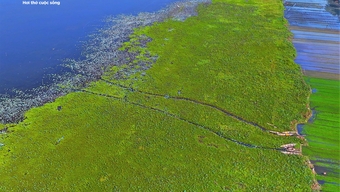
Around the end of spring, when the weather starts to get hot, the people working in the lagoon in my sister's hometown often look at the scum floating on the surface of the lagoon and know that the clam season, "the season to harvest the bounty of the lagoon," is about to begin. The sunnier the weather, the more clams appear. Clams float in large patches on the lagoon's surface, and the people working there simply cast nets and use scoops to bring the clams onto their boats or sail on the lagoon to collect them. The clam season usually lasts only two months, and clams are only available at the market on hot, sunny days. Those who love this dish buy them as soon as they see them at the market because they know that if they keep postponing it, they might not get a proper clam noodle soup until the end of the season – because if the weather doesn't keep its promise, they have no choice but to accept it.
I bought two bags of clams, one for myself and one to give to my neighbor. She said, "It looks simple, but it takes a lot of hard work to get them like that from the pond. You have to soak them in the sun for several hours, then vigorously stir them in a circular motion to remove as much water as possible, until the clams, which were initially as big as a large bowl, are now only the size of a small teacup. A bag of clams like that is actually quite a lot at first."
For the people of Hue, sea snails are a familiar dish that has become addictive. After being squeezed dry, the sea snails are reduced to tiny bodies, yet they retain the aroma and flavor of the lagoon. The smell of fresh seafood and the slightly salty taste of the lagoon are delicious when you're used to them, but can feel a little unsettling to those unfamiliar with them. Hue's mothers have found a way to overcome this: they pick a few guava leaves from their gardens and soak the sea snails in the water with the guava leaves, only taking them out when ready to eat. This makes the sea snails crunchy and also eliminates the raw seafood smell.
Sea snails are "the crystallization of water," so if left for a long time, they will release water. I remember my mother often used a bowl placed upside down on a large, fairly deep plate, and then placed the sea snails around it. The water would drain into the plate, keeping the sea snails dry and crispy. For a more appealing presentation, she would add a few sprigs of herbs and a red chili pepper. In the scorching summer heat of Hue, looking at the plate of fresh sea snails felt like a refreshing lagoon breeze, soothing the soul, pleasing the eyes, and refreshing the mouth—mouths ready for the sea snail noodle soup that Hue mothers knew how to make for their families, guests, and friends.
A simpler version of the vermicelli with fermented shrimp paste is the one with shrimp paste dipped in fermented shrimp paste. This dish is easy to make but requires a delicious plate of fresh vegetables including unripe bananas, figs, and herbs. Take a piece of shrimp paste with some fresh vegetables, dip it into the fragrant fermented shrimp paste with its aroma of lime, chili, and garlic, and the whole experience—the smell, the taste, the aroma, the lagoon, the rice paddies—all enter the stomachs of the children, leaving a lasting impression.
I don't understand how those old country mothers knew everything. My mother said that the water snail is the essence of water. Water snails are born from water, they don't eat anything else, they grow on water, so my mother often said that eating water snails was a blessing from heaven, that it was good, and could cure diseases, specifically goiter. Children believed my mother just as they believed all the food she cooked was delicious, and water snails were a particularly special delicacy, delicious only when it was in season, not always available, so this humble dish became a rare treat.
When the clam season arrives, going to the market reveals the sea and lagoons all present. There's tuna, mackerel, barracuda, tuna, snapper, brown fish, shrimp, prawns, clams, squid... but clams remain the most prominent, thanks to the sea-blue color of their legs. That blue evokes the vast lagoons of Hue, suggesting a deep, boundless view of the ocean, as blue and gentle as the hair of the woman selling clams at the market corner. The clam, gentle and small, looks rustic, but its value is unique. Nowadays, people can farm delicious freshwater and brackish water fish and shrimp, so they are available year-round. But the clam, a gift from the lagoon, arrives and departs according to the season's promise, leaving behind a sense of anticipation for many.
I said goodbye to the woman selling the clams before leaving, her voice filled with heartfelt advice, "With this weather, there might not be any clams tomorrow or the day after. If you see a sunny day, go to the market and buy some. But the clam season is very short."
The season for sea snails is short, but Hue's sea snails will remain forever in the memories and nostalgia of its people.
"The swallows yearn for the distant sea."
Birds remember their nests, people remember their ancestry.
"And my mother's longing for me is endless" (Muong Man)
The harvest season has arrived, a season of bountiful gifts from the lagoons to those who have spent their lives connected to the lagoons of their homeland, a season that further enhances the unique flavor of Hue amidst the myriad flavors of life.
Source
![[Photo] Prime Minister Pham Minh Chinh receives the Chinese Ambassador to Vietnam](https://vphoto.vietnam.vn/thumb/1200x675/vietnam/resource/IMAGE/2026/04/05/1775397481797_ndo_br_dsc-5512-jpg.webp)

























































Comment (0)