

Consequently, many have commented that this is regrettable, because instead of spending money on books to broaden their knowledge, many Vietnamese people squander it on other things, such as drinking, coffee, clothes, phones, and even gambling…
Do I need to read a lot of books?
Some argue that the aforementioned statistics are a concrete manifestation of the decline in reading culture. This also raises concerns about the future of the country if generations continue to refuse to read.
First of all, comparing the amount of money spent on books can be quite inappropriate, because book prices vary from country to country, depending on the cost of living and the printing and distribution conditions of that country. For example, the average income of people in Europe is ten times higher than that of people in Vietnam, and their cost of living is also much higher than in our country. Therefore, it is not surprising that their spending on books is many times higher than that of Vietnamese people.
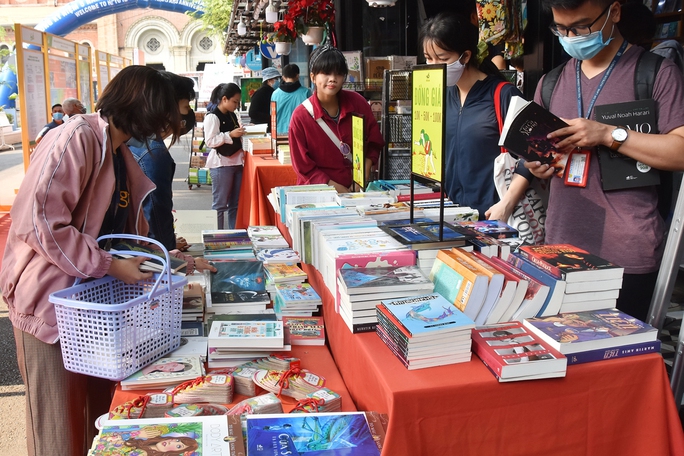
Young people choose to buy books at Ho Chi Minh City Book Street. Photo: TAN THANH
Meanwhile, in Vietnam, publishing houses are state-owned. Besides the business aspect, they also serve the public, so book prices must be in line with the general price level and contribute to meeting the needs of society. Furthermore, in our country, there are many sellers and secondhand bookstores, and prices are generally quite cheap; you can buy several books for around $2 (approximately 50,000 VND). For an average person, reading that many books each year is a very valuable achievement.
Reading an entire book each year can be considered very encouraging. Try to remember the last time you read a book? When was the last time you finished a book, or the last time you felt engrossed or fascinated by a book?… Therefore, even if you spend little on books, choosing a good, useful, and truly meaningful book is very valuable, and it's not necessary to read many books.
More broadly, for many people, having just a few truly meaningful books in life, learning essential things from a few authors, is better than reading many books but not remembering anything useful or finding any practical meaning in them.
We also see people who hardly ever buy books but still read a lot. They borrow books from friends, acquaintances, libraries, etc. Some people often "scout" the bookshelves of acquaintances, waiting for a good book to borrow and read enthusiastically; they even copy down, photograph, or photocopy entire books if they can't find a new copy at the bookstore.
There are also people who, out of love for books, sometimes "forget" to return them. Sometimes, some students do this with good books that they can't find anywhere else, and photocopying them is too expensive… Therefore, one of the requirements for final-year students receiving their diplomas is to fulfill their obligation to return books to the library.
The way you choose books is what matters.
However, regarding spending on books, another noteworthy aspect needs to be considered. That is, there are quite a few people who buy many books—that is, spend a lot on books—but either don't read them or read very little. Some people are willing to buy expensive books, trending titles, and books by popular authors—of course, usually books that are beautifully presented, luxurious, and eye-catching. They might buy books to actually read them, but due to lack of time or after reading only a few pages, they lose interest and stop reading.
Sometimes, people buy books simply to possess them, turning it into a hobby rather than a purchase for reading. Additionally, some people buy books not to read immediately, but to read when they have free time or simply to look them up when needed. Whether they read them or not, or whether they finish the books they buy, they are still book lovers. A book lover is always valuable, because books not only possess intellectual value but also cultural value, and not only entertainment value but also humanistic value.
However, there are also people who never buy books, never read books. Indeed, they may spend a lot of money on shopping and personal expenses, but books are not included in those expenditures. They don't appreciate books, they aren't keen on reading. They may find books very useful, but they prefer to acquire knowledge in other ways rather than read.
Because these people aren't enthusiastic about books and don't have a reading habit, every time they pick up a book... they feel sleepy. As a result, books become something they keep on their bedside table, something they can grab and read whenever they have trouble sleeping – please note, reading, not actually reading the book.
Besides, there are people who read books, but the way they choose books and absorb what they read is worse than not reading at all. They read things that don't deserve to be called books, or even if they are books, the content is useless, trivial, and contains false and dangerous information. The ancients called this "poisonous books," meaning "toxic books," and the more they read, the more harm they do to the reader. In that case, spending money on such books is truly "more harm than good"!
We need to consider whether Vietnamese people spend little on books, but whether that spending is truly necessary and reasonable. That's what's important, not just the amount of money spent on books.
Source













































































Comment (0)