


A favorable harvest, with both good prices and easy sales, has made the atmosphere in the fields even more bustling during the harvest season.
For the 2025-2026 rice crop on shrimp farming land, Ca Mau province will plant over 90,000 hectares; of which, the northern Ca Mau area accounts for more than 47,000 hectares, concentrated in the communes of Vinh Phuoc, Phuoc Long, Hong Dan, Vinh Loc, and Ninh Thanh Loi; the southern Ca Mau area accounts for over 43,000 hectares, including the communes of Bien Bach, Tri Phai, U Minh, and Khanh An. Many early-sown areas have already been harvested with fairly high yields, and the remaining rice crops are ripening, promising a successful harvest.
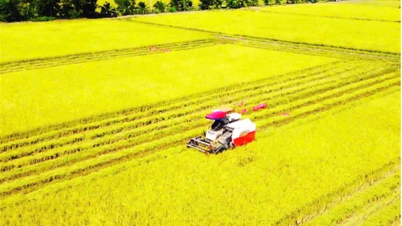
Returning to Phuoc Long commune (Ca Mau province) in the early days of 2026, one can witness the joy and excitement of the local people. On the rice fields, the golden rice stalks are bending under the weight of the harvest, promising another successful crop with both a bountiful harvest and good prices.
According to farmer Nguyen Van Trung in Long Hai hamlet, his family is preparing to harvest 1 hectare of ST rice with high expectations for a bountiful crop. This year's production has been favorable, the rice plants are developing well, and traders are buying up all the produce, promising a successful harvest.
According to Mr. Nguyen Van Trung, since his family started farming using the shrimp-rice model, their family's economy has improved significantly. Initially, only a few households switched to this model, but later, seeing the sustainable benefits it brought, most people in the area have switched to it. Especially since the ST rice variety "took root" in Phuoc Long, the economic benefits for the people have increased even further.
Currently, the price of fresh rice at the field in the early days of harvest ranges from 8,700-8,900 VND/kg, lower than the same period last year but still at a level that ensures farmers make a profit after deducting costs. Thanks to high yields and reduced production costs due to limited use of fertilizers and pesticides, after deducting expenses, farmers earn an average profit of about 3-5 million VND per công (1,000 m2), depending on the rice variety grown.
According to farmer Quan Trong Toan from Long Hai hamlet, people are speeding up the harvest thanks to favorable weather. Traders are also actively buying the rice because of its beautiful, high-quality, and firm grains.
“This season, my family cultivated over 3 hectares of ST rice, so we're hoping for a more prosperous Tet holiday than usual thanks to a good harvest and good selling prices. Compared to other rice varieties, ST rice is less susceptible to pests and diseases, has a reasonable price, and is favored by traders, ensuring that farmers make a profit every season,” Mr. Toan shared.
For many years, the effectiveness of combining rice and shrimp farming has not only helped farmers increase their income per unit of cultivated land but also created a favorable environment for shrimp farming to thrive. The rotation of rice and shrimp has proven remarkably effective, not only increasing income per unit of cultivated land but also producing clean, environmentally friendly agricultural products.
According to the Department of Agriculture and Environment of Ca Mau province, rice yields on shrimp farming land have remained at a relatively high level in recent years thanks to farmers proactively applying a comprehensive range of scientific and technical advancements, especially ecological farming processes suitable for alternating saline and freshwater conditions.
Over the years, in addition to favorable natural conditions, geographical advantages, and human resources, the agricultural sector and local authorities have played a crucial role in proactively arranging planting schedules, selecting adaptable rice varieties, and effectively forecasting and communicating production-related information. This has contributed to successful harvests.
The stable and promising rice prices at the beginning of the 2026 season further motivate farmers to confidently continue production and commit to the shrimp-rice farming model in the future.
To improve efficiency and ensure the sustainable development of the rice-shrimp farming model, Ca Mau province is orienting production towards ecological and organic methods linked to the consumer market. The agricultural sector is focusing on building concentrated production areas, applying synchronized technical processes, and strictly controlling the quality of inputs and outputs; at the same time, it is promoting the issuance of planting area codes, pond codes, and implementing traceability, gradually forming a closed value chain.
Simultaneously, the province focuses on developing the collective economy in rice and shrimp production. Many agricultural cooperatives have been established, acting as a bridge between farmers and businesses in the procurement, processing, and consumption of products. Through these cooperatives, farmers receive technical support, input materials, and guaranteed product sales at stable prices, mitigating the problem of "bumper harvests leading to price drops."
In the fields, combine harvesters are speeding up the harvesting of ripening rice crops. On the river, boats are waiting to weigh the rice. Along the roads, traders are waiting to transport the rice to factories on the paved routes. Thanks to the well-developed infrastructure, the concrete and asphalt roads have helped to speed up the trade of goods for the people, especially in a locality with a strong riverine character like Ca Mau province.
The success of bumper harvests has helped farmers achieve stable lives. Crucially, the right guidance from all levels of government in identifying key crops that are suitable to the local characteristics has led to the right direction and high economic efficiency.
Source: https://baotintuc.vn/kinh-te/mua-vang-tren-canh-dong-tom-lua-20260108070054942.htm


![[Image] National Assembly discusses the implementation of the socio-economic development plan.](https://vphoto.vietnam.vn/thumb/1200x675/vietnam/resource/IMAGE/2026/04/20/1776696707422_ndo_br_img-20260420-185419-jpg.webp)
![[Photo] General Secretary and President To Lam meets with National Assembly delegates from ethnic minorities.](https://vphoto.vietnam.vn/thumb/1200x675/vietnam/resource/IMAGE/2026/04/20/1776696701056_a1-bnd-8331-3342-jpg.webp)


























































Comment (0)