


Shrimp-rice farming: A model that helps farmers transform their lives.
After the complete liberation of South Vietnam and the reunification of the country, Ninh Thanh Loi was a vast, barren wasteland. Faced with this situation, the Party Committee, government, and people of Ninh Thanh Loi commune embarked on land reclamation and the development of various production models. Due to the severely acidic soil, the people here could only cultivate melaleuca trees and pineapples. These two crops, while suitable for the soil conditions, had low economic value. Therefore, the lives of the people remained difficult.
Determined to improve their lives, the local government and people continued to build irrigation and drainage systems to leach out acidity and salinity from the soil. From there, the once barren fields gradually donned a new coat of lush green rice paddies, bringing prosperity to the community. However, Ninh Thanh Loi truly broke through after the 2000s with the successful development of the shrimp-rice farming model.
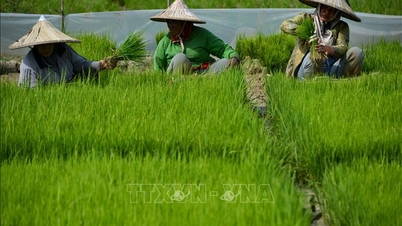
According to farmers, this production model is easy to apply and does not require a high level of scientific expertise. After harvesting the rice, farmers mix saltwater with the remaining freshwater to raise shrimp, crabs, and fish... They have about 6 months to raise shrimp, crabs, and fish, increasing their income. When the rainy season comes, it is also the time for farmers to wash away the salt before sowing rice.
With the shrimp-rice rotation model, farmers earn an average profit of nearly 200 million VND per hectare. Thanks to this, many people in Ninh Thanh Loi commune have achieved a comfortable life. A prime example is Mr. Tran Quoc Thong (Ngo Kim hamlet). Previously, his family faced great hardship. Now, with 6 hectares of land dedicated to shrimp-rice farming, his family earns over 1 billion VND in profit annually. Mr. Thong shared that, through his family's perseverance and dedication, barren, acidic land has been transformed into fertile fields for rice cultivation and shrimp farming. As a result, he has been able to build a spacious house.

Furthermore, in Ninh Thanh Loi commune, thousands of farmers have become wealthy from the shrimp-rice farming model. Mr. Nguyen Van Phong (Ninh Thanh Dong hamlet) shared that his family owns 7 hectares of land. Previously, the land was barren and overgrown with weeds. His family tried to cultivate pineapples, but the income was unstable. Later, they switched to growing rice combined with shrimp farming. Since then, their lives have improved significantly. For many years, the rice yield has been very high, and the shrimp have been very profitable.
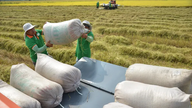
In particular, in recent years, since switching to growing high-quality organic rice to produce clean products, he has harvested over 30 tons of ST24 and ST25 rice annually, earning over 300 million VND. In addition, he also raises tiger prawns, whiteleg prawns, sea crabs, and freshwater fish in the rice paddies, generating high income. Thus, on average, his family earns nearly 1 billion VND in profit each year.
According to Mr. Le Hoang Phi, Chairman of the People's Committee of Ninh Thanh Loi commune, the locality previously had barren land; production and livestock farming were both inefficient. Between 2000 and 2005, 35% of households in the commune were poor. Since the Party Committee and People's Committee of the commune launched a campaign to reclaim and convert over 10,000 hectares of barren land into rice fields, the lives of the people have improved significantly. Statistics from the People's Committee of the commune in 2025 show that approximately 40% of the nearly 5,400 households have an income exceeding 1 billion VND per year, and the poverty rate has decreased to 1%.
Promoting production linkages associated with digital transformation.

According to Mr. Le Hoang Phi, Chairman of the People's Committee of Ninh Thanh Loi commune, in the socio-economic development plan for 2026-2030, the commune has identified the following: Developing sustainable commercial agriculture with a focus on the shrimp-rice production model. Accordingly, the locality will continue to increase the area of rice-shrimp farming; strengthen the application of scientific and technological advancements, and use new high-yield, high-quality varieties that are adaptable to climate change.
Ninh Thanh Loi will build and develop key value chains such as forming a shrimp industry value chain from breeding - commercial farming - processing - consumption; closely linking with processing and export businesses inside and outside the province. The commune will develop a high-quality rice value chain associated with trademarks, product procurement and traceability, registration of planting and farming area codes; encourage the development of cooperative models and cooperative groups linked with businesses to enhance competitiveness and market participation.
The Chairman of the People's Committee of Ninh Thanh Loi commune shared that since the implementation of Resolution No. 57-NQ/TW, dated December 22, 2024, of the Politburo on "breakthroughs in the development of science, technology, innovation, and national digital transformation," the commune has identified this as an important foundation and an opportunity to make breakthroughs in local development and improve the lives of its people in the new era. Ninh Thanh Loi will strengthen the application of science and technology in agricultural and aquaculture production.
In addition, the locality supports farmers and cooperatives in participating in e-commerce platforms to promote and sell their distinctive products; supports the development of websites, fan pages, QR codes for traceability, and modern packaging and labels to enhance product value. The commune facilitates access to cashless payment platforms for businesses and cooperatives to improve transaction convenience and financial transparency.
The local area's current advantages lie not only in shrimp and rice production but also in its transportation connectivity. Many important regional transportation projects are under construction and pass through the commune, such as: Phuoc Long - Ba Dinh; Ganh Hao - Gia Rai - Pho Sinh - Canh Den connecting to Phung Hiep highway and the Can Tho - Ca Mau expressway; and the Ho Chi Minh Highway (Rach Soi - Ben Nhat and Go Quao - Vinh Thuan sections). These will create favorable conditions for the locality to sell goods, attract investment, and promote socio-economic development.

According to the Chairman of the People's Committee of Ninh Thanh Loi commune, digital transformation is gradually entering daily life, from public services to production, creating changes in the way people work and live. In the field of agricultural production, by keeping pace with Industry 4.0 technology, the farmers who once worked in the fields have now changed their mindset in agricultural production.
Mr. Tang Binh (a Khmer ethnic minority resident of Co Thum hamlet) said that in rice production in the hamlet, the application of drones for sowing, fertilizing, and spraying pesticides has become common. Applying technology to rice production helps farmers save time and effort. In addition, through digital transformation in production, farmers are also proficient in using smartphones to update weather information, agricultural product prices, input materials, and learn advanced techniques to apply to their production.
From a barren land, Ninh Thanh Loi has made a breakthrough in socio-economic development based on the shrimp-rice farming model. This is the driving force for the commune to continue to uphold its revolutionary traditions and build an increasingly prosperous and beautiful homeland.
Source: https://baotintuc.vn/kinh-te/vung-can-cu-cach-mang-but-pha-tu-mo-hinh-tom-lua-20260420123136874.htm





































![[Video] Sunset at Lap An Lagoon – Where the sun sets over the fishing nets](https://vphoto.vietnam.vn/thumb/1200x675/vietnam/resource/IMAGE/2026/05/31/1780192137701_beach-landscape-sea-water-nature-grass-745871-pxhere-com.jpeg)





















Comment (0)