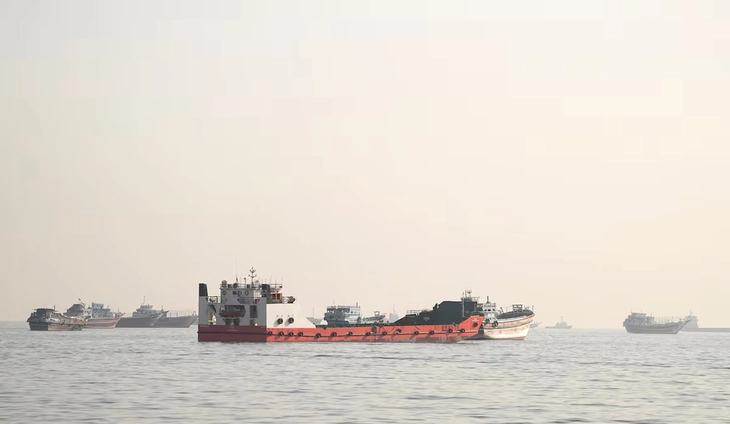
Ships anchored in the Strait of Hormuz, as seen from Musandam, Oman, on June 10 - Photo: Reuters
In just a few days, the Middle East witnessed a series of worrying "firsts": Iran launched long-range missiles at a US base in Jordan, attacked Israel, and was accused of shooting down an Apache helicopter – shattering the fragile order established since the April ceasefire agreement.
On June 10, Iran's Islamic Revolutionary Guard Corps (IRGC) announced attacks on the US air base at Al-Azraq (Jordan, including an F-35 fighter jet hangar) and 21 other targets in the Gulf region.
This is considered one of the most intense military confrontations between the US and Iran since the two sides reached a ceasefire agreement in April. If confirmed, according to The Guardian , it would also be the first time Iran has attacked Jordan since then.
Proportional response
The most direct confrontation erupted after President Donald Trump accused Tehran of shooting down a US Army Apache military helicopter off the coast of Oman on June 8.
An unnamed U.S. official told Reuters that the helicopter was attacked by an Iranian drone, although it is unclear whether this was a deliberate act or an accidental incident.
The U.S. Central Command (CENTCOM) was more cautious, not confirming the cause and stating that the incident was still under investigation.
For weeks prior, Trump had consistently downplayed the severity of Iran's ceasefire violations. However, the Apache helicopter attack forced him to take a tougher stance: "The United States needs to respond to this attack."
The U.S. military then conducted airstrikes lasting approximately four hours targeting Iranian air defense systems, ground control stations, and radar surveillance sites near the Strait of Hormuz using precision munitions from fighter jets.
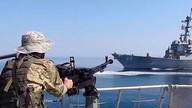


Nearly 20 Iran-linked targets were attacked before CENTCOM announced the operation concluded at 9 p.m. Eastern Time on June 9 (8 a.m. June 10 Vietnam time).
Iran immediately retaliated with a series of long-range missiles targeting US bases in Jordan, along with attacks on Kuwait and Bahrain – home to the US Navy's Fifth Fleet.
CNN quoted a US official as saying that Washington's attacks were intended to send a warning message to Tehran and that Washington believed they would not hinder negotiations to end the conflict.
CENTCOM called this "a proportionate response to Iran's unprovoked aggression." On the Iranian side, Foreign Minister Abbas Araghchi warned on the X platform that foreign forces operating near Iran could be caught in the crossfire or become entangled in the conflict: "The best solution to minimize the risk is for them to leave."
Iran is different now than it used to be.
More broadly, analysts argue that the recent escalation – from the missile attack on Israel in retaliation for Tel Aviv's attacks in Lebanon, to the attack on Jordan – reflects a fundamentally changing Tehran.
Instead of relying primarily on proxy strategies, covert operations, and strategic patience, Iran's new generation of leaders is increasingly willing to act directly and take greater risks.
By targeting Israel, Tehran seems to be signaling that its "red line" is no longer limited to national borders.
"This is the first time in decades that a regional power has had the means, the capacity, and the will to use hard force against Israeli military operations targeting a third party," said Trita Parsi, executive vice president of the Quincy Institute for Responsible Governance (USA).
Aaron David Miller, a former US Middle East peace negotiator, bluntly assessed: "Iran is now putting both Israel and the US in a difficult position. They are willing to take risks. They think they are winning. They don't believe the ceasefire is serving their interests."
Israeli geopolitical expert Yonatan Adiri also commented that recent confrontations are shaping a new reality in the Middle East and forcing Israel to reconsider the limits of its military campaign. "Iran understands that it needs to clash with other parties, and once again redefine the limits with its neighbors, with Israel, and also with the United States," he said.



Diplomatic path
While the fighting continued, on June 10, Iranian Foreign Ministry spokesman Esmaeil Baghaei accused the US of undermining the diplomatic process through contradictory messages and constantly changing positions.
He also argued that Israel was harming the process through repeated violations of the ceasefire in Lebanon, according to Reuters. "Following the events of the night, we need to reassess our diplomatic approach with Washington."
"Any diplomatic process requires a minimum stable environment," Baghaei declared. The escalating violence is increasing skepticism about the prospects of reaching an agreement to end the conflict between the two sides.
Source: https://tuoitre.vn/my-iran-khai-hoa-trung-dong-ruc-lua-20260611074607353.htm