

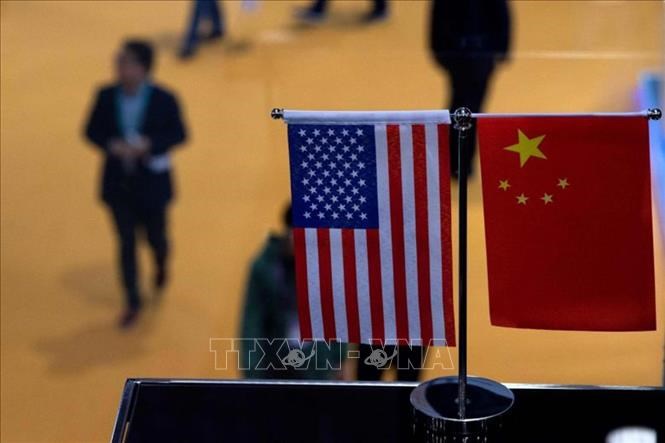
The American flag (left) and the Chinese flag. (Illustrative photo: AFP/TTXVN)
According to the South China Morning Post (SCMP) on June 4, US Treasury Secretary Scott Bessent said that China is expressing interest in purchasing more Boeing aircraft, and this will be one of the issues Washington will push during Chinese President Xi Jinping's planned visit to the US in September.
Speaking before the US Senate Finance Committee, Mr. Bessent reiterated the agreement to purchase 200 Boeing aircraft that the two sides reached during President Donald Trump's recent visit to Beijing. According to him, this was only the initial order, and Washington expects Beijing to commit to purchasing more in the future.
Commenting on this outlook, Sourabh Gupta, a senior research fellow at the Institute for American-China Studies (ICAS), said that Boeing's current orders are closely tied to the US continuing to allow the supply of engines and components for the C919 passenger aircraft developed by China. According to Gupta, if trust between the two sides is maintained and the supply chain remains uninterrupted, the number of Boeing aircraft ordered by China could increase by 500 to 550.
Mr. Bessent's remarks came a day after the U.S. Trade Representative (USTR) announced a public consultation process for the establishment of a U.S.-China Trade Council. The new mechanism is designed to manage and coordinate trade relations between the world's two largest economies .
According to the USTR's proposal, both sides could consider adjusting or exempting tariffs on non-sensitive goods of equivalent value. Mr. Bessent stated that the U.S. could select a portfolio of goods worth approximately $30 billion from each side to apply the tariff exemption mechanism, focusing on low-cost consumer goods or sectors where the U.S. does not need to bring production back domestically.
Professor Hilton Root of George Mason University believes this council could help separate normal business activities from the national security issues that are increasingly dominating US-China relations. However, he argues that this mechanism needs a clear legal framework and appropriate authority from the US Congress to function effectively.
Meanwhile, Gupta assessed the initiative as feasible due to the still substantial scale of bilateral trade between the two countries. He noted that many common product categories still exist where both sides could establish reciprocal agreements without impacting strategic security interests.
However, at the same time as announcing the proposal for a US-China Trade Council, the USTR also announced plans to impose new tariffs ranging from 10% to 12.5% on imported goods from 60 countries, including China, citing forced labor issues. These Section 301 tariffs are seen by observers as an attempt by the Trump administration to partially reinstate tariff measures after the US Supreme Court rejected previous emergency tariffs in February.
Mr. Bessent emphasized that Washington is not pursuing the goal of completely decoupling its economy from China. Instead, the US wants to minimize risks in strategic sectors such as critical minerals, semiconductors, and pharmaceuticals. He argued that excessive dependence on China in these industries is unacceptable.
The US Treasury Secretary also accused China of using subsidies and underpricing in the supply chain of critical minerals. According to him, Washington is pushing forward with a strategic reserve program called Project Vault to reduce dependence on Chinese supplies and protect American producers from potential disruptions to the raw material supply.
Bessent's latest statements suggest that Washington is seeking to maintain economic cooperation with Beijing in normal trade areas, while continuing to tighten competition and reduce dependence in key technology sectors and supply chains.
Source: https://htv.vn/my-va-trung-quoc-can-nhac-mo-rong-thuong-mai-phi-chien-luoc-222260604113231036.htm

![[Image] Shipbuilders exposed to steel and record-breaking heat.](https://vphoto.vietnam.vn/thumb/1200x675/vietnam/resource/IMAGE/2026/06/04/1780545781745_ndo_br_img-5402-4683-jpg.webp)































![[Video] Sunset at Lap An Lagoon – Where the sun sets over the fishing nets](https://vphoto.vietnam.vn/thumb/1200x675/vietnam/resource/IMAGE/2026/05/31/1780192137701_beach-landscape-sea-water-nature-grass-745871-pxhere-com.jpeg)

























Comment (0)