In the center of the classroom, surrounded by gongs, stood the small, gray-haired figure of Ama Khoat. He slowly took each student's hand, adjusting their posture, rhythm, and the coordination of the gongs to create harmonious sounds. Although now 70 years old, Ama Khoat remains passionate about preserving traditional culture.
Growing up amidst the traditional gong culture of the Ede people, Ama Khoat developed a passion for playing the gongs and taught himself from a young age by quietly observing the village's artisans perform during festivals and ceremonies. He listened repeatedly, memorized, and practiced, gradually mastering each gong beat, rhythm, and melody. Ama Khoat recalled: "In the past, many people in the village knew how to play the gongs. No one taught them by hand; we just listened, watched, and learned. The gongs have become an integral part of Ede life. Now, fewer and fewer people know how to play the gongs; if we don't pass on the knowledge, they will gradually disappear."
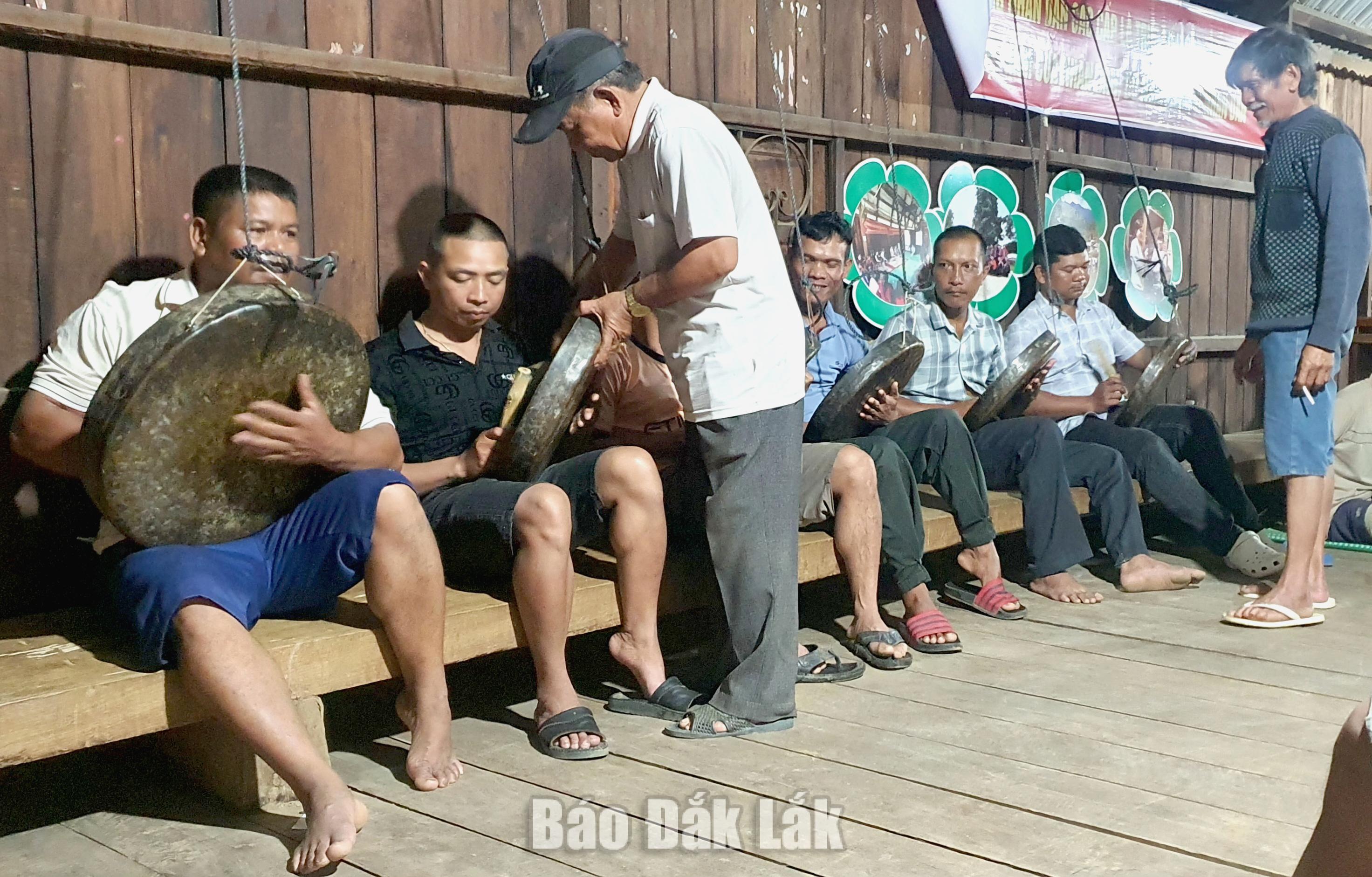 |
| Master craftsman Ama Khoát instructs students from Cham A village on how to play the gong. |
This concern grew even stronger when he witnessed many villages lacking enough gong and drum musicians to perform in traditional ceremonies; in some places, they had to borrow gong and drum ensembles from other villages to perform. This prompted Ama Khoát and the Cham A village self-governance committee to propose opening a class to teach gong and drum playing to the next generation.
When the class was launched, Ama Khoat became the direct instructor. Thanks to his dedication, the class currently maintains 17 students, mostly aged 25 and older. Each week, the students practice on Monday, Wednesday, and Friday evenings. Despite their busy work schedules, many still try to find time to participate in the gong-playing lessons. Notably, among the students are both of Ama Khoat's sons-in-law and one of his own children. He believes that to inspire others, one must first set a good example within their own family. “Teaching gong playing isn't difficult; the important thing is to make the children love and be proud of their ethnic culture. Once they have passion, they will progress very quickly. My wish is that this group of young artisans will continue to pass on their knowledge to the next generation,” Ama Khoat confided.

Ama Khoát is not only a gong artisan, but also a "living archive" of Êđê culture. In his two stilt houses, he still preserves almost intact many traditional items such as axes, machetes, sickles, rice mortars, blacksmith's tools, etc. In particular, his family currently preserves two valuable sets of gongs, many of which are very old; one set has been passed down through five generations, and the other is over 60 years old.
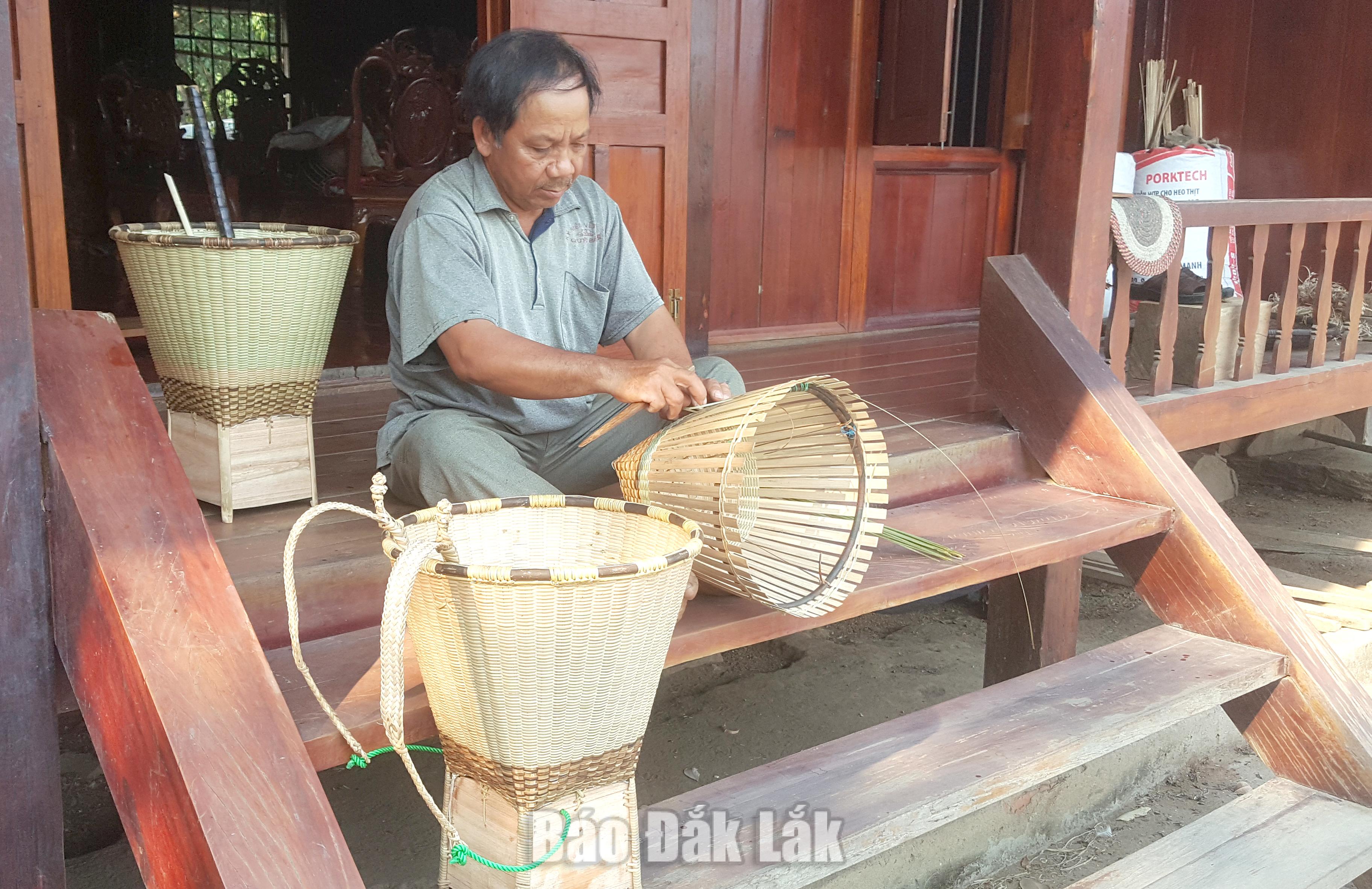 |
| In her free time, Ama Khoát would sit and weave baskets for her family's use and for others who came to order them. |
Both during his working years and after retirement, Ama Khoat regularly participated in gong and drum performances at village festivals and ceremonies. In addition, he was known as an artisan specializing in weaving baskets and winnowing trays, and forging traditional tools. Mr. Vu Van Ve, Secretary of the Cham A village Party branch, said: “Ama Khoat is very dedicated to preserving traditional culture. Not only does he directly teach, but he also actively encourages people to participate in learning. When the village Party branch offered to provide financial support for his work and transportation, he always refused.”
Thanks to the dedication of those who "keep the flame alive" like Ama Khoat, the movement to learn and perform gong music in Cham A village is gradually being restored. In the near future, the village plans to continue opening gong music classes for young people and dance classes for students to create an environment for them to access, understand, and love the cultural values of their ethnic group.
Preserving gongs is not only about preserving a form of folk art, but also about safeguarding the memories, roots, and cultural identity of the community. And in the remote Yang Mao area, people like Ama Khoat are quietly continuing that journey, ensuring that the sound of the village's gongs is not forgotten over time.
Tung Lam
Source: https://baodaklak.vn/dat-va-nguoi/202606/nang-long-voi-cong-chieng-0067a31/
![[Photo] General Secretary and President To Lam receives Palestinian Ambassador Saadi Salama](https://vphoto.vietnam.vn/thumb/1200x675/vietnam/resource/IMAGE/2026/06/25/1782365384740_a1-bnd-9423-8322-jpg.webp)


![[Image] Ho Chi Minh City: Ma Lang area, Chicken-Rice Market about to change its appearance](https://vphoto.vietnam.vn/thumb/1200x675/vietnam/resource/IMAGE/2026/06/25/1782377698627_ndo_br_m1-jpg.webp)

![[Image] Schools organize meetings and introduce teaching models to students admitted to grade 10.](https://vphoto.vietnam.vn/thumb/1200x675/vietnam/resource/IMAGE/2026/06/25/1782368077271_ndo_br_z7970052192242-1ec8daeb77a6eed1a4e9f58c564ddd3e-jpg.webp)