

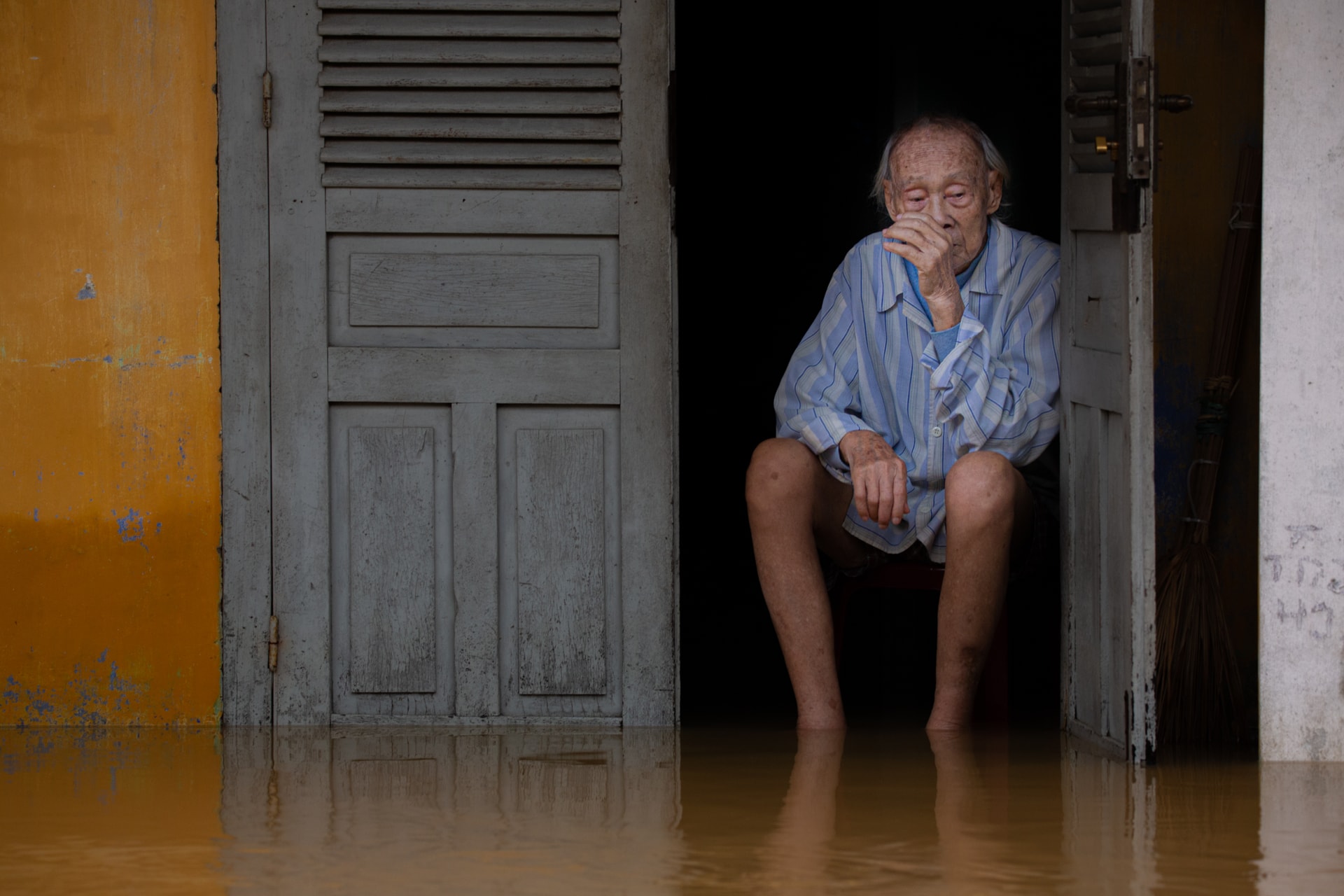
I remember our conversation during the flood days.
Day one. "I haven't seen anything yet. Just outside." Day two noon. "Almost at your doorstep." "How about Dad's house?" "We're upstairs. The side house is ankle-deep." "Have you finished tidying anything?" "I'm tying it up now." "How's Mom?" "I've raised the bed half a meter. If it's too much, I'll carry Mom over to your house." Evening. "We're inside your house, knee-deep. Dad's house is chest-deep. I've moved Mom to a higher place. Everything's completely soaked."
Day 3, day 4, day 5, silence.
People in the countryside don't need to know the level of alert; they just take the year of the Dragon, 1964, as their benchmark. They recount all the tragic events, thinking that if they could still tell stories from 1964, then this time, a full circle of events 60 years later, they would continue to do so.
Those days, I called my uncle. His house was in Kim Bong village (Hoi An). It was completely silent. They were probably busy dealing with the flood. A few days later, he said: “Everything’s submerged, son. That afternoon, the loudspeaker announced the flood had reached alert level 3. Even our house, which is so high, is completely submerged. I just had to move your grandfather’s altar up another meter, and then move your grandmother upstairs. Everything else – appliances, blankets, clothes – was abandoned. The washing machine ran at full capacity for 10 days to finish all the laundry, so you know what that means!” My uncle is my grandfather’s younger brother.
My mother lamented, "Your Uncle Ba fell badly. During the flood, he was climbing to move things and broke a rib. He couldn't even climb with legs like that." My aunt's house is in Duy Vinh, right near the bridge over the old Duy Vinh commune office. My cousin said, "It's 1.7 meters deep, and yet it's all flooded! Uncle Ba normally has to use a cane to walk. Poor thing."
I looked at the flood mark on the altar. My paternal grandparents passed away long ago. My father also passed away. On the altar, the photos of my great-grandmother, my paternal grandparents, and my father, looked motionless, or perhaps behind them was a sigh, a sigh that, from his generation to his grandchildren's, had always been filled with profound suffering and pain when heaven and earth were angry.
Thankfully, everything is still there, even though it's soaking wet, better than so many who are still living as dependents, displaced in their own homeland. And for so many others, not only did the flood cause them to lose their homes and belongings, but this pain will be passed down through generations when, in the future, they find shelter, only to find another photograph on their altar because their loved ones perished in the floodwaters.
Those back home are exhausted and worried sick, but those far from home—the children living abroad—also spend sleepless nights agonizing over their parents, siblings, and loved ones. Social media and news outlets are flooded with a feeling of fear and anxiety that rises slowly and then dies down, quite different from a sudden, devastating fall. It doesn't give you a state of panic followed by calm, but rather like a blood vessel being severed, causing slow, agonizing pain...
That's what the recent flooding was like. My colleague, whose house is right at the foot of the old Cau Lau bridge and who is now starting a business in the Central Highlands, messaged me when I told him the news that the bridge might be washed away and that the authorities were monitoring the situation and trying to prevent it. He replied: "Is that really true?!" That alone was enough to show how devastated he looked.
Each major flood is a test of emotion for what is called "my village." Books have already said that "the water may be lost, but the village will not." It is present today, tomorrow, and will never cease, because every village has children, grandchildren, relatives, and neighbors far from home; the desire to look back and share the village's pain is stronger than any call to action, transcending any discourse.
The younger ones worry about their parents. The older ones sigh anxiously, "There's my older sister and her children there, and then there are the graves, the ancestral altars..." The list goes on and on, each syllable, each word a passage of heartfelt family affection. The rising water brings with it the pain and anxiety of the entire community, causing a constant, throbbing, and agonizing feeling.
I glanced at the tables, chairs, beds, and wardrobes she had arranged; they were still there, not taken down. Even though I knew going back wouldn't help, and saying anything more wouldn't change anything, I couldn't help but say, "Keep them as they are, don't take them down, or there might be another flood." Looking back at the flood mark on the altar one last time, like a line drawn to the fate of those back home—a flood, a storm, everything leveled… A feeling of emptiness overwhelmed me, and I remembered what my friend from Thanh Ha (Hoi An) had said yesterday when he called to check on me; he said with a bitter laugh, "It's all quiet and deserted now…"
Source: https://baodanang.vn/ngan-lut-o-ban-tho-3314007.html
![[Photo] National Assembly Chairman Tran Thanh Man working with the Standing Committee of the National Assembly's Ethnic Council](https://vphoto.vietnam.vn/thumb/1200x675/vietnam/resource/IMAGE/2026/05/21/1779337435930_ndo_br_1-jpg.webp)

![[Image] "Journey of Hope" promotes the organ and tissue donation movement in Vietnam.](https://vphoto.vietnam.vn/thumb/1200x675/vietnam/resource/IMAGE/2026/05/20/1779294400833_1-8910-jpg.webp)






































































Comment (0)