

.jpg)
On moonlit nights, my father would spread out bamboo strips and sit weaving in the courtyard. On rainy days, a small lamp would burn brightly. The familiar clacking sound, the musty smell of soaked bamboo… mingled with the sleepy murmurs of my sisters and me.
Taste of home
My hometown is located in the flood-prone area of the lower Thu Bon River basin. Almost every year there are several floods. During the monsoon season, heavy rains inundate the fields, and bamboo boats become indispensable.
Woven boatmen like my father often have two boats at home: one small and compact, enough for a few people, used for rowing in the fields, casting nets, cutting grass, herding ducks, etc., when the water level rises; and the other, larger, capable of holding around 10 people. These are special boats, meticulously woven and cared for.
During the dry season, they are stored upside down in a dry place. When there's a big flood, my father has to ask the neighbors to help "launch" them. He said that a beautiful, well-sailing boat isn't about its size, but about balance, a steady steering, and the ability to shoot forward and overcome waves.
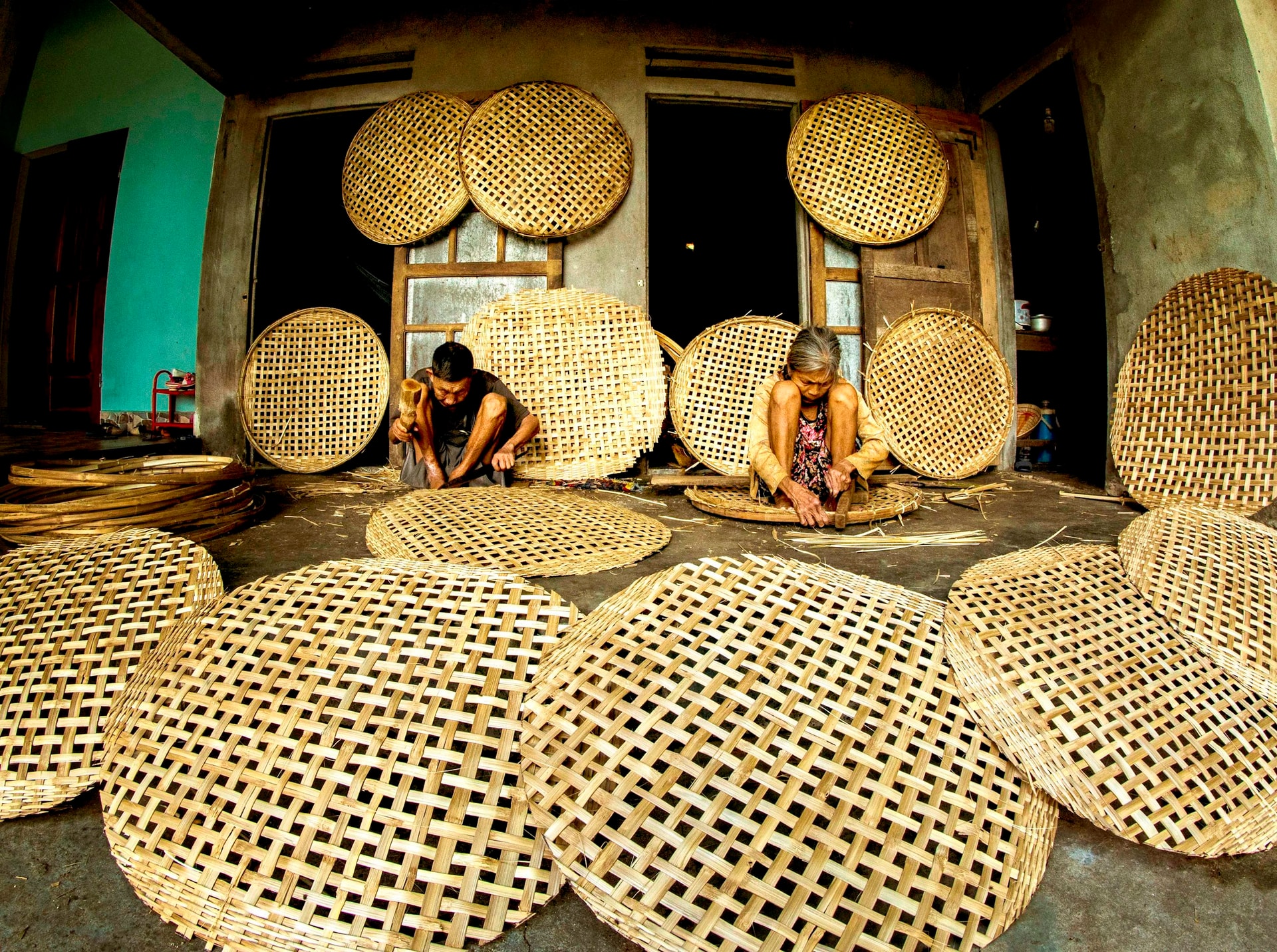
From the initial selection of bamboo type, to the soaking and drying time, and then the main stages of splitting the bamboo into strips, weaving the frame, attaching the edges, and finally applying resin oil… all require skilled craftsmen who are meticulous and careful in every detail.
Back then, my village had a lot of bamboo. Even in our garden, there were several clumps of lush green bamboo. The bamboo used for weaving was made from large, strong, solid, straight male bamboo stalks, free from insect infestation at the nodes. Most of them had been carefully selected by my father when they were still young, and the dates were marked on their bases.
After being cut down, the bamboo was tied into large bundles and soaked in muddy water in the pond behind the house. After a sufficient amount of time, my father would take them out and dry them to remove the water.
Soaked bamboo has a very strong smell; strangers would find it unpleasant, but for the people of my hometown, it's also a rich, nostalgic scent of home, a cherished part of the lives of those who have left their families. From those strong, flexible bamboo stalks, my father carefully splits them into evenly sized strips, then dries them in the sun and lightly singes them over a straw fire. When he estimates he has enough strips for one boat, he begins weaving the hull, also known as the boat frame.
In this land, many things are made of bamboo, from old rice mills to items that are always replaced and renewed every year, such as water buckets, winnowing trays, baskets, sieves, and carrying poles…
Follow the high tide
The techniques for weaving bamboo to create a bamboo boat are all the same, but depending on the tides and the intended use, there are different ways of shaping the boat's sides. Large boats in the lowlands are mainly used to transport people and goods during the flood season, so they have a wide hull, a large capacity, and a stable ride, unlike specialized boats used for transporting passengers across rivers or for long-distance ferrying, and even more different from boats in other areas with fast-flowing water.
The final step is applying resin. During the dry season, I still see people carrying or transporting barrels of resin oil to sell along the village roads.
But whenever my father prepared to plaster the boat, he would often cycle all the way to Ben Dau market on the Vu Gia River in the old Dai Loc region. He would set off early in the morning and only return home at dusk. On either side of the rear seat of his rickety bicycle were two huge barrels of resin oil, and on top of them was a pile of rattan fibers.
My father said that the resin and rattan fibers from Ben Dau in this area are the best. He said he had to go there himself and personally select them before he could feel confident about covering the boat with resin, because it's a crucial factor determining the lives and property of people in flood-prone areas.
Oh, my father and those bamboo boats! His hunched posture, his hands nimbly and diligently weaving the bamboo strips. Every flood season, he would anxiously watch the rising water, a cigarette constantly in his mouth, the silvery water outside his door leaving deep ripples on his forehead…
As I write these lines, my hometown has just faced devastating floods. My house, and indeed the entire countryside, no longer shows any sign of the traditional bamboo boats; occasionally, a few families have acquired small aluminum boats. The floods are becoming increasingly fierce, but those bamboo boats have drifted away with my father and his friends to a bygone era!
Source: https://baodanang.vn/ghe-nan-mua-cu-3313838.html

![[Photo] The General Secretary, President and his wife lay flowers at the Ho Chi Minh Monument in Manila.](https://vphoto.vietnam.vn/thumb/1200x675/vietnam/resource/IMAGE/2026/05/31/1780219759477_anh-man-hinh-2026-05-31-luc-16-29-07.png)









![[Video] Sunset at Lap An Lagoon – Where the sun sets over the fishing nets](https://vphoto.vietnam.vn/thumb/340x192/vietnam/resource/IMAGE/2026/05/31/1780192137701_beach-landscape-sea-water-nature-grass-745871-pxhere-com.jpeg)





















































Comment (0)