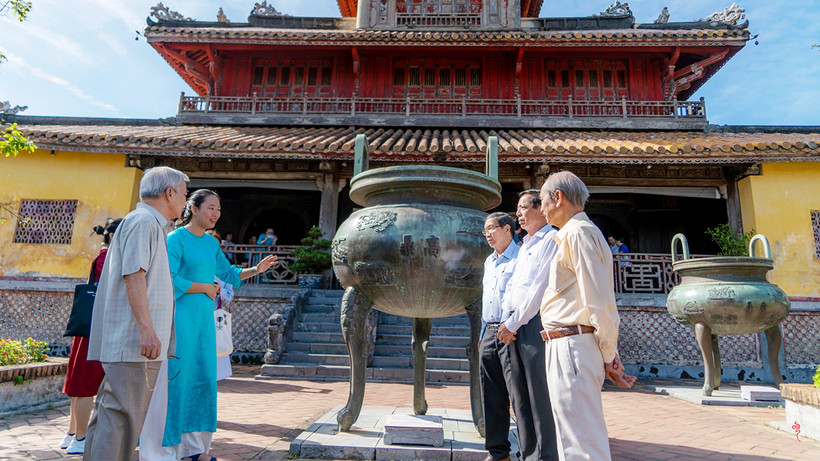
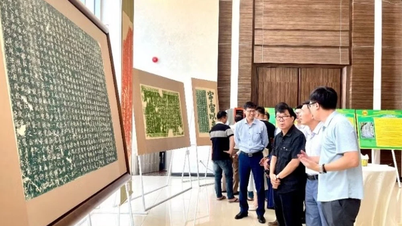
Experts and researchers are studying the documentary heritage on the Nine Dynastic Urns in the Imperial Citadel of Hue .
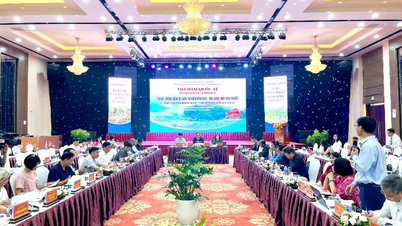
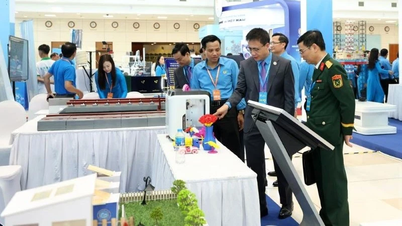
Over the past period, under the direction of Thua Thien Hue province and the Ministry of Culture, Sports and Tourism, and with the support of the international community, the conservation of the Hue Imperial City relics has been implemented and achieved very important results. The role and position of Hue are increasingly affirmed at the national and international levels; contributing to affirming and honoring the unique cultural values of Vietnam to the world.
Restoration and preservation efforts
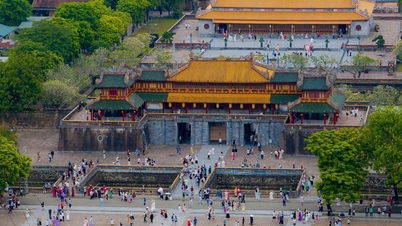
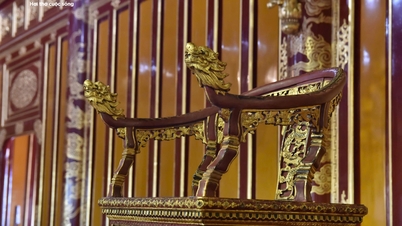
Over 200 years of formation and existence, marked by numerous historical events and the passage of time, Thai Hoa Palace – the most famous and important historical monument in the Hue Imperial Citadel – has suffered severe deterioration. Thanks to the timely attention of the Government , central ministries and agencies, and the Provincial People's Committee, a comprehensive conservation and restoration project for Thai Hoa Palace was launched at the end of 2021 with a total investment of over 128 billion VND.
Given the importance and value of Thai Hoa Palace, the Center, together with the construction unit, is determined to carry out the restoration work with the highest quality, ensuring accuracy and precision in every stage. The wooden structural system has been installed, and the construction, decoration of the roof ridge, and roof tiling will begin this year, with completion expected in early 2025.
Phan Van Tuan, Deputy Director of the Hue Imperial City Relics Conservation Center
According to Mr. Ho Huu Hanh, Director of Hue Relic Restoration Joint Stock Company (the design and construction consulting unit for the project), Thai Hoa Palace has 80 wooden columns and 16 concrete columns. Over time, with many previous restorations, many wooden components have been severely damaged by termites and deteriorated. The tiled floor of Thai Hoa Palace is a "signature" of the structure, possessing historical value. This type of floor tile was imported from France to Vietnam, and was laid in 1894 during the reign of King Thanh Thai.
To preserve the integrity of the brick foundation during the restoration process, the unit meticulously carried out the following steps: thoroughly cleaning the foundation, applying a layer of waterproof paint to protect it, then laying a layer of nylon, and finally laying a layer of rubber to absorb shock in case heavy objects fell onto the foundation during construction. After that, the unit added a layer of wooden frame, topped with a 5mm thick layer of steel welded together to form a cohesive structure, ensuring the safety of the brick foundation during construction. “This is the first time we have implemented this method to preserve the foundation of a historical site during restoration. Thai Hoa Palace is the first historical site nationwide to use this solution,” Mr. Hanh affirmed.
The Thai Hoa Palace is a historical site of significant importance, therefore it is closely monitored, with input from a scientific council throughout the restoration process, especially regarding technical decorative details and construction solutions. According to Mr. Tuan, the biggest goal of the comprehensive conservation and restoration project of the Thai Hoa Palace is to ensure the preservation of the original elements of the site.
Therefore, this project has a separate 3D scanning contract, which involves reconstructing the Thai Hoa Palace in real size and with realistic images of the existing components to preserve the original elements. This serves as a basis for comparison and verification during the restoration process, and also allows tourists to experience a virtual tour of the structure. This approach is not unique to the Thai Hoa Palace; the Hue Imperial Citadel Conservation Center applies it to all other monument restoration projects to ensure scientific accuracy and authenticity, with the ultimate goal of creating a structure that honors the heritage values of Hue.
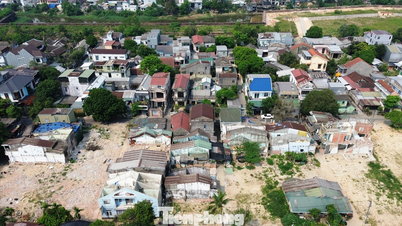
Since 2018, the Prime Minister has approved the policy framework for compensation, support, resettlement, and land clearance for the relocation and land clearance project in Zone I of the Hue Imperial Citadel. Phase 1 of the project has been completed, relocating over 5,200 households and constructing a resettlement area within the Hue Imperial Citadel, including the Upper Citadel, the Eo Bau area, the Ho Thanh Hao moat, and the defensive road.
Currently, the project is in phase 2, relocating approximately 1,000 households and constructing a resettlement area within the boundaries of the Tinh Tam Lake, Hoc Hai Lake, Xa Tac Altar, Kham Thien Giam, Xien Vo Tu, Luc Bo, the lake system in four inner-city wards, and the Tran Binh Dai historical site. Upon completion of phase 2, the relocation of residents from these historical sites will be essentially complete. This represents a significant effort by all levels of government to restore the appearance of Hue's historical sites.
Reviving Hue's heritage
According to the 1990 assessment of Hue's historical sites, the Hue Imperial City, at its most complete, had a total of 850 architectural works, but now only 460 remain, representing 54%. Other historical sites have become ruins, and up to 80% of them require urgent restoration. Faced with this situation, the Government has made efforts to promote the preservation and restoration of these sites and has outlined a long-term plan, approving the "Plan for the Preservation and Promotion of the Value of Hue Imperial City's Historical Sites" for the period 1996-2010, with a total investment of 720 billion VND to restore over 80 major structures.
Subsequently, the Government approved the adjustment of the Plan for Conservation and Promotion of the Value of Hue Imperial City relics for the period 2010-2020, with a total investment of over 2,300 billion VND to carry out conservation, restoration, and embellishment of more than 171 works and project components.
The history of the ancient capital of Hue has created cultural heritage of outstanding global value, a vast complex of historical sites including citadels, palaces, tombs, temples, shrines, and mansions, along with rich and distinctive intangible cultural values and unique landscape elements associated with these heritage sites.
Hoang Viet Trung, Director of the Hue Imperial City Heritage Conservation Center
According to Mr. Trung, along with the severe consequences of war, historical upheavals, and the difficult circumstances of the country in the early period after reunification; the issue of outdated perspectives, backwardness in conservation science, and extremely limited investment resources for conservation work have led to countless difficulties and challenges in the management, preservation, and promotion of the cultural heritage of Hue Imperial City.
Following the call to save Hue's heritage by UNESCO Director-General Amadou Mahtar M'Bow, an international campaign to support Hue was strongly launched; the typical and outstanding values of the Nguyen Dynasty's heritage were recognized and appreciated in accordance with their true significance; and consequently, the perception of this dynasty's heritage gradually changed in a positive way.
The Hue Imperial Citadel Conservation Center has implemented a series of comprehensive solutions to save Hue's heritage. From a state of peril and neglect, the heritage has undergone a remarkable transformation and revival. From desolation and ruin, Hue's heritage quickly recovered, overcoming the emergency rescue phase to enter a stable and sustainable development phase. Particularly, after 30 years of being recognized as a World Cultural Heritage site by UNESCO (since 1993), with two projects approved by the Prime Minister, in the field of preserving tangible cultural values, a total of more than 200 works and components of the Hue Imperial Citadel complex have been preserved, restored, and renovated; more than 5,500 households have been relocated from Zone I of the protected area surrounding the relics, and especially from 2019 to the present, the total investment for the project from 1996 to 2021 exceeded 2,200 billion VND.
In addition, there was international funding of over 8 million USD from 1993 to 2020. However, due to limited investment resources, obstacles in compensation and land clearance, as well as insufficient historical documents and appropriate scientific basis for project implementation, many works and clusters of works planned for the 2010-2020 period have not been implemented, including important works and clusters of works.
From the perspective of the Central Government's guidance on culture and following the call of the UNESCO Director-General, this period has witnessed positive changes in the preservation and conservation of Hue's heritage. Intangible cultural heritage has also been systematically studied and effectively promoted. The face of Hue's heritage is constantly changing, gradually reviving its historical appearance and rising with increasingly vibrant energy, helping Thua Thien Hue emerge from oblivion to become the first locality in the country to be honored by UNESCO for both tangible and intangible heritage.
Nguyen Van Phuong, Chairman of the People's Committee of Thua Thien Hue Province
According to UNESCO's assessment, the conservation of the cultural heritage of Hue Imperial City is currently entering a stable and sustainable development phase. In particular, the preservation of cultural heritage values has always been closely linked to the process of exploiting and promoting them effectively, creating conditions for the socio-economic development of the province and region, with a focus on tourism and services. Most relics are regularly preserved through measures to prevent leaks, collapses, and termite damage, as well as reinforcement and replacement of aging parts. Thanks to these measures, even in the face of repeated severe natural disasters, the relics are preserved and their lifespan is extended.
“The Hue Imperial Citadel complex has become one of the most effectively preserved historical sites, both in terms of its structural integrity and other intangible heritage elements. The Hue Imperial Citadel is a successful example in Vietnam and the region,” assessed Ms. Miki Nozawa, Acting Head of UNESCO's representative office in Vietnam.
Source: https://nhandan.vn/phuc-dung-dien-mao-di-tich-co-do-hue-post762449.html







































![[Video] Sunset at Lap An Lagoon – Where the sun sets over the fishing nets](https://vphoto.vietnam.vn/thumb/1200x675/vietnam/resource/IMAGE/2026/05/31/1780192137701_beach-landscape-sea-water-nature-grass-745871-pxhere-com.jpeg)



























Comment (0)