

Transformations from fermented fish
No one could answer Professor Hibino Terutoshi's question about the ayu fish used in sugata-zushi sushi during a visit to the "I Love Sushi" exhibition at the Japan Foundation ( Hanoi , exhibition runs until May 5th): Which part of the fish is the tastiest? Ultimately, Professor Hibino Terutoshi explained that in ancient times (8th-12th centuries), the fish was fermented, making the bones and head tender and delicious. However, in later periods, when the fish wasn't fermented for as long, the head was no longer as tasty. In fact, some sushi dishes even have the head and bones removed.
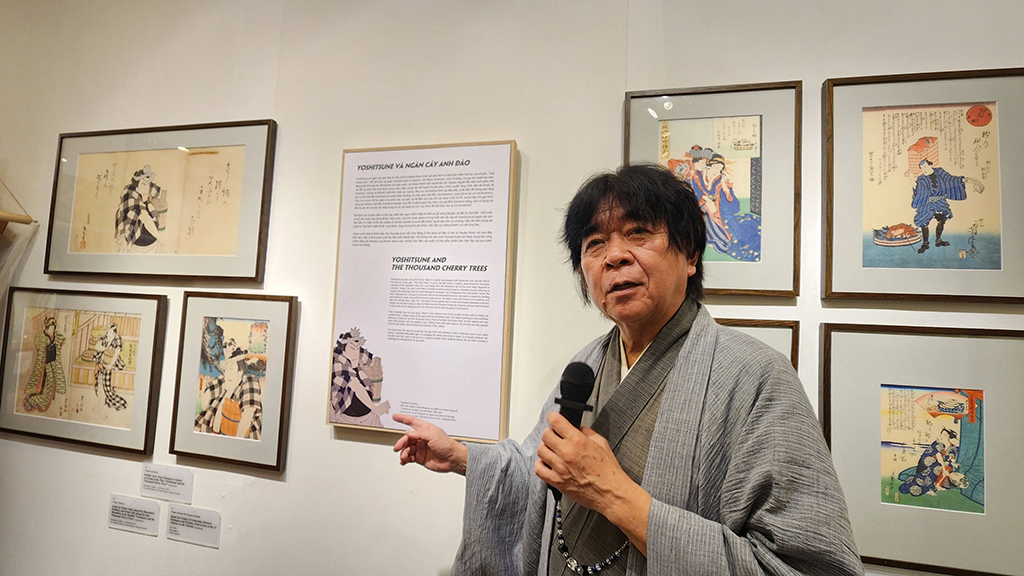
Professor Hibino Terutoshi introduces the history of sushi.
The more than 1,200-year history of sushi is vividly displayed with (plastic) exhibits illustrating sushi through different periods. There are sushi dishes made and preserved in wooden barrels for as long as 3 months to a year. There are also dishes fermented for shorter periods, only 1-3 months. Later, the time required to make sushi also shortened. "There were sushi dishes with fish fermented for a year, but people wanted to shorten the preparation time so they could eat it sooner," said Professor Hibino Terutoshi. Sushi initially consisted only of fermented fish; later, rice was mixed with fermented fish, and then there were types of sushi with rice mixed with rice wine, koji (rice yeast), and vinegar.
See "I Love Sushi" to see that some sushi dishes also "rose to prominence" thanks to… the refrigerator. Tuna appeared later and only began to be widely used in sushi from the 19th century. Before that, its fat content made it prone to spoilage, and people in the Edo period only ate the lean meat of tuna after marinating it in soy sauce. "People only started eating toro (the fatty part of tuna) raw after refrigeration technology improved in the 1960s. After that, the demand for toro and fresh tuna quickly skyrocketed, becoming an indispensable part of sushi," said Professor Hibino Terutoshi.
Stories of political power are also reflected in sushi. The exhibition features a replica of a Meiji-era scroll painting titled "Nagara River Mussel Sushi ." This artifact, from the Gifu City History Museum, depicts the production of scad sushi during the Edo period at the Owari clan's workshop, a clan that ruled much of present-day Aichi and Gifu prefectures. The process included quality control checks before the sushi was offered as tribute to the Shogunate. This rigorous quality control continued until the tribute system was completely abolished.
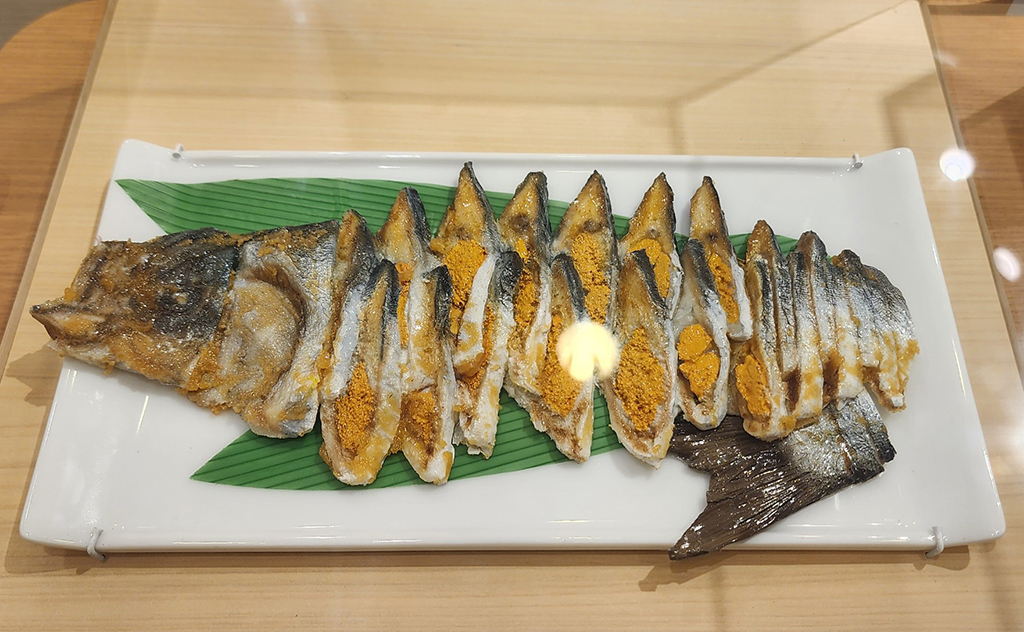
Fermented sushi, the oldest form of sushi in Japan.
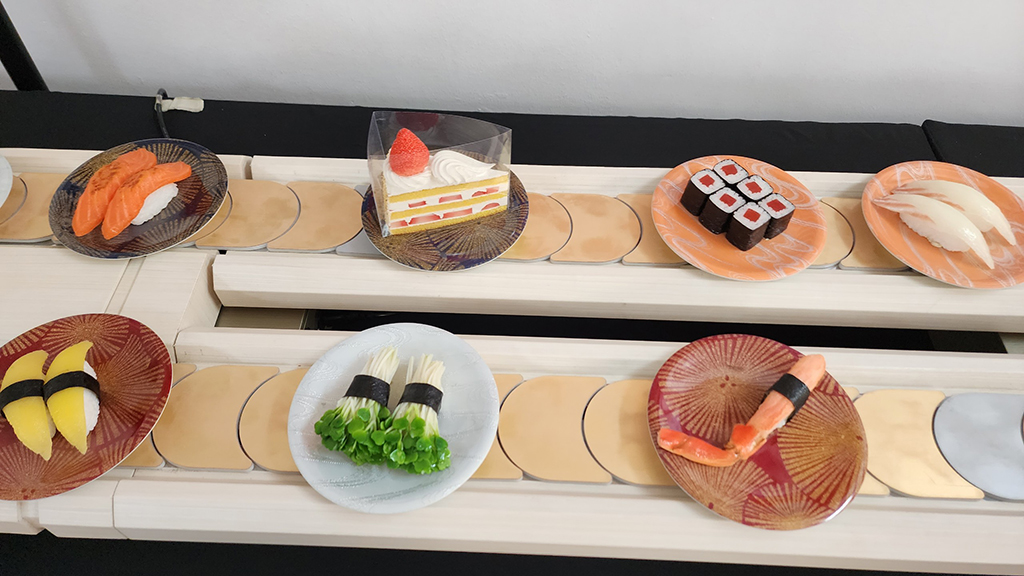
Conveyor belt sushi
Sushi culture
As a sushi researcher, Professor Hibino Terutoshi also selected artifacts for the exhibition so that viewers could visualize Japan's intangible cultural heritage – sushi culture. The exhibition features depictions and portrayals of sushi in art. Many reproductions of famous paintings from museums such as the Ota Memorial Art Museum, the Sumida Heritage Museum, the Osaka Castle Museum, the Waseda University Museum, and private collections, as well as those of the Ajinomoto Food Culture Foundation, are included in " I Love Sushi ." Viewers can imagine what a sushi restaurant used to be like, how celebrities ate sushi, and how ordinary people enjoyed it.
The sushi culture on display at the exhibition combines the depth of tradition with the openness of the modern era. "We can't count exactly how many types of sushi there are, because they keep being created," said Professor Hibino Terutoshi. In fact, the constantly changing and added toppings have resulted in an ever-increasing number of sushi dishes. For example, there's a type of sushi roll called California . This dish has an outer layer of rice wrapped around seaweed (the seaweed being the inner layer), sprinkled with toasted sesame seeds, and filled with cucumber, avocado, crab meat, and imitation crab. This dish is considered a creation of Japanese chefs to suit the North American market.
The "I Love Sushi" exhibition also showcases the diversity of the sushi market in Japan, with over 20,000 sushi restaurants and a value of approximately $12.5 billion in 2017. The Japanese market includes traditional sushi restaurants where simply sitting in front of a sushi chef can cost tens of thousands of yen. Meanwhile, there are also conveyor belt sushi restaurants offering two small pieces of sushi on a plate for just 150 yen. While the number of traditional restaurants is decreasing and fewer people are making traditional sushi dishes, it still generates significant revenue due to its status as a high-end market.
Did sushi originate in Vietnam?
Professor Hibino Terutoshi stated that during his years of research on sushi, he encountered some documents in China suggesting that Japan was not the birthplace of this dish. Sushi may have originated in Southeast Asia, more specifically the Mekong Delta, before reaching Japan. This is one of the reasons why this expert traveled to many Southeast Asian countries, including Vietnam. In Vietnam, Professor Hibino Terutoshi saw a dish that seemed very close to ancient sushi: fermented fish paste and fermented rice in Chau Doc, An Giang. These are also dishes that use rice and fish to ferment. However, many researchers believe that this is a Khmer dish, and therefore may have originated in Cambodia. During this trip to Vietnam, Professor Hibino Terutoshi exchanged information with paleontologists, food scientists, and ethnographers about the customs of fermenting fish. Through this, he received information that the custom of fermenting fish also exists in Phuoc Son District, Quang Nam Province, and Tuyen Quang Province. "I used to think that research into the origins of sushi in Vietnam was over. However, now I think there's room for further research," he said.
Source link
![[Photo] National Assembly Chairman Tran Thanh Man arrives in Türkiye to attend IPU-152](https://vphoto.vietnam.vn/thumb/1200x675/vietnam/resource/IMAGE/2026/04/15/1776261003665_tnk10-jpg.webp)
![[Photo] Mrs. Ngo Phuong Ly meets and exchanges views with Mrs. Peng Li Yuan](https://vphoto.vietnam.vn/thumb/1200x675/vietnam/resource/IMAGE/2026/04/16/1776277858080_phu-nhan-1-jpg.webp)
![[Photo] National Assembly Chairman Tran Thanh Man attends the opening session of IPU-152](https://vphoto.vietnam.vn/thumb/1200x675/vietnam/resource/IMAGE/2026/04/16/1776277863731_ctqh5-jpg.webp)
![[Photo] The General Secretary, President and his wife meet with Vietnamese-Chinese friendship leaders.](https://vphoto.vietnam.vn/thumb/1200x675/vietnam/resource/IMAGE/2026/04/15/1776264829725_vna-potal-tong-bi-thu-chu-tich-nuoc-to-lam-gap-mat-nhan-sy-huu-nghi-viet-nam-trung-quoc-8703641-3130-jpg.webp)
![[Photo] My Son at night: A thousand-year-old heritage site amidst the Milky Way](https://vphoto.vietnam.vn/thumb/1200x675/vietnam/resource/IMAGE/2026/04/15/1776261039184_ndo_br_chon6-jpg.webp)






































![[Infographic Series] Red Addresses of Dong Nai: Location of the establishment of the Binh Phuoc - Tan Trieu Party Branch and the provisional Bien Hoa Provincial Party Committee, the site of the victory at Doc 31, the place where the 302nd Division was established.](https://vphoto.vietnam.vn/thumb/402x226/vietnam/resource/IMAGE/2025/9/26/1331532306fb4ad18e4a849e5c64202a)













Comment (0)