

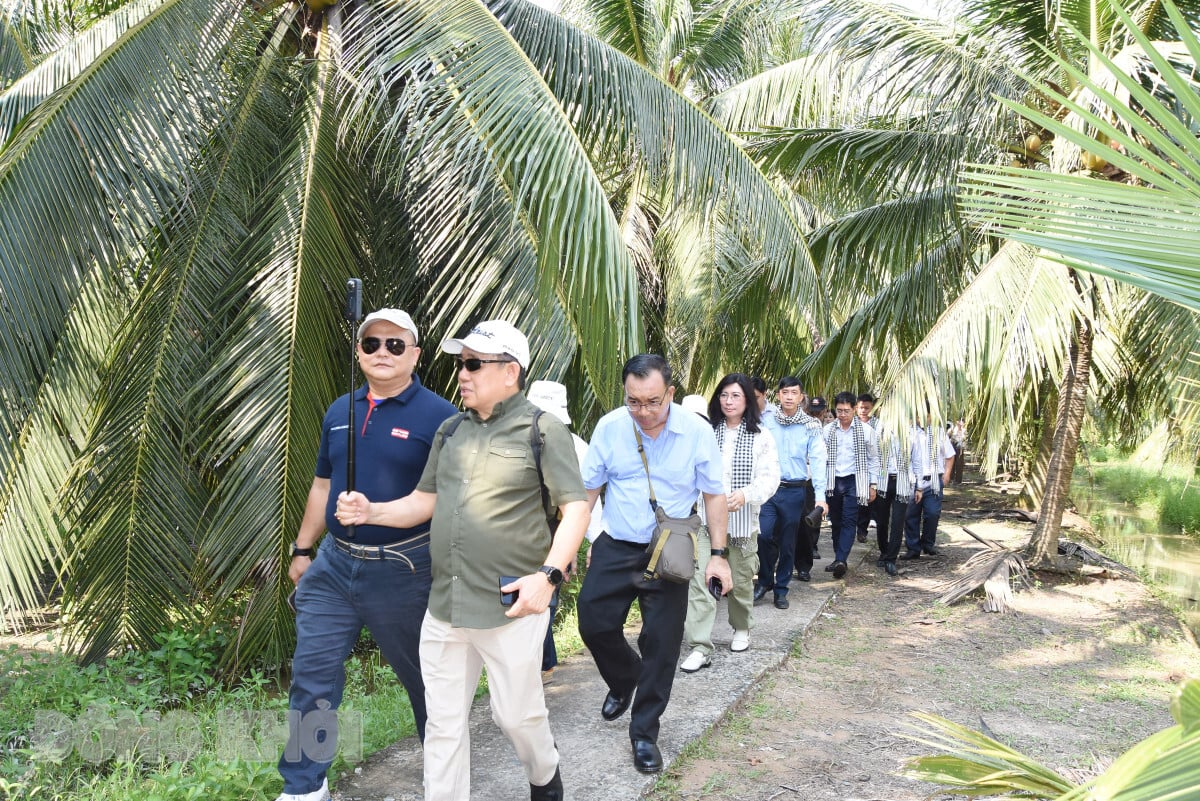
International tourists visit an organic coconut garden in Huong My commune, Mo Cay Nam district.
On the coconut industry map
Coconut trees are considered to have better salinity and flood tolerance compared to other agricultural crops. Their ability to withstand these risks makes them an important crop in farming systems, contributing to the sustainable agricultural development of the locality and the development orientation towards 2030.
According to statistics from the Department of Crop Production and Plant Protection under the Ministry of Agriculture and Environment, the area planted with coconut trees in the province has rapidly increased from 51,560 hectares in 2010 to 77,232 hectares in 2022, accounting for 39.7% of the total coconut area nationwide. The area planted with coconut trees is expected to increase rapidly each year and reach approximately 80,000 hectares by the end of 2024. The province's coconut yield is among the highest, at 9,863 fruits/hectare/year, higher than the average of countries belonging to the Asia- Pacific Coconut Association.
Approximately 15% of the province's coconut growing area is planted with varieties of coconuts grown for fresh fruit (drinking coconuts), such as the Siamese coconut. The remaining 85% is planted with varieties for industrial processing or multi-purpose use. Areas for growing fresh coconuts are interspersed with areas for industrial processing. Common varieties include the local coconut, the strawberry coconut, and the green Siamese coconut... Farmers typically use their own seedlings for 35-40% of the total, while the majority are purchased. Coconut cultivation in the province is practiced by small-scale households. Over 250,000 households cultivate coconuts, with an average area of 0.4 hectares per household.
Recent studies have confirmed the province's central position on the national and regional coconut industry map. Therefore, coconut is an industrial crop playing a crucial role in the province's economic development. This has significantly contributed to Vietnam ranking 4th in the Asia-Pacific region and 5th in the world in coconut exports.
Provincial development strategy
The province's coconut development strategy has always been a priority and has been concretized in Resolution No. 07-NQ/TU dated January 29, 2021, of the Provincial Party Committee on building concentrated production areas and linking the development of value chains for key agricultural products in the province for the period 2020-2025; and Program No. 08-CTr/TU dated January 29, 2021, of the Provincial Party Committee on developing key industries and the province's business sector for the period 2020-2025, with a vision to 2030. In particular, adopting the Project on the Development of Key Industrial Crops until 2030 of the Ministry of Agriculture and Rural Development (now the Ministry of Agriculture and Environment ), the provincial agricultural sector has implemented it in conjunction with focusing on tasks to develop the province's coconut industry.
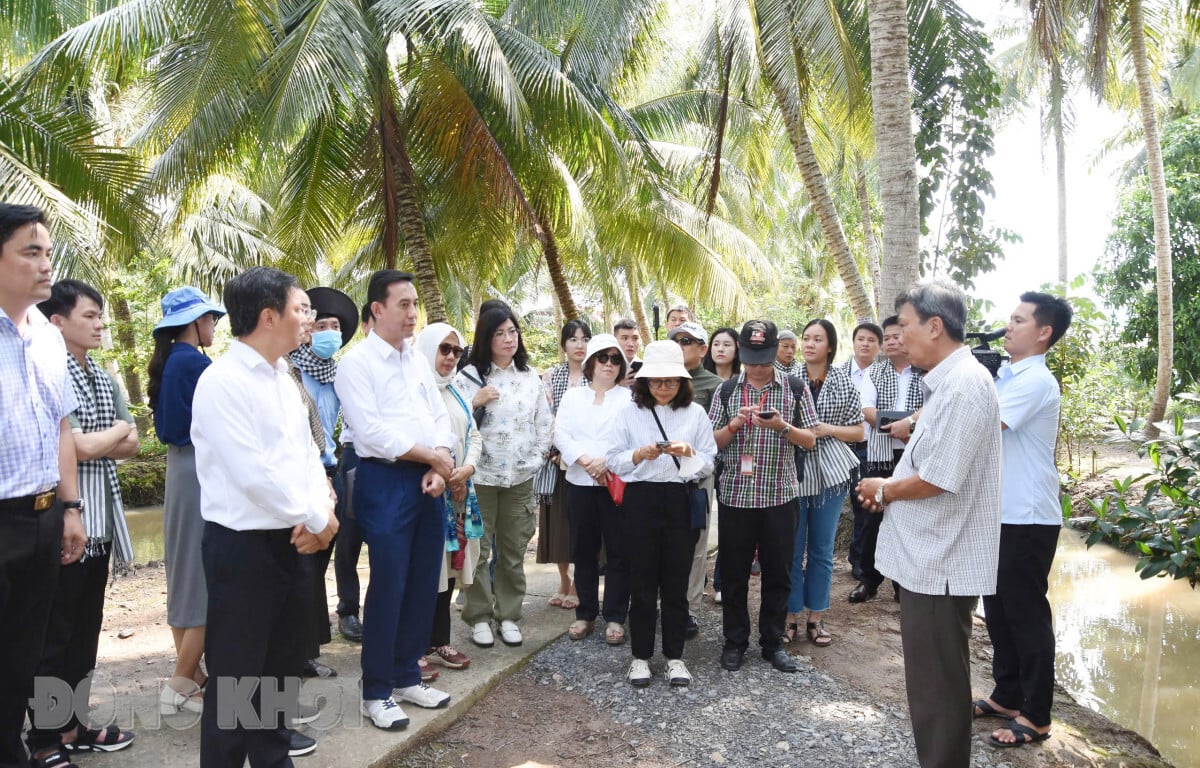
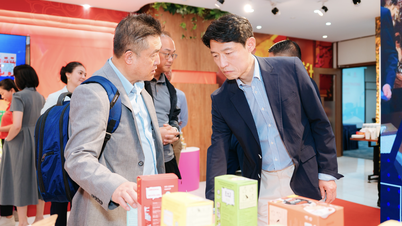
International delegation visits organic coconut farming model in the province.
Based on the objectives and tasks of Resolution No. 07-NQ/TU of the Provincial Party Committee, the province has successfully built a coconut value chain with two chains: industrial coconut and drinking coconut. The industrial coconut chain includes 34 cooperatives and 20 cooperative groups, covering over 13,000 hectares and employing over 6,200 members. The drinking coconut chain includes 2 cooperatives and 16 cooperative groups, with over 8,300 members.
According to Huynh Quang Duc, Deputy Director of the Department of Agriculture and Environment: In the period 2021-2024, the province developed nearly 8,800 hectares of organic coconuts, raising the total area of coconuts produced according to organic standards in the province to over 20,000 hectares; of which 16,300 hectares have been certified. To date, the province has selected and certified over 9,700 mother coconut trees, granted 6 domestic coconut growing area codes, covering nearly 530 hectares in the districts of Chau Thanh, Giong Trom, Thanh Phu and Ben Tre City; and granted 133 growing area codes for over 8,300 hectares of coconuts exported to Europe, the US, and China.
The coconut processing industry consumes 85.74% of the total coconut harvest in the province and accounts for a significant proportion of the processing industry, considered a key economic sector of the province. The province has approximately 180 enterprises, representing 26% of the province's industrial production enterprises, and nearly 2,400 establishments producing and processing coconut products.
Expanding export markets
According to Nguyen Truong Thinh, Deputy Director of Luong Quoi Coconut Processing Co., Ltd. (An Hiep Industrial Park, Chau Thanh District): The year 2000 marked the period when businesses in the province pioneered investment in dried shredded coconut production lines. This technology enabled coconut drying to bring coconut products to the Middle Eastern market. With increased sales demand, businesses interacted with the market and had the opportunity to learn about it. They also updated their technological trends from countries specializing in coconut production such as the Philippines, Thailand, and Indonesia... This led to the development of new, groundbreaking technological products for the Vietnamese coconut industry.
According to the General Department of Customs, by the end of 2024, Vietnam's fresh coconut exports reached US$390 million, a 61% increase compared to the same period. Total exports of coconut products reached nearly US$1.1 billion, a more than 20% increase compared to 2023. This marks the first time in 14 years that Vietnamese coconuts have surpassed the US$1 billion mark, affirming the coconut industry's position on the agricultural export map.
In the province alone, coconut exports reached over $450 million in 2024, accounting for more than 25% of the province's total export turnover. The province expects that by 2025, the coconut industry will generate $1 billion in revenue annually. The export market for coconut products has expanded, contributing to a rapid increase in export turnover. The market structure has shifted from some intermediary markets in Asia such as China, Taiwan, Hong Kong, and Singapore to direct markets in Europe and North America with significant potential.
Among the leading coconut businesses in Vietnam, Betrimex (Phong Nam Industrial Cluster, Giong Trom District) is considered the top coconut producer in Vietnam, ranking among the top 6 largest coconut producers in the world. Betrimex has also committed to pioneering expanded cooperation and working alongside stakeholders to deeply exploit the coconut value chain, making coconut products an Asian symbol and a leading industry of the century.
When recognized as a key national industrial crop, the status and stature of the coconut industry in Ben Tre in particular and Vietnam in general will be elevated to a new level, both domestically and internationally. The brand and reputation of Vietnamese coconut products will be enhanced, and opportunities to penetrate domestic and international markets will become even wider…
“From 2010 to the present, it can be called a period of “rapid growth” for the coconut industry. Countless products have been created with diverse types and in many sectors. In particular, processed food products made from coconuts are worth mentioning. Businesses have updated and implemented product trends to meet customer needs, such as: organic products through the establishment of organic coconut plantations, products certified Halal, Kosher, etc.” (Nguyen Truong Thinh, Deputy Director of Luong Quoi Coconut Processing Company Limited) |
Text and photos: Cam Truc
Source: https://baodongkhoi.vn/nganh-dua-vung-vang-hoi-nhap-02042025-a144574.html















![[Photo] New recruits happily exercise their right to vote at their unit.](https://vphoto.vietnam.vn/thumb/1200x675/vietnam/resource/IMAGE/2026/03/14/1773473286544_stug0337-6388-jpg.webp)



















































Comment (0)