

The legal framework for digital transformation in the banking sector continues to be improved.
Specifically, regarding the task of promoting digital transformation in banking operations and boosting cashless payments, the State Bank of Vietnam stated that in recent times, the legal and policy framework for payment activities has continued to be improved, promoting digital transformation and cashless payments, meeting the payment needs of people and businesses, and contributing to the development of the national economy .
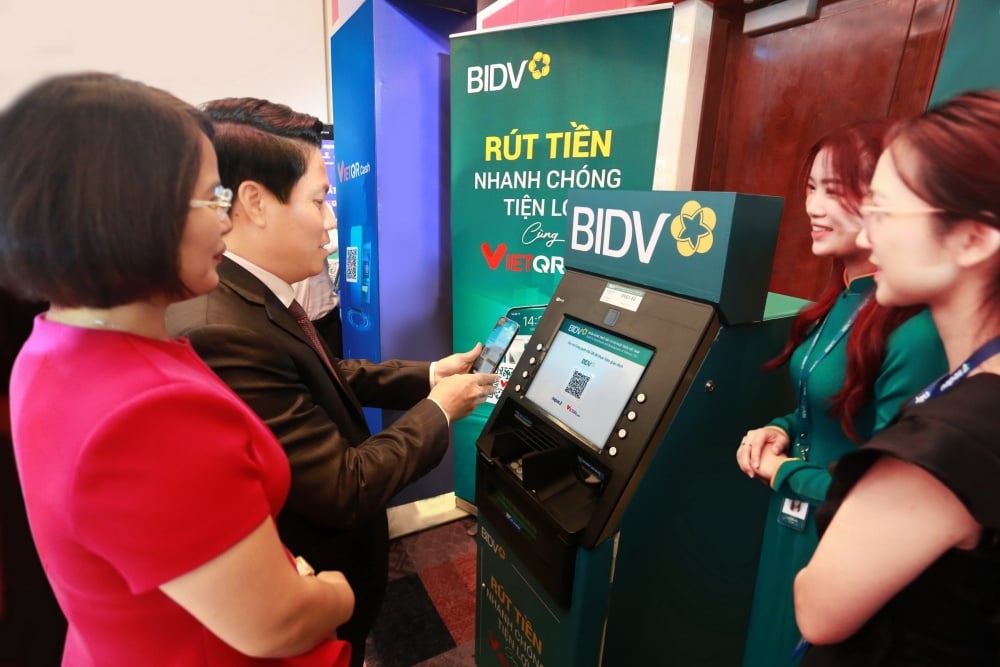 |
| The banking industry has always recognized that digital transformation plays an extremely important role. |
The State Bank of Vietnam (SBV) has researched, issued, and implemented many important policies such as: Decree No. 52/2024/ND-CP dated May 15, 2024, on electronic payment; the Strategy for the Development of Vietnamese Payment Systems until 2030; the Directive on promoting digital transformation and ensuring information security and safety in banking operations; the Decision on the basic standard for the technical specification of QR Code displayed from the customer side in Vietnam; and 7 Circulars detailing and guiding the Law on Credit Institutions and Decree 52/2024/ND-CP. At the same time, the SBV has submitted to the Government a draft Decree regulating the Controlled Testing Mechanism in the banking sector, and has researched, finalized, and submitted to the Prime Minister a proposal for the development of a Decree regulating Mobile-Money services.
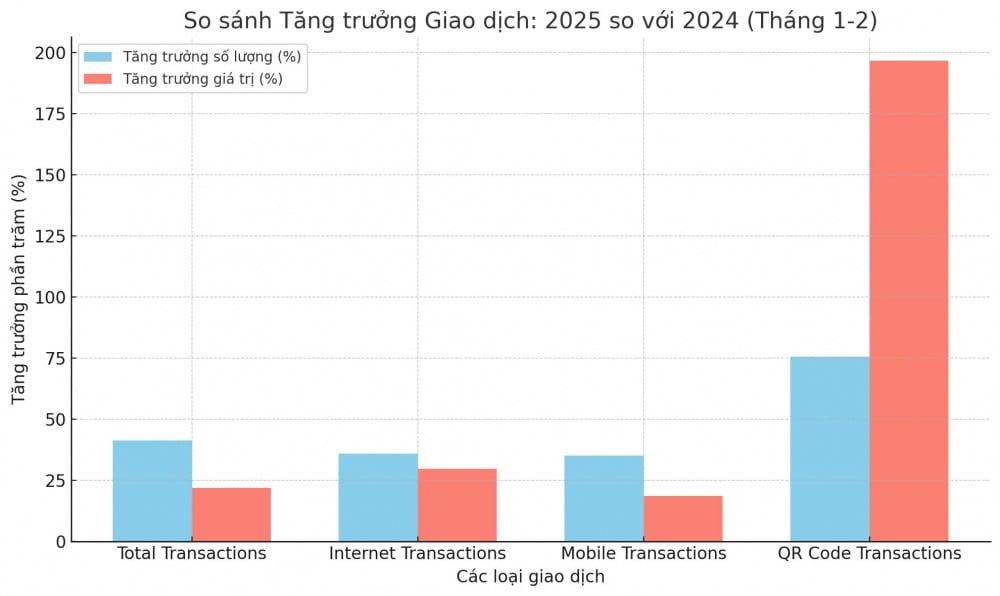
Thanks to the proactive guidance from the State Bank of Vietnam, digital transformation in the banking sector, especially cashless payment activities, has achieved many positive results. The diverse digital ecosystem has brought many attractive benefits to users. To date, most basic banking services have been implemented through digital channels, with many banks achieving a rate of over 95% of transactions conducted digitally. According to statistics, in the first two months of 2025 compared to the same period in 2024, the total number of cashless payment transactions increased by 41.28% in quantity and 21.91% in value; through the Internet channel increased by 35.81% in quantity and 29.69% in value; through the mobile phone channel increased by 35.13% in quantity and 18.63% in value; and transactions via QR Code increased by 75.54% in quantity and 196.62% in value.
 |
Enhancing security and safety in the payment sector.
Over the past period, the State Bank of Vietnam (SBV) has managed and supervised the provision of electronic banking services and closely coordinated with law enforcement agencies to handle related violations; directed payment service providers (including banks) to strengthen security and safety measures; and coordinated with law enforcement agencies and relevant authorities in handling cases of legal violations, fraud, and misappropriation of assets related to payment activities. The SBV actively monitors incidents arising in the provision of payment services to gather information and warn payment service providers about new criminal methods and tactics.
In addition, the State Bank of Vietnam has strengthened inspection and supervision of a number of licensed payment intermediary organizations and continues to research and improve the legal framework regulating this activity to ensure safe and efficient operation. Overall, electronic payment activities in the past have operated relatively safely and efficiently, meeting the payment needs of the economy well.
 |
| The implementation of biometric banking has quickly gained the approval and support of the public, organizations, and businesses. |
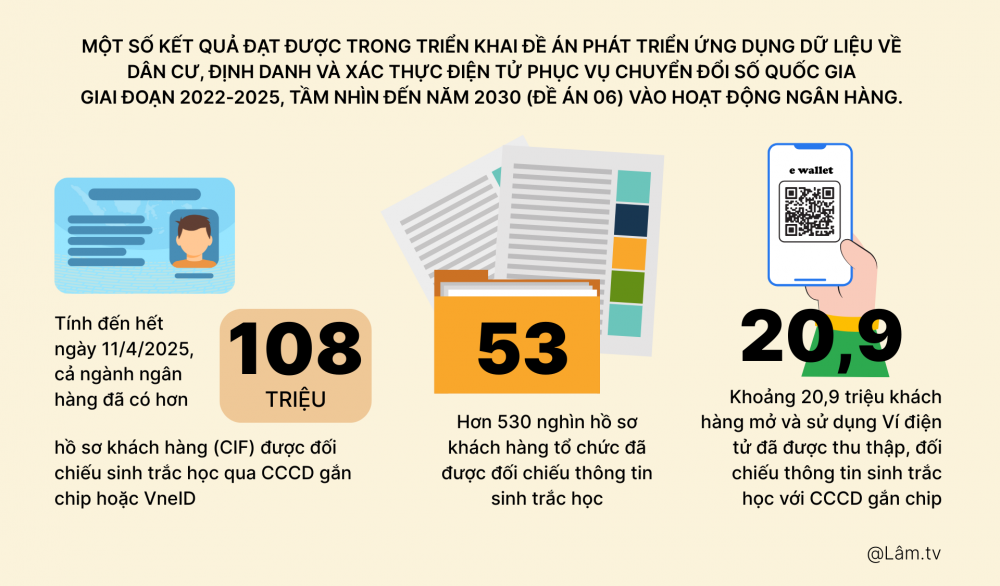
Regarding the coordination, exploitation, and use of information from the National Population Database and information on chip-embedded citizen identity cards (CCCD) in managing account systems at credit institutions, the State Bank of Vietnam (SBV) stated that, in accordance with Decision No. 2345/QD-NHNN dated December 18, 2023, of the SBV Governor, effective from July 1, 2024, after 10 months of implementing biometric authentication from the National Population Database (via chip-embedded CCCD and VneID), more than 108 million customer records have been collected and verified with biometric information. Payment activities are proceeding normally, contributing to a reduction in the number of fraud cases resulting in customer losses. In order to enhance information security and safety in online payment activities in particular and online services in the banking industry in general, the State Bank of Vietnam (SBV) issued Circular No. 50/2024/TT-NHNN dated October 31, 2024, regulating safety and security for the provision of online services in the banking industry, effective from January 1, 2025.
The implementation of biometric banking has quickly gained support from the public, organizations, and businesses nationwide. Credit institutions and payment intermediaries have been active and pioneering in implementing the Project on the Development of Data Applications on Population, Identification, and Electronic Authentication to Serve the National Digital Transformation in the period 2022-2025, with a vision to 2030 (Project 06) into banking operations.
 |
| The implementation of electronic identification and authentication in the banking sector has yielded many positive results. |
Furthermore, the State Bank of Vietnam (SBV) has actively implemented technical solutions to ensure the security of information systems used in banking operations and to combat high-tech crime in the banking sector. The SBV regularly and proactively monitors and directs payment service providers and payment intermediary service providers to strengthen security measures in payment operations. Simultaneously, the SBV collaborates with relevant agencies in the prevention and control of high-tech crime, conducts joint drills for responding to information security incidents, trains information security experts, and cooperates in investigations and provides information to apprehend criminals using high-tech methods related to the banking industry.
Furthermore, the State Bank of Vietnam (SBV) is researching and consulting on the experiences of central banks around the world in implementing digital currency projects. As the Standing Agency of the National Task Force for Research and Advice on Digital Currency, the SBV has proactively researched and coordinated with ministries and agencies to develop and submit reports to the Prime Minister on the implementation of the Task Force's tasks. The SBV has also collaborated with ministries, agencies, and research institutions on digital currency, reporting to the Prime Minister on the implementation situation in other countries and proposing a lead agency for further research.
In the coming period, to effectively implement the Project on the Development of Non-Cash Payments in Vietnam giai đoạn 2021-2025 and the Digital Transformation Plan of the Banking Sector, the State Bank of Vietnam will continue to deploy solutions to promote digital transformation, non-cash payments, and ensure security and confidentiality in banking operations. It will also research and implement new payment models and technologies, including cross-border payments. At the same time, strengthen supervision of key payment systems, provide timely warnings and recommendations on risk issues, and recommend solutions to enhance security and safety in electronic payments, ensuring the security and safety of information technology systems in the banking industry, and protecting the legitimate rights of customers. The State Bank of Vietnam will also continue to promote information and communication about payment mechanisms and policies, and digital transformation; enhance people's financial management knowledge and skills, and improve their understanding of using banking products and services safely and effectively. |
Source: https://thoibaonganhang.vn/nganh-ngan-hang-dat-nhieu-thanh-qua-trong-chuyen-doi-so-163812.html



























































































Comment (0)