

Thousands of people in Kherson were truly racing against time when the Kakhovka Dam broke, causing floodwaters to rise rapidly and gradually submerge everything.
As the sounds of shelling from fighting between Russian and Ukrainian forces still echoed overhead, many civilians in the city of Kherson on the west bank of the Dnieper River rushed to evacuate on June 6th, climbing onto truck beds and makeshift wooden rafts. Below them, floodwaters rose by the minute as the Kakhovka Dam north of the city broke.
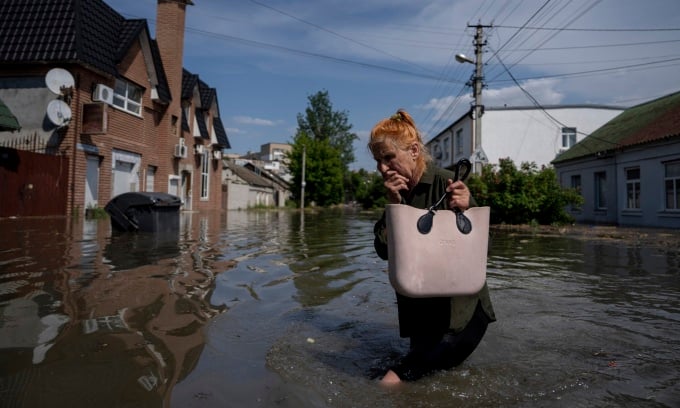
A woman wades through a flooded road in Kherson after the Kakhovka Dam broke on June 6. Photo: AP
The barking of dogs left behind in homes only worsened the mood of the evacuees. A woman sat on a raft, clutching her daughter tightly as the child trembled with fear. A stalled military truck, stuck in rising floodwaters, added to the panic, despite Red Cross volunteers' efforts to ensure an orderly evacuation.
No one knows how high the raging floodwaters cascading down from the Kakhovka dam will rise, or whether people and livestock will be able to escape the danger zone. The evacuation is the latest example of the chaos people have endured as a result of the Russia-Ukraine conflict over the past year.
Oleksandr Prokudin, the governor of Kherson province in Ukraine, said that nearly 1,600 homes on the west bank of the Dnieper River had been submerged by floodwaters and about 42,000 people on both banks faced danger due to rising water levels. By June 7, Ukrainian authorities had evacuated 1,457 people along the riverbanks to cities such as Mykolaiv and Odesa in the west.
On the other side of the river, in the Russian-controlled area, around 22,000 people live in areas at risk of being submerged by floodwaters. The Russian-appointed Kherson provincial authorities have declared a state of emergency, amid reports that 2,700 homes have been flooded and nearly 1,300 people have been evacuated to safety.
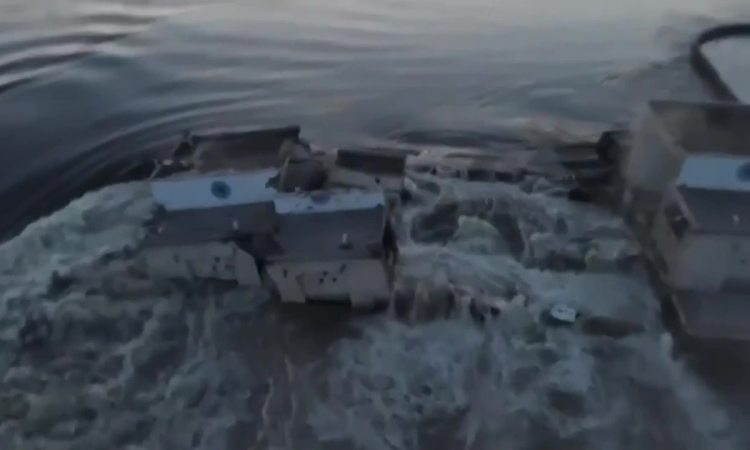
The devastating impact of the dam collapse on the downstream Dnieper River. Video : RusVesna
Nadejda Chernishova, 65, breathed a sigh of relief as she stepped into a rubber dinghy that had taken her to safety from her flooded home in the city of Kherson.
"I'm not scared now, but when I was inside the house, I was really panicking," Chernishova said. "The floodwater came from all sides and I didn't know where it was going."
Her house is located in one of the lowest districts in the city of Kherson, so it couldn't escape the flooding. "Everything was normal in the morning, but then the water rose almost immediately," she recounted.
Chernishova left almost everything behind, taking only what she could salvage, including two suitcases and some of her most valuable possessions.
"This is my beautiful little cat, Sonechka," she said, lifting the lid of the small pet cage, revealing a frightened animal inside. "She's terrified. She's a house cat who's never been outside before."
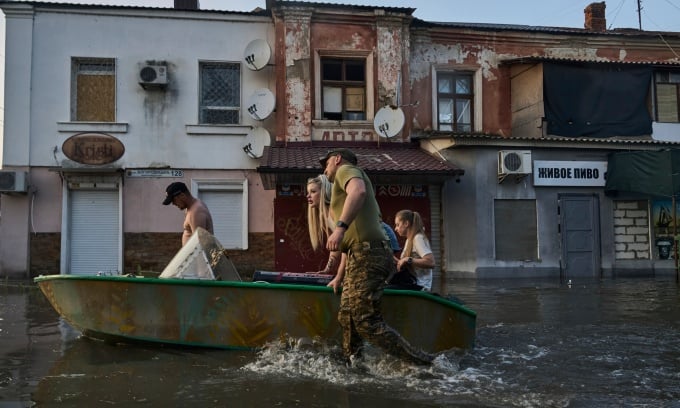
Rescue workers pull a boat carrying residents evacuated from a flooded area in Kherson on June 6. Photo: AP
Chernishova was among the first group evacuated by Ukrainian authorities from the city of Kherson, as floodwaters began to inundate many buildings and inundate the city center, completely cutting off several areas.
Ukrainian President Volodymyr Zelensky said today that hundreds of thousands of people living along the Dnieper River are without clean water due to flooding. He declared that evacuating residents and providing clean water are the top priorities in Kherson.
Governor Prokudin, who has been overseeing rescue efforts in towns and cities downstream of the Dnieper River, said the operation is becoming increasingly difficult as floodwaters rise.
"In the morning we were able to evacuate with cars, then trucks, but now larger vehicles can't get through anymore," he said. "The water has risen so high that we have to use boats. About eight boats of various types are working at full capacity to get people out of the area."
A neighborhood in central Kherson was completely submerged by floodwaters in less than 60 minutes. The water level rose so dramatically that it was visible to the naked eye.
"Everything is submerged in water, furniture, refrigerator, food, everything," said 53-year-old Oskana, a resident, when asked about the condition of her home in Kherson.
In areas without assistance, people were forced to wade through knee-deep floodwaters to evacuate, carrying plastic bags to hold their belongings or putting small pets in strollers.
In frontline cities like Kherson, which are frequently shelled, rising water levels create even greater danger.
"Besides the floodwaters, landmines are also a huge risk factor, because the floodwaters carry floating landmines that could explode at any time," Prokudin said. "But we will race against time; rescue workers will not rest. We will take turns and get people out of danger if necessary."
By June 7th, the flood had peaked in the city of Nova Kakhovka at the foot of the dam, submerging the area under 12 meters of water. The flood is expected to peak soon downstream as well and gradually recede.
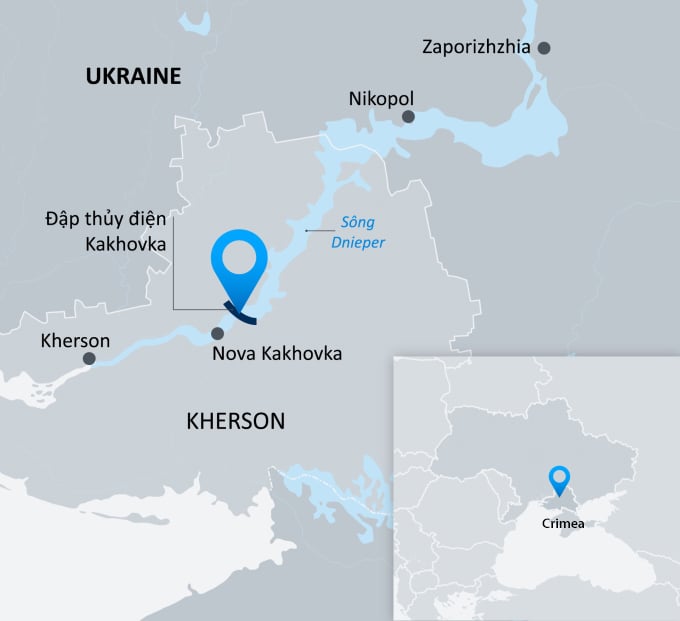
Location of the Kakhovka hydroelectric dam. Graphic: DW
Amidst intermittent artillery fire, search and rescue operations continued urgently. The soldiers and rescue workers showed no signs of confusion or panic.
The Kakhovka hydroelectric dam on the Dnieper River, in the Russian-controlled Kherson province, collapsed on June 6, releasing 18 billion cubic meters of water into towns and farmland downstream. Both Russia and Ukraine claim the dam collapse was a deliberate attack and hold each other responsible.
While the Ukrainian government accuses Russia of blowing up the Kakhovka dam to try to prevent them from launching a counteroffensive, Moscow claims that Kyiv shelled the dam to cut off water supply to the Crimean Peninsula and distract attention from the stalled major counteroffensive.
"The West's reaction in such situations is entirely predictable. Their ultimate desire is to blame Russia for everything that happens, whether it actually happened or is just imagined. Their reaction will always be like that," Russian Foreign Ministry spokeswoman Maria Zakharova said on June 7.
While both sides blamed each other, many civilians in Kherson were left penniless after suffering so many losses in the fighting. "Everything has been submerged," said Chernishova as she loaded suitcases and a bag containing her cat, Sonechka, onto the vehicle that was taking her to evacuation.
Vu Hoang (Based on CNN, AP, and Guardian )
Source link




![[Photo] General Secretary and President To Lam presides over the meeting to approve the draft report on the results of the second inspection by the Politburo of the Standing Committee of the Hanoi City Party Committee.](https://vphoto.vietnam.vn/thumb/1200x675/vietnam/resource/IMAGE/2026/05/26/1779789811432_a2-bnd-4430-9620-jpg.webp)



























































































Comment (0)