

Around the 1950s and earlier, fishermen in the old Phuong Cui village (part of Phuong Sai ward, Nha Trang city) used to go to sea in hand-rowed sailboats. At that time, seafarers didn't know about iron anchors; they only used wooden anchors. They carved anchors from wood and tied a stone to it. The wooden anchors also had a base to be inserted into the sand. Despite being soaked in saltwater, the wood was very strong. Even if the ropes were broken by storms, the anchors wouldn't be pulled up. A single fishing boat needed more than 30 wooden anchors to secure both the boat and the nets, not just one iron anchor like boats do now. That's why there were people who specialized in cutting down hard wood from the mountains to carve anchors and sell them to fishing boats that commissioned them.
 |
| Ben Ca Road. |
The boats were also very simple. The anchor and sail ropes were braided from forest rattan or coconut fiber. The lead weights were just stones. The floats were made from joined bamboo tubes. The net frames were woven from stripped and twisted fibers of the *Cynanchum stauntonii* plant, weighing tons. The sails were woven from forest *Bauhinia* leaves. The leaves were collected from the forest, dried until white, and woven into long sheets, rolled into coils like pressed bamboo mats but softer and more durable. Boat owners usually bought whole coils and sewed them together with coconut fiber thread to make sails. The sails were white and light. When the sails were worn out or torn, they were replaced. There were also large and small sailboats. The "tẹc" boats were large sailboats made of good wood, used to transport coral from the sea to lime kilns, and sometimes to carry dozens of cattle. Smaller sailboats could be loaded directly onto the "tẹc" boats.
 |
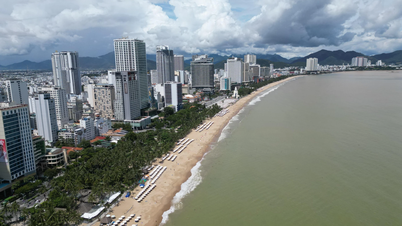
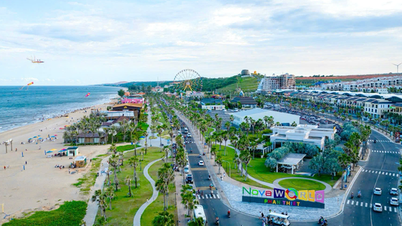
| A view of Ben Ca today. |
The owner of the fish farm had to stay at sea for many days with the boats. Only the oarsman steered the boat and supervised the crew, not directly doing the work himself. The crew were considered employees. Those who went to sea for hire were called crew members. The owner called them workers. The profits were divided according to a "four-six" system: crew members got four parts and the owner six (meaning the crew got 4 parts and the owner 6 parts). However, the owner bore all the costs of buying boats, nets, anchors, sails, bidding fees, and taxes. The two main boats were made of good quality wood, each costing several dozen gold bars. The nets, anchors, mooring ropes, and sail ropes alone could cost hundreds of gold bars. Under the owner, there were also people called "rowers," or overseers of the trade, one for each boat. The rowers would dive down to check the nets; if they saw fish coming in, they would tell the crew to close the net gates and then release the nets to pull the fish up.
The practice of setting nets was only feasible in areas around islands with rocky outcrops, using the base of the island to set up nets to catch fish. Back then, the names of the islands were often used to name the fishing grounds. A fishing grounds were the sea areas surrounding the base of an island. To set up nets in a fishing grounds (or island), one had to bid. Winning a bid for a fishing grounds granted the right to set up nets there for three years. After three years, the bid would be renewed. The owner of a fishing grounds was called a "business owner" or "occupant," but they didn't have a specific name for the grounds. For example, if someone won the bid for Hon Mun fishing grounds, they would be called the "Owner of Hon Mun." Three years later, if they won the bid for Hon Ngoc fishing grounds, they would be called the "Owner of Hon Ngoc fishing grounds"...
 |
| Quéo Hamlet is now a residential area within Cận Sơn neighborhood. |
With such rudimentary sails, boats had to be rowed manually in headwinds or when there was no wind, so during storms, they often couldn't reach the shore in time. People would steer their boats to sheltered islands with calm waters and no large waves, such as Bich Dam or Dam Bay, to avoid the storm. After anchoring their boats in the lagoons, people could go up to the island mountains and stay for several days until the storm passed.
Fishing at sea depends on the weather; some years the sea is bountiful, other years it's scarce, sometimes there's a good harvest, sometimes there's a bad one. But the catch is always abundant back then. Every year on the fourth day of the Lunar New Year, the fish farms hold a ceremony to send off the fishing fleet, and crowds flock to the docks to watch. The ceremony takes place in the shrine dedicated to the God of the South Sea near the riverbank, where a drum is placed. After the ceremony, both fishermen and their crews board the boats. The owners, dressed in long robes and headscarves, stand in front, light firecrackers, then shout loudly before rowing. Dozens of people on the boats also shout along and row in unison. One boat follows another, with the boats of the larger farms going first. Back then, the fishing dock was cool, lush, and the water was deep and very clear.
Following the main fishing boat are two smaller boats. One is a small boat used for adjusting the nets, going back and forth, buying alcohol and tobacco, carrying food, and bringing water for bathing. The other is a smaller boat that carries the fish back daily. The owner stays at the fishing pond and lets the smaller boat transport the fish. When a larger boat arrives at the dock, someone on board runs up to the communal house to beat a drum to signal the owner's family and the buyers. By hearing the drumbeats, they know which boat has arrived. The people on the larger boat usually carry two mackerel or barracuda in each hand, and some large tuna require two people to carry them on a pole. Smaller scad and mackerel are kept in baskets. The amount of fish that boat brings back that trip is weighed and recorded, and a receipt is given to the owner's family. Afterwards, the larger boat also carries rice, vegetables, and food. In the evening, if there is more fish, another trip is made. The vendors would often gut the fish on the spot, cut the fish meat into pieces or chunks, load them onto horse-drawn carts, and transport them to various places for sale, a practice known as "cart fish"...
Around the eighth lunar month each year, the stormy season begins, and fishing nets are put out of service. They only resume fishing after the Lunar New Year. During these months, the fishing harbor is always bustling with people, piled high with nets. On sunny days, people wash and dry their nets, mend them, paint and seal their boats, and repair their fishing gear. Along the riverbank, long rows of men wearing conical hats sit. They pound the leaves of the red-leaved mangrove, stripping the fibers to make threads for weaving nets. The nets must be made from threads spun from the red-leaved mangrove. The red-leaved mangrove grows on high mountains. The white-leaved mangrove grows on lower slopes and is easier to find, but its fibers are only used for weaving hammocks, not for making nets. Throughout the village and along the riverbank, the sound of pounding mangrove leaves has become a familiar sound.
The name "Phường Củi" refers collectively to a cluster of three hamlets: Cây Quéo Hamlet, Bến Cá Hamlet, and Dọc Rau Muống Hamlet. Bến Cá was once known as a fishing port, where fishing boats and trawlers often docked. About fifteen years ago, when I came across the street signs for "Bến Cá Road" and "Cây Quéo Road," I silently thanked the person who named the streets for preserving these place names. However, I can no longer find "Cây Quéo Road." Only "Xóm Quéo" remains, now a residential area within Cận Sơn neighborhood. Nevertheless, the name "Xóm Quéo" is still there; if you ask the locals, especially the elderly, they all know it.
VAN HA
Source: https://baokhanhhoa.vn/van-hoa/nhung-vung-ky-uc/202409/nghe-chuyen-ben-ca-ngay-xua-8244bd9/



















![[Photo] Tran Cam Tu, Standing Member of the Secretariat of the Central Committee, presides over the first meeting of the Central Steering Committee on the Development of Vietnamese Culture.](https://vphoto.vietnam.vn/thumb/1200x675/vietnam/resource/IMAGE/2026/03/19/1773895004549_ndo-br-bnd-1195-2-jpg.webp)









































Comment (0)