
The artifacts are preserved at the Oc Eo Culture Exhibition House. Photo: Phuong Lan
According to the Oc Eo Cultural Relics Management Board, prior to the 1944 excavation, from 1937 to 1942, Louis Malleret and his colleagues conducted numerous archaeological surveys, investigations, and fieldwork throughout the Southern Mekong Delta. Through perseverance, meticulous work, and a rigorous scientific research methodology, he discovered hundreds of archaeological sites, spanning from the western part of the Hau River region, the area between the Tien and Hau rivers, to the southeastern region. In An Giang province alone, he surveyed dozens of sites at Mount Sam, the Bay Nui region, the slopes of Ba The mountain, and the Oc Eo plain.
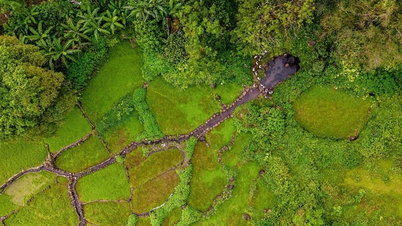
In April 1942, guided by local people, Louis Malleret approached the Oc Eo plain – a unique area with many mounds and ridges rising amidst a vast swampy landscape. Here, he observed dozens of fairly evenly distributed mounds, on which were preserved traces of large brick structures, wooden stilt houses, religious statues, and various artifacts made of pottery, stone, metal, and jewelry. These discoveries indicated that these were not scattered settlements but rather the remnants of a stable, long-standing community with a rich material and spiritual life.
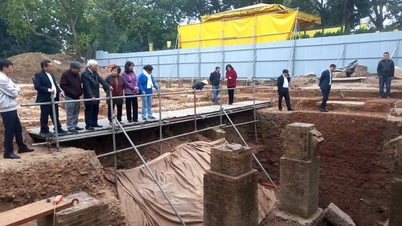
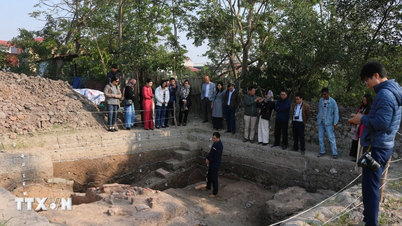
From the results of field surveys, combined with analysis of aerial photographs, Louis Malleret arrived at an important conclusion: Beneath the alluvial soil lay the remains of a large-scale ancient city. This conclusion was confirmed in reality when, on February 10, 1944, he and his colleagues officially began the first archaeological excavation at Oc Eo - Ba The. The excavation lasted nearly three months, beginning at the Oc Eo mound - the site that would later give its name to an entire ancient culture: the Oc Eo culture.
In the early days of spring 2026 (Year of the Horse), the Oc Eo Cultural Relic Management Board organized a ceremony to commemorate the 82nd anniversary of the first archaeological excavation at Oc Eo - Ba The (February 10, 1944 - February 10, 2026). This is a particularly important event, not only marking the beginning of research into a brilliant ancient culture that once existed in the Southern region of Vietnam, but also opening a new chapter for Vietnamese archaeology, contributing to affirming the position and role of Oc Eo culture in the development of civilization in Southeast Asia and the world .
Following the 1944 excavation, Louis Malleret spent nearly 20 years researching and producing the monumental four-volume work "Archaeology of the Mekong Delta"—a foundational scientific work for all subsequent archaeological research on Southern Vietnam. The international scientific community affirms that his work remains an indispensable starting point in the study of the Oc Eo culture.
While archaeologists have contributed to the discovery, the people have been the guardians of this heritage throughout the years. One of the highlights of the Oc Eo Cultural Relic Management Board since its establishment in 2013 is its work in promoting and encouraging the people to donate artifacts. From 2016 to the present, 70 organizations and individuals have voluntarily handed over "treasures" they accidentally found during farming and production. The 7,407 artifacts received are a vivid testament to the love and responsibility of the people of An Giang towards their homeland's heritage. Among them are strings of precious stones, sparkling glass, and ceramic artifacts reflecting the essence of ancient life.
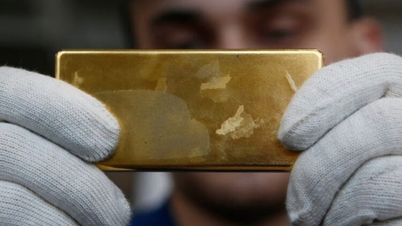
The story of the Funan coins at the Oc Eo Cultural Exhibition House always amazes visitors. The house currently preserves 46 intact coins and 14 small fragments, evidence of an early developed monetary economy. Remarkably, the majority of these artifacts were donated by the people of Phu Hoa commune (the Da Noi archaeological site area), with the largest number being donated by the local people. Their generosity has provided scientists with valuable data to decipher the transnational trade system of the ancient Oc Eo inhabitants. Nguyen Van Nhien, Director of the Oc Eo Cultural Relics Management Board, shared: “In the coming time, central and provincial authorities will continue to closely coordinate with UNESCO and international consulting organizations, proactively supplementing, explaining, and clarifying the contents as requested. At the same time, we will implement comprehensive solutions for sustainable preservation, effective management, and promotion of the value of the Oc Eo - Ba The archaeological site, aiming for UNESCO's recognition as a world cultural heritage site.”
On January 29, 2026, Vietnam officially submitted the dossier for the Oc Eo - Ba The archaeological site to UNESCO for recognition as a World Cultural Heritage site. This is the result of a meticulous and serious preparation process, with the unanimous support of the Party, the State, and the scientific community. |
PHUONG LAN
Source: https://baoangiang.com.vn/oc-eo-hon-xua-thuc-day-a478045.html





![[Photo] First session of the 14th Congress of the Vietnam Trade Union](https://vphoto.vietnam.vn/thumb/1200x675/vietnam/resource/IMAGE/2026/06/03/1780465947883_ndo_br_img-3852-jpg.webp)



































![[Video] Sunset at Lap An Lagoon – Where the sun sets over the fishing nets](https://vphoto.vietnam.vn/thumb/1200x675/vietnam/resource/IMAGE/2026/05/31/1780192137701_beach-landscape-sea-water-nature-grass-745871-pxhere-com.jpeg)






































Comment (0)