Huynh Thuc Khang School of Journalism
The early part of 1949 marked the beginning of a fierce phase in the resistance war against French colonialism. The Viet Bac war zone, with its headquarters in Thai Nguyen, operated day and night to devise the most effective revolutionary leadership strategy.
At this time, recognizing the importance of the press in disseminating information to the people about the resistance strategy and praising the achievements of units and individuals who contributed to the resistance and national reconstruction, in April 1949, President Ho Chi Minh directed the establishment of a journalism school. He also chose the school's name in connection with a patriotic intellectual and an outstanding journalist in the modern press. That is the reason for the founding of the Huynh Thuc Khang School of Journalism.
 |
| Students of the first and only class of the Huynh Thuc Khang School of Journalism - Photo: Archival material |
Although called a school, due to the fierce war, the facilities were extremely rudimentary, consisting only of makeshift bamboo huts in the dense forest. However, the teaching staff included not only revolutionary leaders like Trường Chinh, Võ Nguyên Giáp, Hoàng Quốc Việt… but also renowned intellectuals and writers such as Từ Giấy, Nguyễn Huy Tưởng, Nam Cao, Xuân Diệu… The teaching staff numbered 31, with the Board of Directors consisting of journalist Đỗ Đức Dục, Deputy Secretary of the Việt Minh General Headquarters, as Director, and journalist Xuân Thủy as Deputy Director.
The first and only journalism class consisted of 42 outstanding journalists from major newspapers during the resistance war, such as Nhan Dan, Cuu Quoc, Ve Quoc Quan, Lao Dong, Voice of Vietnam Radio, Vui Song, Phu Nu Cuu Quoc Lien Khu X, Doc Lap, Quan Bach Dang…, in addition to a few students from the Propaganda Department and the Propaganda Office. These 42 students later became veteran journalists, leaders of media organizations, or researchers in journalism, such as Banh Bao, Huu Mai, Hoang Kien Trung (Tran Kien), Pham Viet Thieu, Hai Nhu…
This first and only course commenced on April 4, 1949, and concluded on July 6, 1949. In just over three months, this special school and classroom managed to sow the "red seeds" of revolutionary Vietnamese journalism from its early beginnings to the present day.
Training journalists amidst the flames of war.

As members of the younger generation of journalists, in the age of digital journalism, we were quite surprised when we visited the Huynh Thuc Khang School of Journalism. Amidst the raging flames of the resistance war, the only journalism training program at this school was conducted in a very systematic and scientific manner, both in theory and practice, covering not only journalism but also literature and art related to journalism and propaganda work.
 |
| National Historical Monument Plaque of Huynh Thuc Khang School of Journalism - Photo: XH |
A quick glance at the course topics and teaching content on journalism reveals this. Regarding the history, theory, and general politics of journalism, there were specialized courses taught by comrades such as Trường Chinh, Hoàng Quốc Việt, and Tố Hữu…
Regarding journalistic skills in various content areas and genres, the instructors included journalists such as Như Phong (in charge of the Cứu Quốc newspaper in Zone III), Văn Tân (specializing in international commentary for Cứu Quốc), and Xuân Trường (specializing in current affairs commentary for Sự Thật newspaper). For cultural and artistic topics related to journalism and propaganda, the classes were taught by writers, poets, and playwrights such as Đồ Phồn, Tú Mỡ, Xuân Diệu, and Nguyễn Đình Thi.
Indeed, in just three months of the course, the trainees acquired general knowledge of journalism, journalistic skills in various fields, and a foundation of cultural and artistic understanding to support their propaganda work. In addition, there were other excellent topics on management, administration, and newspaper distribution.
We were extremely pleased that the journalism training programs included courses on modern journalistic theory taught by key revolutionary leaders and renowned journalists. For example, General Vo Nguyen Giap taught the course on war reporting and chronicles, and Comrade Tran Huy Lieu, a member of the Executive Committee of the Vietnam Cultural Association, taught the course on polemics and history… It can be said that training a team of journalists with such teaching and learning content was truly a unique miracle amidst the flames of war.
From this special school…
 |
| A reconstructed blackboard in a classroom at the Huynh Thuc Khang School of Journalism - Photo: XH |
Although he did not directly teach, President Ho Chi Minh, as the founder of the Huynh Thuc Khang School of Journalism, sent letters twice, once at the opening and once at the closing ceremonies. The letters encouraged the students and outlined the goals of journalists in the resistance against French colonialism and the defense of the Fatherland. They also highlighted the necessary qualities for journalists to improve their skills and produce quality works to serve the resistance and national reconstruction efforts at that time.



The students of this class later became seasoned journalists, leaders of propaganda, cultural, and media organizations, and role models for succeeding generations of journalists to follow.
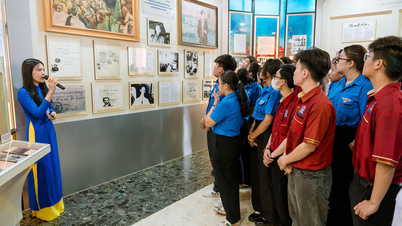
Over three-quarters of a century have passed since the restoration of the Huynh Thuc Khang School of Journalism, which was classified as a National Historical Monument by the Ministry of Culture, Sports and Tourism in 2019. Today, it welcomes many tourist groups and journalists from provinces and cities across the country who come to visit and learn about the history of revolutionary Vietnamese journalism in the early days of the resistance war.
Pham Xuan Hung
Source: https://baoquangtri.vn/xa-hoi/202606/ngoi-truong-dac-biet-e41526b/
![[Image] A look back at the capital's preparations for the century-long master plan.](https://vphoto.vietnam.vn/thumb/1200x675/vietnam/resource/IMAGE/2026/06/29/1782750453122_quy-hoach-100-nam-minh-duy-1-2118-jpg.webp)














![[Photo] General Secretary and President To Lam works with the Party Committee of the Government on the work of preventing and combating storms, floods, extreme natural disasters and climate change.](https://vphoto.vietnam.vn/thumb/1200x675/vietnam/resource/IMAGE/2026/06/29/1782729441945_a1-bnd-0385-9454-jpg.webp)