

The language of silence
When I was in middle school, my teacher asked me to read aloud in front of the class. A sudden fear overwhelmed me; I felt like I was dissolving in fear, and that was all I had. I stood up and ran out of the classroom.
I noticed the wide, round eyes of my classmates and teachers following me.
Then I tried to explain my strange behavior by saying I needed to go to the bathroom. I could see on the faces of the people listening that they didn't believe me. And they probably thought I was crazy. Yes, I was going crazy.
The fear of reading aloud haunted me. I bravely asked my teachers for permission to skip reading aloud, because I was terrified of it. Some teachers believed me and didn't ask any more questions, but others, in one way or another, thought I was teasing them.
I learned something important about people from this experience.
I learned many other things.
Something has enabled me to stand here and read this Nobel Prize acceptance speech aloud. And now there is virtually no fear.
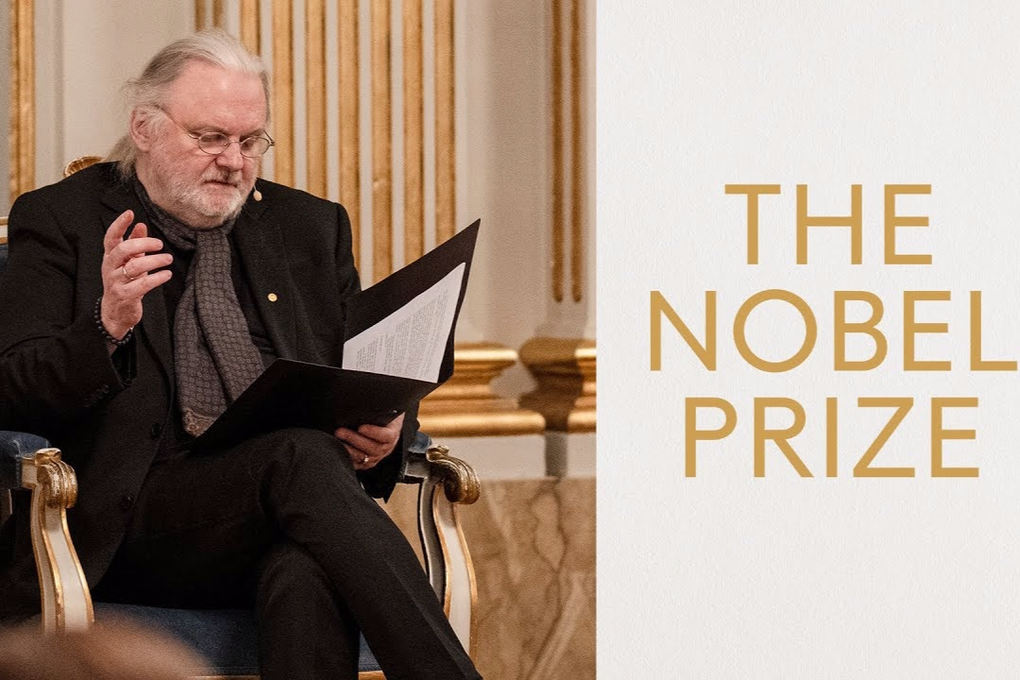
Jon Fosse delivered his Nobel Prize acceptance speech on December 7th at the Swedish Academy in Stockholm (Photo: Nobel Prize).
What did I learn?
In a way, it was as if fear had taken away my language and I had to reclaim it. I started writing prose, short poems, short stories, and realized that doing so gave me a sense of security, dispelling my fear.
I have found a place within myself that is solely my own, and from there, I can write down what is uniquely mine.
Now, almost 50 years later, I still write from a secret place within myself, a place about which I honestly know little beyond its very existence.
The Norwegian poet Olav H. Hauge wrote a poem comparing writing to a child building leaf huts in the woods, crawling inside, lighting candles, sitting and feeling safe on dark autumn evenings.
I think this is a beautiful image of how I experience writing. Now—as well as 50 years ago.
And I learned even more. I learned, at least for me, that there is a big difference between spoken and written language, or between spoken and literary language.
Spoken language is often a monologue or a rhetorical way of conveying a message with persuasive or convincing intent.
Literary language is never like that—it's not informative, but rather more meaningful than communicative. It has an existence of its own.
In that sense, a good piece of writing is clearly the opposite of a lecture.
Because I was afraid of reading aloud, I entered the solitude that is more or less the life of a writer – and have remained there ever since.
I have written a great deal, both prose and plays. It could be said that each work has its own fictional universe, its own world . A fresh world for each play, each novel.
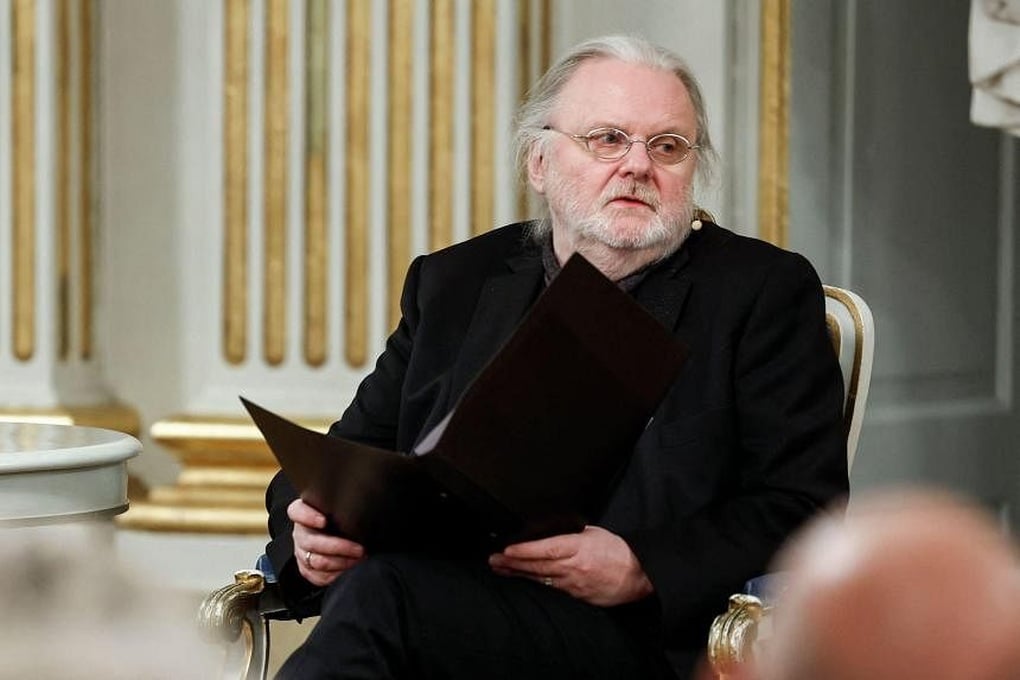
Jon Fosse says that "writing is about listening and escaping from yourself" (Photo: AFP).
Writing to escape from myself.
One thing is certain: I never wrote to express myself, as some people say, but simply to escape from myself.
As a result, I became a playwright.
I wrote novels, poetry, and had no desire to write for the stage. But over time, I did, because I—a poor author—was offered money to write the opening scene of a play, and eventually wrote an entire play—my first and still most frequently performed work— Someone Will Come .
My first attempt at writing a play turned out to be the biggest surprise of my life as a writer. Because in both prose and poetry, I had been trying to write things that were normally impossible to express in words.
I tried to express the unspeakable, which was considered the reason for awarding me the Nobel Prize.
According to the Nobel Prize, Jon Fosse was awarded the Nobel Prize in Literature in October "for his innovative plays and prose that give a voice to the unspeakable."
Writing is about listening.
Writing is a lonely profession, as I have said, and loneliness is a good thing—as long as the path back to other people remains open, to quote a poem by Olav H. Hauge.
What attracted me when I first saw my work performed on stage was the companionship—as opposed to loneliness—of creating art through sharing, which gave me a feeling of immense happiness and security.
This insight has stayed with me ever since, and I believe it has played a crucial role in helping me not only persevere with a peaceful mind but also find a kind of happiness even from my own terrible performances.
For me, writing is about listening. When I write, I never prepare, I don't plan anything; I write by listening. If I were to use a metaphor for the act of writing, it would have to be listening.
In my teenage years, I more or less directly transitioned from being solely involved with music to writing. I essentially stopped playing and listening to music entirely and began writing. In my writing, I tried to create something that mirrored what I had experienced while playing music.
That's what I did back then—and that's what I still do.
Another thing, perhaps a little strange, is that when I write, at some point I always have the feeling that the text has already been written, somewhere out there, not inside me. I just need to write it down before the text disappears.
Sometimes I can do it without making any changes. Other times I have to search for words by rewriting, cutting, and editing, and carefully trying to bring out the pre-written text.
And I, who didn't want to write for the stage, ended up doing it for about 15 years. The plays I wrote were even performed. Over time, many of them were produced in many countries.
I still can't believe it.
Life is unbelievable.
Just as I can hardly believe I'm standing here now, trying to say something more or less reasonable about writing, in relation to the Nobel Prize in Literature that has been awarded to me.
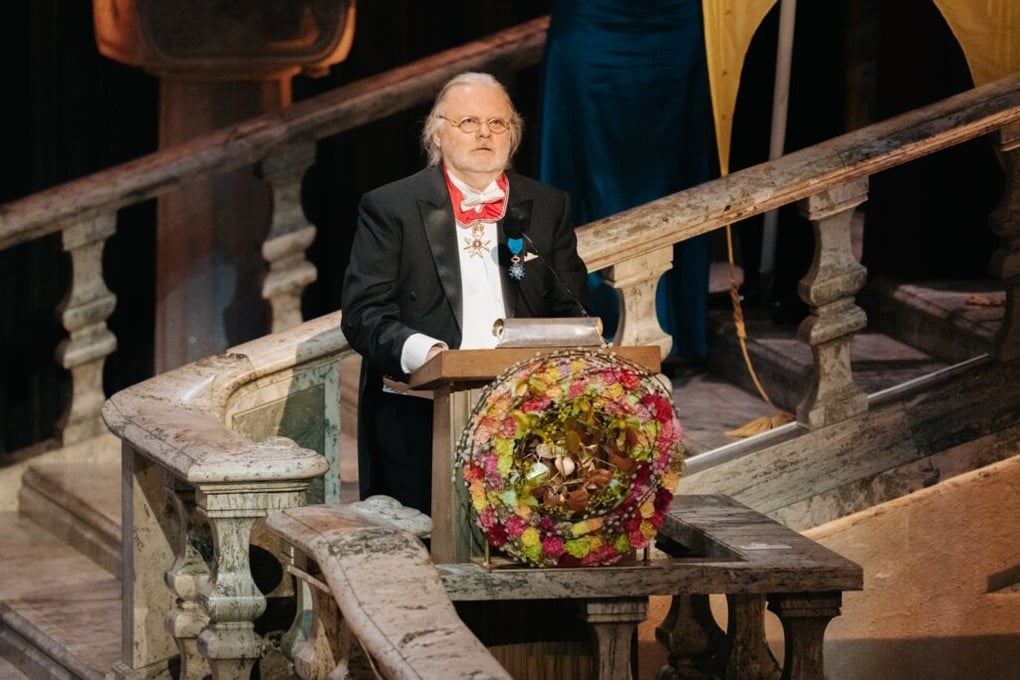
Jon Fosse giving his acceptance speech at the Nobel Prize in Literature ceremony, December 10 (Photo: Nobel Prize).
Writing can save lives.
While writing the novel *Septology* , I experienced some of my happiest moments as a writer. I didn't intend to write a long novel, but the book more or less wrote itself. I wrote many sections so smoothly that everything fell into place immediately.
I think that was when I was closest to what is called happiness.
The entire Septology contains memories of much of the other work I've written, but seen from a different perspective. The absence of a single period throughout the novel isn't an invention. I simply wrote the novel as it was, in one continuous flow, without needing to pause.
My first books received rather poor reviews, but I decided not to listen to the critics. I should just trust myself and persevere with my writing.
If I hadn't done that, I would have stopped writing after my first novel— Raudt, svart ( Red, Black )—came out 40 years ago.
After that, I mostly received positive reviews and even started receiving awards. I think it's important to continue with the same logic: If I didn't listen to negative reviews, I wouldn't let success affect me either.
I will stick to my writing, stick, stick to what I have created. I think that's what I've accomplished, and I truly believe I will continue to do so even after receiving the Nobel Prize.
When I was informed that I had won the Nobel Prize in Literature, I received many emails and congratulatory messages. I was very happy. Most of the messages were simple and expressed joy for me, while some were so moved they shed tears.
That really touched me.
Therefore, what touched me most was that readers frankly shared that my writing had simply saved their lives. In a way, I've always known that writing can save lives, even my own.
And if my writing can also help save someone's life, nothing could make me happier.
Jon Fosse was born in 1959 in Haugesund, Norway. His first novel, * Raudt, svart * ( Red, Black ), was published in 1983. In 1989, he gained critical acclaim for his novel *Naustet* ( Houseboat ).
He then went on to write his first play in 1992 - Nokon kjem til å kome ( Someone will come ). In 1994, the play Og aldri skal vi skiljast was performed at the National Theatre in Bergen.
Fosse composed his work in Nynorsk (also known as New Norwegian). This is one of the two standard languages within Norwegian, spoken by approximately 27% of the population.
He is the most performed living playwright in Europe, with his works translated into 40 different languages. A hotel in Oslo (Norway) has a suite of rooms named after him.
In addition to writing plays and novels, Jon Fosse is also a translator.
(Source: Nobel Prize)
Source link




































![[VIMC's 40-day rapid rollout] VOSA accelerates the deployment of a comprehensive logistics solution for HODA.](https://vphoto.vietnam.vn/thumb/402x226/vietnam/resource/IMAGE/2025/12/23/1766473634002_vosa-23-12-25-2_upscayl_2x_remacri.jpeg)












![[Photo] Closing Ceremony of the 15th Conference of the Central Committee of the 13th Party Congress](https://vphoto.vietnam.vn/thumb/402x226/vietnam/resource/IMAGE/2025/12/23/1766462841764_a1-bnd-3731-1647-jpg.webp)
































Comment (0)